

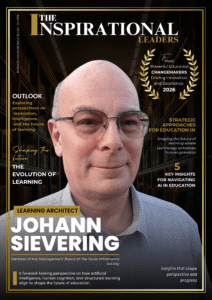
At a moment when artificial intelligence is not only transforming industries but fundamentally reshaping how knowledge is created, accessed, and applied, education finds itself at a defining inflection point. The challenge is no longer whether it must evolve, but how it can evolve without losing what makes learning deeply human.
For Johann Sievering, Member of the Management Board at the Swiss Informatics Society, this question is not theoretical – it is the foundation of a lifelong pursuit. With a career spanning electronics, informatics, artificial intelligence, and decades of hands-on teaching, he has consistently worked at the intersection of technology and education, navigating both its promises and its limitations with equal clarity.
Yet what distinguishes Johann is not simply his technical breadth, but his perspective. He approaches education not as a system to be disrupted, but as a living process to be refined and aligned. In his view, learning is inherently human – shaped by curiosity, struggle, discovery, and growth. Technology, no matter how advanced, must serve this process rather than attempt to replace it.
This belief continues to define his work. Rather than advocating for rapid, unstructured adoption of innovation, Johann champions a more deliberate path – one where artificial intelligence enhances understanding, supports individual learning journeys, and strengthens the foundations upon which knowledge is built. In an era defined by constant acceleration, his approach offers something increasingly rare: a model of progress that is both forward-looking and deeply grounded in the realities of how humans truly learn.
A Personal Journey Rooted in the Nature of Learning
For Johann, the foundation of his work begins with a simple yet powerful belief: the human ability to learn is one of the most remarkable aspects of life. Learning, in his view, is not merely the acquisition of knowledge. It is the ability to understand, experiment, progress, think, and ultimately innovate. Yet his own early experiences were not without difficulty. Like many learners, he initially struggled within traditional educational structures before discovering his own way of understanding.
This turning point shaped his entire perspective. It led to a realization that continues to guide his work today: learning is not universal in its form. Each individual builds understanding differently, and education must reflect that diversity.
Starting his career as a teacher, Johann entered classrooms with curiosity and attentiveness. While he encountered strong pedagogical approaches and high-quality materials, he also identified clear limitations – moments where learners disengaged, where methods failed to connect, and where potential remained untapped.
This dual perspective – recognizing both strengths and gaps – sparked a deeper inquiry into how education could evolve. His transition into informatics and artificial intelligence in the 1990s marked a significant expansion of that inquiry. Even at that time, early forms of AI – such as expert systems, semantic networks, and e-learning environments – offered promising opportunities to enhance learning.
However, he also recognized their limitations. Technology alone was not sufficient. Without thoughtful integration, it risked misalignment with how humans actually learn. This realization led him to dedicate his work to bridging informatics and education in a way that empowers learners while preserving the integrity of the learning process. Today, with the rise of generative AI and large language models, both the opportunities and the risks have intensified.
Artificial Intelligence and the Risk of Delegated Thinking
One of the most pressing challenges Sievering identifies is the growing tendency for learners to delegate thinking to artificial intelligence. While AI has immense potential as a learning companion, its use in practice often diverges from its intended role. Instead of acting as a guide or tutor, it is frequently treated as a shortcut.
Learners ask for answers instead of guidance.
They bypass complexity instead of engaging with it.
They produce results without building understanding.
This leads to what Sievering describes as a critical risk: the illusion of competence. Today, it is possible for learners to complete assignments, write reports, and even pass examinations without having truly acquired the underlying skills. On the surface, performance appears strong. In reality, the cognitive structures required for long-term success may be missing.
The implications are profound. Without genuine skill development, learners may struggle in professional environments that require independent thinking, adaptability, and problem-solving. The gap between perceived ability and actual competence becomes increasingly difficult to bridge. To address this, Sievering proposes a structured and balanced approach to integrating AI into learning.
A Two-Phase Model for the Future of Learning
At the heart of his philosophy is a clear two-phase model that defines how AI should be used in education.
Phase One: Building Cognitive Foundations
The first phase focuses on traditional learning processes – effort, trial and error, experimentation, and gradual understanding. During this stage, learners must construct their cognitive frameworks. These mental structures enable reasoning, problem-solving, and the ability to apply knowledge in new contexts.
AI, if misused at this stage, can undermine this development. The temptation to seek immediate answers is strong, but doing so bypasses the very process that builds competence. This phase requires discipline – from learners and guidance from educators – to ensure that learning remains active and engaged.
Phase Two: Amplifying Learning Through AI
Once foundational knowledge is established, AI becomes a powerful accelerator. At this stage, learners are equipped to use AI critically and effectively. They can explore advanced concepts, test ideas, expand their understanding, and push beyond traditional boundaries. AI shifts from being a shortcut to becoming an enhancer of human capability.
This phased integration reflects a fundamental principle: technology must be introduced at the right moment, for the right purpose, and in a way that supports – not replaces – learning.
Informatics as the Backbone of Modern Education
Johann views informatics not merely as a subject, but as a structural component of modern education. Its role is to maintain balance. On one hand, the fundamental principles of learning remain unchanged. The human brain still requires structured development, and foundational knowledge remains essential for informed citizenship.
On the other hand, digital technologies offer unprecedented opportunities to enhance learning experiences. Informatics provides the framework through which these two dimensions can coexist. It enables the integration of digital tools while preserving the core of education.
This balance is particularly important in today’s generational context. Learners are already immersed in digital environments. They interact with AI tools naturally and often discover new applications faster than educators themselves. As a result, the traditional dynamic of education is shifting.
Teachers are no longer the sole source of knowledge. Instead, they become facilitators – guiding learners through a landscape where information is abundant, but understanding remains the true objective.
The Challenge of Speed in an Accelerating World
While technology has been part of education for decades, the current pace of change presents an entirely new challenge. Artificial intelligence has spread rapidly across all sectors, forcing educational institutions to adapt at an unprecedented speed. Curricula, pedagogy, and organizational structures must evolve simultaneously.
This creates complexity – and often fragmentation. Different stakeholders act independently, sometimes without fully understanding the implications of their decisions. This lack of coordination can lead to unintended consequences.
For example:
Teachers may upload student assessments to public AI tools without considering data privacy.
Administrative teams may rely on generative AI for internal processes without evaluating confidentiality risks.
Students may use AI to complete academic work without engaging in learning.
These actions are rarely intentional misuses. Rather, they reflect a lack of structured guidance in a rapidly changing environment. To address this, Sievering emphasizes the importance of practical, experience-based training. Stakeholders must understand not only the capabilities of AI, but also its implications, limitations, and ethical considerations. However, implementing such training at scale remains a challenge in itself.
Lunch-Café AI: A Practical and Scalable Innovation
Rather than waiting for large institutional reforms, Sievering has focused on practical solutions that can be implemented immediately.
One such initiative is the Lunch-Café AI model. These are informal, local sessions where educators and stakeholders come together to discuss, experiment with, and explore AI in a collaborative setting. The strength of this model lies in its simplicity and relevance:
Discussions are grounded in real-world challenges
Participants bring their own use cases and questions
Learning is directly connected to daily practice
Knowledge is shared organically among peers
Because these sessions are local, they address specific concerns and contexts, making them highly effective. What began as a small initiative has since been adopted by multiple institutions, demonstrating its scalability and impact. It highlights an important principle: meaningful transformation often begins with simple, human-centered approaches that create space for dialogue and experimentation.
Balancing Digital Transformation with Educational Integrity
As institutions integrate digital technologies, maintaining quality and accessibility becomes essential. Sievering strongly rejects the idea of a one-size-fits-all solution. Educational systems are diverse, shaped by local cultures, resources, and constraints. Digital transformation must therefore be contextual.
At the core of this approach is a clear priority: the learner. Technology should enhance learning experiences, not replace foundational methods. Traditional teaching practices continue to play a critical role in building understanding.
For instance:
Students may learn data analysis through traditional methods while using AI tools to apply and extend that knowledge.
Institutions may implement device-sharing programs to ensure equitable access to digital resources.
This balanced approach ensures that innovation supports education without compromising its core values.
Collaboration as a Driver of Meaningful Change
In a rapidly evolving ecosystem, collaboration between academia, industry, and policymakers is essential.
Each brings a unique perspective:
Academia understands learning processes and knowledge development
Industry drives technological innovation
Policymakers ensure alignment with societal values and ethics
Individually, their contributions are valuable. Together, they become transformative. Without collaboration, misalignment is inevitable. Education risks becoming disconnected from real-world needs, technology may develop without ethical grounding, and regulations may lag behind innovation. Through initiatives such as the Athena AI Hub within the AI4Ed group, Sievering is actively working to bridge these gaps. These platforms enable stakeholders to collaborate, experiment, and co-create solutions.
Inclusion Through Thoughtful Use of AI
Artificial intelligence has the potential to significantly enhance inclusion in education – when used intentionally. One of its key strengths lies in its ability to support differentiated and personalized learning. For example, educators can adapt content for learners with specific needs, such as dyscalculia, while maintaining alignment with pedagogical objectives.
AI can also assist institutions in ensuring compliance between curricula and regulatory frameworks, improving both quality and accessibility. However, inclusion is not automatic. It requires deliberate design, ethical awareness, and a clear understanding of diverse learner needs. When implemented thoughtfully, AI can become a powerful enabler of equity.
Human-Centric Strategies for a Technological Future
At the core of Sievering’s approach is a guiding principle: human first and human in the loop. Technology must serve human needs, and humans must remain actively involved in decision-making processes. This requires:
Understanding how technologies work
Recognizing their implications
Maintaining oversight and control
As AI systems become more autonomous, the importance of human judgment increases. Critical decisions must remain guided by human values and responsibility. Creating environments where learners and professionals can experiment with technology in meaningful ways is essential to achieving this balance.
Making the Invisible Visible
One of the most powerful contributions of technology in education is its ability to make abstract concepts tangible. In fields such as chemistry, where understanding often relies on visualization, simulation tools can bridge the gap between theory and reality. They allow learners to see processes that would otherwise remain invisible, making complex ideas more accessible and understandable. This capability transforms learning from abstraction into experience.
Mindsets for Continuous Relevance
In a rapidly evolving world, mindset becomes as important as skill. Sievering emphasizes the importance of:
Curiosity
Critical thinking
Discernment
Not every new tool needs to be adopted. The key lies in selecting technologies that align with real needs and objectives. Equally important is the exchange between learners and educators. This dynamic relationship creates opportunities for mutual learning, where experience and innovation intersect.
A Dynamic Vision for the Future of Education
Looking ahead, Johann Sievering envisions an education system that evolves with the same intelligence, adaptability, and responsiveness that it seeks to cultivate in learners themselves. Rather than advocating for disruption, his vision is rooted in structured evolution – a model that builds on what already works while enabling continuous transformation.
At the heart of this vision lies the concept of dynamic centers of excellence. These centers are not static institutions, but flexible, interconnected ecosystems that emerge, adapt, and evolve based on real-world needs. As industries transform and new competencies become essential, new centers can be created. At the same time, existing ones can be reconfigured, expanded, or even paused when they become less relevant. This introduces a level of agility that traditional education systems often struggle to achieve.
Within this framework, learning becomes modular, competency-based, and continuously evolving. Instead of being defined solely by degrees or fixed professional titles, individuals build dynamic portfolios of competencies that reflect their actual capabilities at a given moment. Learning is no longer confined to a specific phase of life but becomes a continuous process of development, adaptation, and refinement. Importantly, this model does not replace existing educational institutions. It enhances them by adding a flexible layer that allows systems to respond more effectively to change – without losing their foundational stability.
In this vision:
Learners are active participants in shaping their educational journeys
Educators act as facilitators, mentors, and co-creators of knowledge
Institutions become adaptive environments rather than rigid structures
Through initiatives such as the Athena AI Hub, this vision is already taking shape. By creating spaces for collaboration, experimentation, and shared learning, Sievering is working to connect stakeholders across education, industry, and policy – ensuring that innovation is both meaningful and aligned with societal needs.
Ultimately, his vision is not about reinventing education from the ground up, but about aligning it more closely with reality – a reality defined by constant change, technological advancement, and the need for lifelong learning.
Conclusion: Shaping the Future Without Losing the Human Core
As artificial intelligence continues to redefine the boundaries of knowledge and capability, the future of education will depend not only on what technologies can do, but on how thoughtfully they are integrated into human learning.
Johanng’s approach offers a clear and grounded path forward. It is a vision that embraces innovation without surrendering to it. One that recognizes the transformative power of AI, while insisting on the irreplaceable role of human cognition, curiosity, and critical thinking. It acknowledges that while machines can generate answers, true learning remains a deeply human process – one that requires effort, reflection, and engagement. Central to this perspective is a commitment to balance:
Between tradition and transformation
Between autonomy and guidance
Between technological acceleration and cognitive depth
By advocating for structured learning phases, human-centered design, and collaborative ecosystems, Sievering ensures that education does not drift into passive consumption of knowledge, but remains an active process of understanding and growth. His work also serves as a reminder that the goal of education is not simply to keep pace with change, but to equip individuals to navigate, question, and shape that change responsibly.
In a world where the temptation to delegate thinking is stronger than ever, this perspective is both timely and essential. Because ultimately, the future of education will not be defined by artificial intelligence alone – but by how effectively humanity chooses to use it. And in that future, the most important role of education remains unchanged: to empower individuals not just to succeed in the world as it is, but to thoughtfully and responsibly shape what it becomes.