
In the global energy conversation, attention is often drawn to what is visible – production volumes, infrastructure, market shifts, and policy debates. Yet the real determinants of performance, efficiency, and sustainability are frequently hidden far below the surface, embedded within complex geological systems that resist certainty and demand precision.
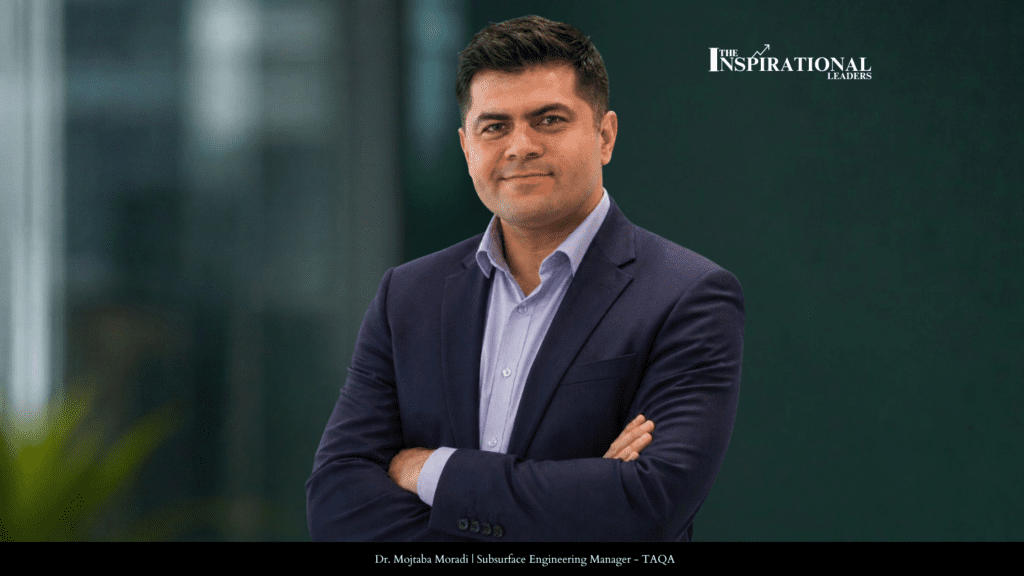
It is in this invisible domain that Dr. Mojtaba Moradi has built his career. As Subsurface Engineering Manager at TAQA, Dr. Moradi operates in one of the most technically demanding environments in the energy industry – where incomplete data, geological variability, and operational constraints intersect. But rather than viewing uncertainty as a limitation, he has consistently treated it as an opportunity.
“The subsurface is one of the most uncertain environments we work in,” he explains. “What drew me to this field was the ability to transform that uncertainty into actionable insight and measurable value.”
Over more than 15 years, supported by a PhD in Petroleum Engineering, he has developed a body of work that reflects this philosophy – turning complexity into clarity, and engineering solutions that simultaneously enhance production, reduce waste, and lower environmental impact. At a time when the industry is under increasing pressure to deliver energy more responsibly, his approach offers a compelling blueprint: one where performance and sustainability are not competing priorities, but outcomes of the same intelligent design.
A Career Defined by Complexity – and the Pursuit of Better Answers
Dr. Moradi’s journey into subsurface engineering was shaped by a fundamental question: how can engineers make confident decisions in environments defined by uncertainty?
While academic training provided him with a strong theoretical foundation, it was his hands-on experience across diverse reservoirs that sharpened his ability to navigate ambiguity. Each reservoir presented a different set of challenges – varying rock properties, fluid behaviors, and production constraints – requiring not just technical knowledge, but adaptability and judgment.
Over time, he began to see a gap in traditional approaches. Subsurface disciplines – reservoir engineering, completions, production – were often treated as separate functions, each optimised individually. But real performance, he realised, depended on how well these elements worked together.
This insight led him to develop a more integrated approach, combining reservoir engineering principles with advanced completion technologies to create solutions that address challenges at their source rather than reacting to them later.
That ability to connect disciplines – to think beyond silos – has become a defining feature of his work, enabling him to deliver outcomes that are not only technically robust, but operationally efficient and environmentally aligned.
From Reactive Systems to Intelligent Control
One of the most significant shifts in subsurface engineering today is the move away from reactive intervention toward intelligent, self-regulating systems. Dr. Moradi has been at the forefront of this transition, particularly through the deployment of Autonomous Inflow Control Device (AICD) technologies. At its core, the challenge these systems address is both technical and environmental. Unwanted water production is one of the most persistent issues in oil and gas operations. It increases energy consumption, requires extensive surface processing, and contributes significantly to greenhouse gas emissions.
Traditional approaches often deal with the problem after it arises. AICD technology, by contrast, manages it at the source – within the reservoir itself. “By controlling unwanted water and gas production downhole, we reduce the need for surface processing, lifting and reinjection,” Dr. Moradi explains. “This directly translates into lower energy use and fewer emissions.” The scale of impact becomes evident in one of his flagship implementations in Oman. Initially piloted across 28 wells, the technology was later expanded to more than 300 wells – transforming field performance in the process.
The results were striking: a 217% increase in oil production, a 52% reduction in water production, a 51% reduction in carbon intensity, and up to a 73% reduction in energy consumption. These are not incremental gains. They represent a fundamental shift in how subsurface systems are designed – moving from reactive correction to proactive optimisation, where the reservoir itself becomes part of the solution.
Sustainability Where It Matters Most
While large-scale production improvements are significant, the true test of engineering lies in its ability to perform under constraint. Nowhere is this more evident than in environmentally sensitive regions, where operational decisions carry broader ecological implications.
In the Peruvian Amazon, within a protected natural reserve in the Marañón Basin, Dr. Moradi led the deployment of AICD technology in a heavy oil field – a project that required balancing resource development with environmental stewardship. The results demonstrated what is possible when engineering is approached with both precision and intent. Carbon intensity was reduced by up to 56%, greenhouse gas emissions decreased by 64%, and energy consumption dropped by 78%.
“What this project demonstrated is that sustainability is not a trade-off,” he notes. “With the right technology and mindset, it becomes a performance advantage.” This perspective reflects a broader shift within the industry. Sustainability is no longer treated as an external requirement or compliance metric – it is increasingly embedded within the engineering process itself, influencing decisions at every stage.
Embedding Sustainability into Engineering Decisions
One of the more significant, yet less visible, aspects of Dr. Moradi’s work has been the development of environmental modelling tools within TAQA. These tools enable engineers to quantify emissions and integrate sustainability metrics directly into design workflows – bringing environmental considerations into the core of technical decision-making. “This is a major shift,” he explains. “Sustainability is no longer an external metric – it is embedded into the engineering decision-making process itself.”
By making environmental impact measurable and actionable, these tools allow teams to evaluate trade-offs more effectively, ensuring that performance improvements are aligned with sustainability goals. This integration marks an important evolution in subsurface engineering – one where efficiency is no longer defined solely by output, but by how intelligently resources are managed across their entire lifecycle.
Extending Subsurface Expertise Beyond Oil and Gas
As the global energy landscape continues to evolve, subsurface engineering is playing an increasingly important role in emerging energy systems. Dr. Moradi has been actively involved in extending his expertise into areas such as carbon capture, utilisation and storage (CCUS), and geothermal energy.
Both domains rely heavily on subsurface understanding. In CCUS, the safe injection and long-term storage of CO₂ require precise knowledge of reservoir behavior and containment integrity. In geothermal systems, the challenge lies in optimising heat extraction while maintaining system efficiency.
Through his work, Dr. Moradi has demonstrated how traditional reservoir engineering principles can be adapted to support these applications – positioning subsurface engineering as a critical enabler of the broader energy transition.
Digital Transformation with Engineering at the Core
The increasing adoption of digital technologies is reshaping how subsurface decisions are made. Advanced reservoir modelling, AI-driven analytics, and real-time data integration are enabling faster, more informed decision-making. Dr. Moradi has been a strong advocate for these tools, particularly in developing workflows that combine predictive modelling with real-time production data. These systems allow for continuous updates to reservoir understanding, enabling dynamic optimisation rather than static planning.
Digital twins further enhance this capability, allowing engineers to simulate different scenarios and evaluate outcomes before implementation. Yet despite these advancements, he remains clear about the limits of technology. “Digital tools enhance our capabilities, but they do not replace experience,” he says. “The value lies in how we interpret and apply the insights they provide.” This balance – between data and judgment – ensures that technological progress translates into meaningful operational outcomes.
Navigating Complexity Through Leadership
Driving innovation in mature fields is rarely straightforward. Resistance to change, operational constraints, and uncertainty can slow even the most promising initiatives. Dr. Moradi has addressed these challenges through a leadership approach grounded in transparency and trust. By organising structured workshops, facilitating knowledge transfer, and conducting detailed risk assessments, he has been able to build alignment among stakeholders and accelerate the adoption of new technologies.
“Change requires both evidence and trust,” he explains. “Our role is to provide both.” Central to this approach is uncertainty management – developing workflows that allow teams to make informed decisions even in unpredictable environments. Rather than attempting to eliminate uncertainty, his focus is on understanding and managing it effectively.
Collaboration as a Catalyst for Industry-Wide Impact
Dr. Moradi’s influence extends beyond his immediate organisation. Through collaborations with leading global operators – including Saudi Aramco, ADNOC, PDO, KOC, TotalEnergies, Equinor, BP, and Shell – he has contributed to scaling innovative solutions across the industry. His work is supported by multiple peer-reviewed technical publications, which not only validate his approaches but also contribute to the broader body of knowledge in subsurface engineering and sustainable energy production.
As an active member of the Society of Petroleum Engineers (SPE), he plays a role in shaping industry standards – serving on technical committees focused on sustainability and energy efficiency, and acting as a judge for industry awards. These contributions reflect a commitment not just to organisational success, but to advancing the industry as a whole.
Recognition That Reflects Real Impact
The impact of Dr. Moradi’s work has been recognised across multiple platforms. He was recently Highly Commended for Sustainability Advocate of the Year at the Oil & Gas Middle East Awards 2026 – an acknowledgment of his leadership in driving environmentally responsible innovation.
Under his leadership, TAQA has also received several prestigious accolades, including recognition in the Sustainability category at the Offshore Achievement Awards (UK) 2026, the OPAL Awards 2024 in Oman, and the Sustainability Initiative of the Year at the Oil & Gas Middle East Awards 2025.
These recognitions are not merely symbolic. They reflect tangible outcomes – measurable reductions in carbon intensity, improvements in energy efficiency, and the successful integration of sustainability into core engineering practices.
Building Teams for a Changing Industry
At the heart of Dr. Moradi’s work is a strong focus on people. Leading multidisciplinary and globally distributed teams, he places emphasis on empowerment, ownership, and continuous development. By creating structured frameworks that align technical objectives with environmental goals, he ensures that sustainability is not treated as a separate initiative, but as an integral part of everyday engineering decisions.
He is also deeply committed to mentoring young professionals, recognising that the future of the industry depends on the capabilities and mindset of the next generation. “The future of our industry depends on the people we develop today,” he says.
Balancing Demand, Efficiency, and Responsibility
Looking ahead, the energy industry faces a complex challenge: meeting growing global demand while significantly reducing environmental impact. Dr. Moradi believes that the solution lies in integration – leveraging existing assets more efficiently while advancing new energy technologies.
“Maximising recovery from existing fields is one of the most sustainable strategies we have,” he explains. “At the same time, we must expand into areas such as CCUS and geothermal to support the broader energy transition.” His work demonstrates that these objectives can be achieved simultaneously through intelligent engineering – where optimisation and sustainability are part of the same equation.
Advice for the Next Generation
For young engineers entering the field, Dr. Moradi emphasises the importance of adaptability and interdisciplinary thinking. As the industry evolves, the ability to integrate knowledge across engineering, data science, and environmental disciplines will become increasingly important.
Equally critical is a mindset of continuous learning and a willingness to challenge conventional approaches. “The industry is evolving rapidly,” he says. “Those who succeed will be the ones who embrace change and actively contribute to it.”
A Legacy Built on Possibility
As he looks to the future, Dr. Moradi’s vision is clear: to demonstrate that energy production and environmental responsibility can coexist – not as competing priorities, but as complementary outcomes.
“I want my work to show that we can produce the energy the world needs while significantly reducing our environmental footprint,” he says. “That is the legacy I hope to leave.”
It is a vision grounded not in aspiration alone, but in proven results – projects that have already delivered measurable improvements in performance and sustainability.
Shaping Energy from the Subsurface Up
In a world where energy demands continue to grow and environmental expectations continue to rise, the path forward will depend on more than new technologies or policy shifts. It will require a fundamental rethinking of how energy systems are designed and managed. Through his work, Dr. Mojtaba Moradi is contributing to that shift – demonstrating that the most impactful innovations are often those that address challenges at their source.
By engineering smarter systems beneath the surface, he is helping to build an energy future that is not only more efficient and reliable, but also more responsible. And in doing so, he is proving that the future of energy may well be shaped by what we cannot see – but can engineer with precision, insight, and intent.