
There is a quiet revolution underway in the world of design. It is not being led by louder interfaces, flashier visuals or products demanding more of our attention. It is being shaped by a more profound ambition: to make technology feel less like technology and more like an extension of human instinct. The next era of digital experience will not be defined by what users see, but by what they no longer have to think about – friction removed before it is felt, complexity simplified before it becomes overwhelming and systems intelligent enough to anticipate needs before they are spoken.
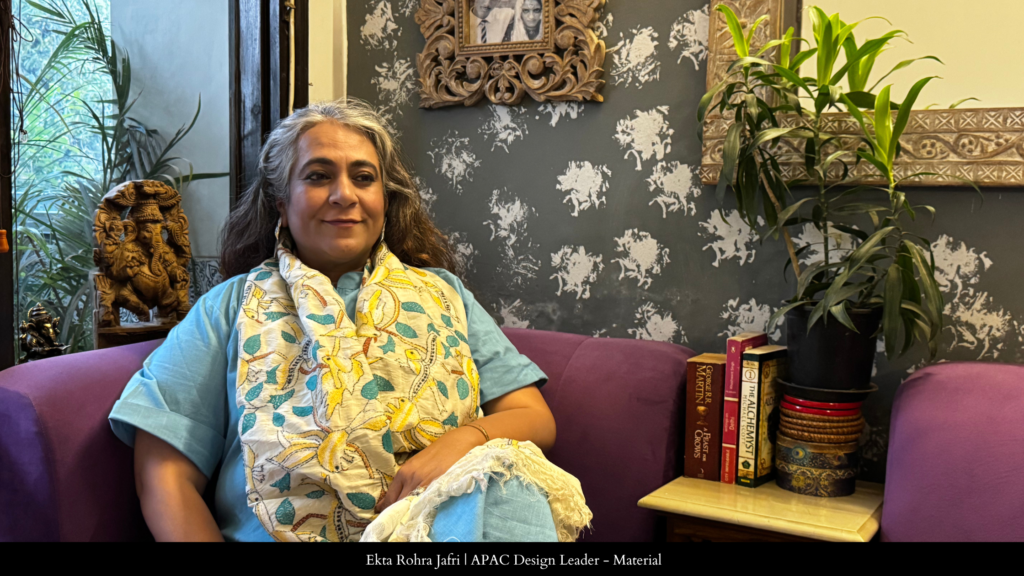
Few leaders understand this shift as deeply – or articulate it as powerfully – as Ekta Rohra Jafri. For more than 25 years, Ekta has been at the forefront of experience design, not merely crafting interfaces but solving deeply human problems through systems, empathy and intelligence. As director of experience design in APAC at Material, she operates at the intersection of design, strategy and innovation – guiding organizations toward experiences that are not only intuitive and elegant, but transformative.
Material is an intelligent growth company fueled by behavioral science and data analytics and drawing on a 50-year history of building deep customer intelligence into brands that don’t just participate, they compete and win. By integrating insight into the very DNA of design, strategy and digital experience, the consultancy moves beyond the superficial to deliver outsized business impact.
Within this ecosystem, Ekta leads with a philosophy that mirrors these integrated capabilities to anticipate shifts and influence behavior in a way that is rigorously analytical and deeply human. The best design does not call attention to itself it shapes demand by dissolving into life.
Her work spans some of the most complex and meaningful sectors in the modern economy. She has designed maternal healthcare services for rural communities in India, sustainability finance platforms with global implications, enterprise ecosystems for multinational organizations, educational research initiatives across Singapore’s learning landscape and digital solutions for vulnerable populations through humanitarian organizations. Across each challenge, one principle remains constant: design is not about the artifact; it is about the outcome.
That principle has earned her not only industry recognition but global respect. Her work on a maternal healthcare service for rural pregnant women in India won multiple international accolades, including three IxDA awards, the INDIGO Award, the iF Design Award and publication in the Service Design Journal. The sustainability platform she designed was launched at COP26 and received the Visionary CleanTech Financial & Investment Institution Award. Yet, beyond awards and recognition, the true measure of her work lies in the lives made easier, systems made clearer and barriers made smaller.
What makes Ekta’s perspective uniquely compelling is her ability to pair deep operational expertise with a visionary lens. Through her thought leadership in the Data Driven Design series and her futuristic storytelling in Sienna Tales, she has spent years imagining a world where interfaces disappear and technology organizes itself around people rather than forcing people to organize themselves around technology.
Today, that world is no longer theoretical. As artificial intelligence reshapes the economics of creativity, compresses timelines and changes how ideas become reality, the design profession stands at a defining inflection point. For many, AI feels disruptive. For Ekta, it feels clarifying. It is shifting design away from superficial execution and returning it to what it was always meant to be: understanding people deeply enough to solve the right problems beautifully. In many ways, Ekta Rohra Jafri is not simply responding to the future of design. She has been designing toward it all along.
Designing Experiences That Dissolve into Life
For Ekta, exceptional digital experiences are not measured by aesthetic appeal alone. In a world where visual trends dominate product conversations, she challenges the industry to think more deeply. “The bar for exceptional experience is not aesthetic. It’s cognitive,” she says – an observation that reframes the very purpose of design.
In her view, the most remarkable experiences are those that “dissolve into life.” They are so intuitive they become invisible and so attuned to context they feel almost anticipatory. She often draws inspiration from the intelligent assistant in Sienna Tales, a world she imagined where technology does not simply react to commands but understands context and intervenes before friction emerges. In that world, the assistant recognizes when its user has a headache before she wakes, understands when she is hungry and knows when essentials need replenishing. It does not interrupt life; it integrates into it.
That philosophy underpins the way Ekta approaches real-world digital experiences. She believes exceptional products are never born from internal assumptions or boardroom opinions. They are built from listening, observing and iterating. What users say matters. What they do matters more. What they think and feel reveals the deeper truths behind behavior.
In an increasingly instrumented digital world, organizations are flooded with behavioral data. Yet, for Ekta, the value lies not in collecting data but in translating it into empathy and action. The organizations that succeed are those agile enough to interpret signals quickly and evolve experiences in response.
While technology evolves rapidly, human needs remain strikingly consistent. People want to feel understood. They seek clarity in moments of complexity, ease in moments of friction, and reassurance that the products they use were designed with their realities in mind. For Ekta, empathy is what gives design its humanity, and data is the lens that makes that humanity visible.
Her work consistently brings those real-world stories into decision-making spaces, transforming abstract conversations about features into meaningful discussions about outcomes. In her hands, design becomes less about demonstrating possibility and more about simplifying reality.
The User Is Not You: Designing Across APAC’s Complexity
Designing across APAC requires more than localization. It demands cultural intelligence, behavioral nuance and the humility to acknowledge that assumptions often fail. One principle sits at the center of Ekta’s design philosophy: “The user is not you.”
It is a deceptively simple statement, yet one she believes remains one of the most violated principles in design. In her writing on data-driven design, Ekta emphasizes that personas are not demographic abstractions. They are people. Every heat map, search pattern, drop-off point and survey response represents a real human being navigating habits, frustrations, ambitions and constraints. Numbers become meaningful only when viewed through a human lens.
This philosophy shaped her work in Indonesia, where she led the design of a loyalty app. A familiar retail framework may have seemed like the obvious starting point, but Ekta recognized the Indonesian shopper’s relationship with loyalty cards, mobile apps and in-store connectivity differed significantly from other markets. The product had to be built on local realities rather than imported assumptions.
A similar principle informed a mobile youth magazine project she led earlier in her career. By conducting deep contextual studies into the digital behaviors of that generation, her team calibrated not only content but timing, tonality and engagement mechanics to reflect how users actually lived. The result was extraordinary: response rates rose between 30 and 80 percent because the experience felt relevant rather than generic.
For Ekta, understanding users is not a one-time research exercise. It is an ongoing discipline of observation, immersion and iteration. Once that understanding is established, her work extends beyond design execution. She aligns business, technology and strategy around an evidence-based understanding of who the user is and why solving their problem matters. Across APAC’s vast cultural, linguistic and infrastructural diversity, this philosophy remains her most reliable compass.
Leadership Beyond the Screen
The most impactful UX leaders in 2026 are not simply managing teams or directing creative outputs, they are systems thinkers capable of seeing the invisible forces shaping human experience.
Ekta’s work on a maternal healthcare service for rural pregnant women in India remains one of the clearest examples of this mindset. The challenge extended far beyond interface design. It required understanding healthcare access limitations, literacy barriers, family dynamics, trust gaps and infrastructure challenges that prevented women from following treatment plans. Ekta and her team designed against every layer of that problem, resulting in not just a digital product but a life-changing service that earned global recognition.
Her leadership, however, is not limited to project outcomes. She describes herself as a bridge, not merely a protector of design vision, but a translator who helps stakeholders, engineers, product managers and clients understand the user’s perspective and align around it.
That role becomes even more critical in the age of AI. Ekta believes the same skills that make a strong leader – clarity, direction-setting and strategic articulation – are now amplified through AI as a creative partner. “The prompting muscle and the leadership muscle are the same muscle,” she says. In a world where execution is becoming faster and cheaper, the leaders who stand apart will be those who combine empathy, systems thinking and decades of craft with the speed AI provides.
Data, Creativity, and the Art of Better Decisions
Ekta rejects the notion that data and creativity are opposing forces. In her experience, they sharpen one another. Her work with a leading pharmaceutical company today demonstrates how data can become the foundation of creativity. Through content performance metrics, regional NPS scores and user verbatims, her team discovered users were not arriving to browse or feel inspired, they were trying to complete tasks. Support document retrieval is a critical pain point in this industry, solving it remains the cornerstone.
That insight fundamentally changed the design strategy. The creative brief was no longer based on instinct but on evidence. On the other hand, the sustainability finance platform required creativity to lead where data could not. There was no precedent for helping organizations across industries navigate green financing opportunities. Her team translated complex financial and regulatory criteria into a simple cognitive conversation, making the process easier to understand and easier to act upon. The platform went on to win a prestigious CleanTech award.
Across humanitarian work, where data may be ethically difficult or incomplete, creativity fills the gaps until measurable outcomes can validate decisions. For Ekta, the best work emerges when data deepens empathy and creativity transforms understanding into action.
Building Teams That Innovate Through Uncertainty
Ekta’s leadership was tested in 2020 when she was preparing to launch one of the most ambitious human-centered research programs of her career, including more than 300 interviews across Singapore’s education ecosystem for a leading bank seeking to understand students, parents, educators, founders and institutions.
Then COVID changed everything. Borders closed. Visas froze. In-person research became impossible. Instead of scaling back, Ekta led the entire program virtually without compromising rigor or insight. That experience taught her one of leadership’s most enduring lessons: process is an act of care. In moments of uncertainty, a stable process gives teams confidence. It creates familiarity while enabling experimentation. It provides psychological safety when the environment feels unpredictable.
That same philosophy guides how she fosters innovation today. She creates environments where ideas are visible, questions are welcome and creativity is shared. For Ekta, innovation does not emerge from pressure. It emerges from trust, visibility, and shared ambition.
Designing What Comes Next
The future of UX, in Ekta’s view, is becoming increasingly invisible. Interfaces are disappearing. Experiences are becoming contextual, adaptive and anticipatory. AI is accelerating research, synthesis and execution at unprecedented speed, enabling empathy at scale. The designer’s role is shifting from creating screens to shaping behavior. Success will no longer be measured by outputs delivered but by barriers removed, outcomes improved and lives made easier.
For aspiring designers, her advice is timeless: design with intention, embrace change and never stop learning. At its heart, design remains an act of optimism – a belief that life can be clearer, easier and more dignified because someone cared enough to improve it. And in a world increasingly shaped by automation and intelligence, leaders like Ekta Rohra Jafri ensure that while interfaces may disappear, humanity never does.