

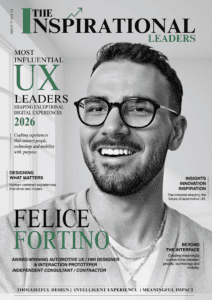
As vehicles become increasingly intelligent, much of the automotive industry’s attention is focused on what technology can do next. Artificial intelligence is advancing at an extraordinary pace. Autonomous systems continue to evolve. Digital ecosystems are becoming more sophisticated with every product generation. Yet for Felice Fortino, Award-Winning Automotive UX/HMI Designer and Interaction Prototyper, the more important question is not what technology can do. It is what people will need from it.
That perspective has shaped his approach throughout a career spanning concept vehicles, production HMI systems, interaction prototyping, and connected mobility experiences. While the industry often celebrates technological breakthroughs, Felice has consistently focused on understanding how those advancements fit into real human behavior. His work is grounded in the belief that innovation becomes meaningful only when it improves people’s experiences in ways that feel natural, intuitive, and valuable. It is a philosophy that feels particularly relevant today.
The automotive industry is navigating one of the most significant transitions in its history. Vehicles are evolving from machines primarily defined by engineering and mechanical performance into intelligent environments shaped by software, connectivity, and digital interaction. Consumers increasingly evaluate vehicles not only by how they drive but by how they communicate, how they adapt, and how seamlessly they integrate into daily life.
As this transformation continues, user experience has become one of the most influential factors shaping the future of mobility. For Felice, however, the objective extends far beyond creating attractive interfaces or introducing new digital capabilities. The real challenge lies in designing experiences that people can trust, understand, and genuinely benefit from.
Why Automotive UX Captured His Attention
What has always fascinated Felice about automotive UX is the unique relationship between the digital and physical worlds. Unlike many other areas of user experience design, automotive experiences exist within environments where interactions carry immediate real-world consequences. Every decision affects how people move, how they perceive information, and ultimately how safely they navigate the world around them. This creates a level of responsibility that makes automotive UX fundamentally different from designing traditional digital products.
At the same time, it is precisely this complexity that makes the discipline so compelling. Throughout his career, Felice has been drawn to the challenge of balancing physical and digital experiences in ways that feel complementary rather than competitive. While many discussions within the industry frame physical controls and digital interfaces as opposing philosophies, he sees them as equally valuable tools that serve different purposes.
Physical controls provide reassurance, tactile feedback, and familiarity. They allow users to interact with systems confidently and efficiently. Digital interfaces, meanwhile, offer flexibility, adaptability, and opportunities for personalization that would be impossible through purely physical interactions. The future, in Felice’s view, does not belong to one approach or the other. It belongs to thoughtful integration. This perspective reflects a broader principle that has shaped his work. Technology should never exist simply because it can. It should exist because it improves an experience. Every design decision must ultimately answer a simple question: does this make life better for the person using it?
When the Vehicle Becomes an Experience
The role of UX within the automotive industry has changed dramatically over the past decade. What was once considered a supporting function has become a defining component of vehicle development. Major launches increasingly highlight digital experiences alongside performance specifications, reflecting a growing recognition that user experience is now central to how people evaluate products. Felice sees this evolution as both necessary and inevitable.
As connected technologies continue to mature and autonomous systems become more capable, designers are being asked to rethink what mobility actually means. Historically, automotive experiences were built around a straightforward assumption: one person sits behind the wheel and actively controls the vehicle. That assumption is beginning to change.
One of the most significant implications of autonomous driving is not simply the technology itself but the shift in human roles it creates. The driver gradually becomes a passenger. While discussions often focus on technical capability, Felice believes the more interesting questions concern how experiences change once driving is no longer the primary activity.
Trust is the first challenge. Before users can comfortably rely on autonomous systems, they must understand them and feel confident in their decisions. Yet trust is only the beginning.
As autonomy advances, vehicles become environments where people may work, communicate, relax, consume content, or engage with services during travel. Multiple occupants may have entirely different expectations and priorities while sharing the same space. One person may want productivity. Another may want entertainment. Another may simply want quiet. Designing for this future requires a fundamentally different mindset.
The vehicle becomes less of a machine and more of an experience platform. The challenge is no longer helping users operate a vehicle. It is helping multiple individuals coexist comfortably within an intelligent environment that understands and adapts to their needs. For Felice, this transformation represents one of the most exciting opportunities facing automotive UX today.
Keeping Technology in Service of People
As technological capabilities expand, there is often pressure to introduce innovation simply because it exists. Felice views this tendency as one of the industry’s greatest risks.
Technology undoubtedly creates opportunities to improve experiences, but innovation loses its value when it becomes disconnected from human needs. Features introduced solely to appear advanced often create complexity rather than clarity. They increase cognitive load, complicate interactions, and ultimately diminish the quality of the experience. This is why Felice believes great UX leaders must possess both technological curiosity and critical judgment.
Understanding emerging technologies is essential. Equally important is the ability to question whether those technologies genuinely improve people’s lives. Not every capability deserves implementation. Not every innovation creates value.
Sometimes the most effective solution is also the simplest. No matter how sophisticated vehicles become, one principle remains constant. Designers are creating experiences for human beings. Whether people are actively driving or interacting with increasingly autonomous systems, their expectations, emotions, limitations, and behaviors remain at the center of the design process. Technology should support those realities rather than compete with them.
Moving Beyond the Feature Mindset
One of Felice’s most distinctive observations concerns what he describes as the industry’s long-standing feature mindset.
For decades, automotive innovation was often measured by quantity. More features meant more value. More capabilities suggested greater sophistication. While this approach may have worked in previous eras, it becomes increasingly problematic in today’s software-driven environment.
Adding features does not automatically create better experiences. In many cases, it creates fragmentation. Users encounter disconnected systems, inconsistent interactions, and competing priorities that make experiences feel unnecessarily complicated. Vehicles become collections of features rather than cohesive products.
According to Felice, these issues often reveal deeper organizational challenges. The user experience frequently mirrors the structure of the organization that created it. Fragmented teams tend to produce fragmented experiences. Separate priorities lead to disconnected outcomes.
Artificial intelligence will only make these issues more visible. Many organizations view AI as a solution capable of fixing fragmented experiences. Felice believes the reality is more nuanced. AI does not automatically solve organizational challenges. If anything, it exposes them. Inconsistencies that may have remained hidden within traditional interfaces become increasingly apparent when experiences are expected to function as unified systems.
This is why he believes the future belongs to organizations that move beyond feature thinking and begin designing around cohesive, integrated experiences.
Designing for a Global Audience
Another challenge shaping the future of automotive UX involves the growing complexity of global markets. Automotive manufacturers naturally seek efficiency through standardization. Developing common platforms and experiences offers clear operational advantages. Yet user expectations differ dramatically across regions.
Regulations vary. Cultural norms vary. Attitudes toward technology vary. Expectations surrounding privacy, convenience, and personalization vary. As a result, creating globally successful experiences requires far more than localization.
At the same time, user centricity should not be mistaken for implementing every customer request. In automotive design, user preferences must be balanced against safety requirements, technical realities, regulatory constraints, and brand identity. This balancing act is one of the defining responsibilities of design leadership.
For Felice, the goal is not to choose one priority over another but to create solutions that successfully navigate all of them simultaneously. The strongest experiences emerge when designers understand both the broader context and the specific needs of the people they are designing for.
Personalization and the Importance of Trust
Personalization remains one of the industry’s most discussed priorities, yet Felice believes the conversation often overlooks a critical element. Trust.
Modern systems increasingly possess the ability to learn preferences, anticipate needs, and adapt experiences. However, personalization cannot succeed through technology alone. It depends on relationships.
The more a system understands about a user, the more meaningful its recommendations and adaptations can become. Yet users must first believe that sharing information is worthwhile. They need confidence that their data is being handled responsibly and that personalization genuinely improves their experience.
This becomes particularly challenging on a global scale, where attitudes toward privacy and data sharing vary significantly between markets. Felice often describes personalization as a partnership between the user and the automaker.
It is not a one-way transaction. It is an ongoing exchange built on mutual trust and shared value. Before expecting users to share preferences and behaviors, brands must demonstrate transparency, respect, and reliability.
When that foundation exists, personalization becomes something much more meaningful than customization. It becomes an experience that feels naturally aligned with the individual while remaining intuitive and unobtrusive.
Beyond Interfaces: AI and the Future of Interaction
Artificial intelligence is transforming virtually every industry, but Felice believes its influence on automotive UX extends far beyond improving existing features. The true opportunity lies in changing how people interact with vehicles altogether.
Historically, users have engaged with systems through menus, applications, and predefined workflows. AI introduces the possibility of interactions built around intent rather than navigation. Instead of searching for functions, users communicate goals.
Experiences become increasingly conversational, contextual, and adaptive. This evolution represents a shift from feature-driven design toward something more unified and agentic. Rather than forcing users to navigate multiple systems, future experiences may function more like intelligent partners capable of understanding context and coordinating actions across numerous services.
One of the key challenges involves creating multi-modal experiences. Different occupants may prefer different methods of interaction. Some may use voice. Others may rely on touch or visual interfaces. Future systems must accommodate these preferences seamlessly without creating confusion or inconsistency. The objective is not simply making technology smarter. It is making interaction feel more human.
Sustainability Through Better Experiences
While sustainability discussions often focus on engineering and infrastructure, Felice believes UX occupies a uniquely influential position within this conversation. User experience exists at the point where decisions happen. This creates opportunities to influence behavior in meaningful ways.
The most effective sustainability initiatives rarely feel restrictive. Instead, they make environmentally responsible choices feel intuitive and rewarding. Whether encouraging efficient driving habits or simplifying EV charging experiences, UX can help reduce friction and make sustainable behavior easier to adopt.
If sustainable choices feel inconvenient, adoption suffers. If they feel valuable and effortless, people are far more likely to embrace them. For Felice, this is one of the most powerful contributions UX can make to the future of mobility.
Curiosity as a Competitive Advantage
When discussing the next generation of UX professionals, one theme consistently emerges in Felice’s advice. Curiosity.
Curiosity drives exploration, learning, and deeper understanding. It encourages designers to look beyond surface-level solutions and investigate how systems actually work.
In a field that combines technology, engineering, psychology, business strategy, and design, this mindset becomes invaluable.
Every designer brings unique experiences and perspectives. Those perspectives often generate insights that no tool or technology can replicate. Curiosity expands that perspective, helping designers discover opportunities others might overlook. As the industry continues to evolve, curiosity remains one of the most reliable sources of growth and innovation.
The Courage to Think Differently
Beyond technology, processes, and methodologies, Felice believes one challenge continues to influence the industry more than many people realize which is Conformity.
Over time, organizations can become hesitant to take risks. Ideas are discussed extensively but pursued cautiously. Innovation slows not because opportunities disappear but because confidence fades.
Yet many of today’s most respected automotive brands built their reputations through bold thinking. They embraced new ideas. They expressed clear points of view. They created products that reflected conviction rather than consensus.
Felice believes that spirit still exists. What is needed is the willingness to embrace it. Organizations already possess the talent, creativity, and technical capability required to build exceptional future experiences. The challenge lies in trusting those strengths and expressing them consistently throughout the user experience.
A Future Built Around Human Understanding
The future of mobility will undoubtedly introduce smarter systems, increasingly capable AI, and new forms of interaction that continue to reshape expectations. Vehicles will become more connected, more adaptive, and more intelligent than ever before.
Yet for Felice Fortino, the most meaningful advancements will not be measured by technological sophistication alone.
They will be measured by how naturally they fit into people’s lives. They will be measured by how effectively they earn trust. They will be measured by how successfully they help individuals navigate an increasingly connected world.
Throughout his career, Felice has remained focused on a principle that becomes more important with every new innovation: technology succeeds when it serves people. As the automotive industry moves toward an increasingly intelligent future, that perspective offers a valuable reminder that great experiences begin not with technology itself, but with the people it is meant to support.
In an era defined by rapid change, that human perspective may prove to be one of the industry’s most important competitive advantages.