
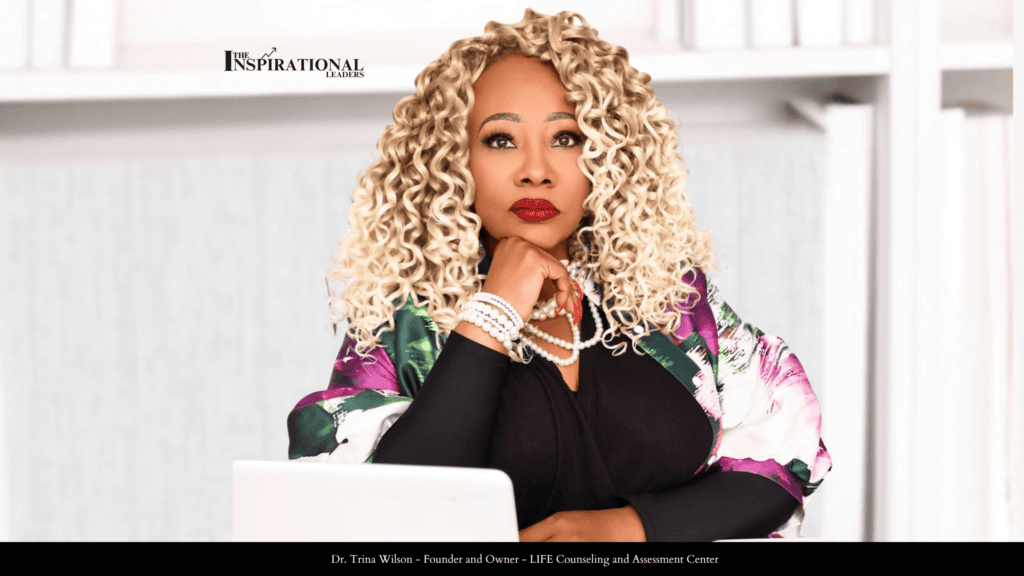
There is a noticeable shift happening inside boardrooms, workplaces, and leadership circles across the world. Organizations are investing in technology faster than ever before, businesses are scaling rapidly, and conversations around innovation dominate nearly every industry. Yet beneath all the advancement and acceleration lies another reality that many leaders can no longer ignore. People are exhausted. Employees are navigating burnout, emotional fatigue, uncertainty, and pressure while still being expected to perform at increasingly demanding levels.
For Dr. Trina Wilson, Founder and Owner of LIFE Counseling and Assessment Center, this conversation is not a trend or corporate talking point. It is the reality that has shaped her life’s work for years.
Long before emotional wellness became part of executive leadership discussions, Dr. Wilson understood the quiet struggles many individuals carry behind professional titles, responsibilities, and appearances. She recognized how often people continue showing up for their families, careers, and communities while privately navigating emotional burdens that remain unseen by the world around them.
That understanding became the foundation of a leadership philosophy centered not only on organizational success, but on human transformation. “My leadership journey was never just about building a business. It was about building people,” she says.
The statement captures the essence of who Dr. Wilson is both as a leader and as a person. Her work has never been driven purely by expansion, visibility, or professional recognition. Instead, it has been guided by a deeper mission to create spaces where individuals can heal, rediscover their identity, and move forward with clarity and purpose.
As a therapist, entrepreneur, strategist, mentor, speaker, and executive leader, Dr. Wilson has built a platform rooted in emotional wellness, faith, leadership development, and sustainable impact. Her approach combines strategic thinking with empathy in a way that feels increasingly rare in today’s business landscape. While many leaders focus primarily on systems and performance metrics, she remains deeply committed to the people operating within those systems.
That perspective has made her voice especially relevant in a time when organizations are being forced to rethink what effective leadership truly looks like. Employees no longer want leadership built solely around hierarchy, authority, or output. They want authenticity. They want emotional intelligence. They want leaders who understand that productivity and wellbeing are connected.
Dr. Wilson has spent years building leadership models around those very principles. Her work through LIFE Counseling and Assessment Center reflects more than professional expertise. It reflects a calling grounded in service, stewardship, emotional healing, and purpose driven leadership. Every initiative she leads carries the same underlying belief: people are not broken, they are becoming.
The Early Understanding That Shaped Her Mission
Some leadership journeys begin with ambition. Others begin with opportunity. Dr. Wilson’s journey began with awareness.
Growing up, she became deeply conscious of how many individuals silently carried emotional pain while continuing to function in everyday life. She observed people trying to fulfill responsibilities while privately struggling with anxiety, emotional wounds, identity challenges, and internal battles that often went unspoken.
Those experiences stayed with her.
Rather than ignoring what she saw, she became increasingly drawn toward understanding human behavior, emotional healing, and personal transformation. Over time, that awareness evolved into purpose.
As she stepped into counseling and leadership, her perspective on success became fundamentally different from many traditional business narratives. She did not view leadership as control or authority. She viewed it as stewardship.
Through years of sitting across from individuals during some of the most vulnerable moments of their lives, Dr. Wilson developed a profound understanding of how emotional wellness influences every aspect of human functioning. She saw how unresolved pain can affect relationships, confidence, leadership ability, workplace performance, and personal growth. Those experiences shaped her approach not only as a therapist, but as an entrepreneur and organizational leader.
What makes Dr. Wilson’s leadership style particularly distinctive is her ability to move fluidly between emotional insight and executive strategy. She understands that businesses cannot thrive long term if the people within them are emotionally depleted, disconnected, or unsupported.
That realization continues to influence every aspect of her work. Her faith also became central to her leadership identity. Dr. Wilson believes leadership is a calling attached to responsibility. Every opportunity, in her view, creates an obligation to uplift others and contribute to something larger than personal success.
Whether she is counseling clients, mentoring leaders, speaking publicly, or developing organizational strategies, her mission remains rooted in impact that extends beyond temporary accomplishments.
That sense of purpose gives her leadership a level of depth that resonates strongly in today’s business environment. She is not simply building programs or organizations. She is building environments where people feel safe enough to heal, strong enough to grow, and empowered enough to evolve.
Building Organizations Through Alignment, Not Noise
In today’s business climate, leaders are constantly navigating disruption, rapid change, and increasing pressure to evolve quickly. Amid that environment, Dr. Wilson believes one principle remains essential for sustainable growth: alignment.
For her, successful organizations are not built through activity alone. They are built when mission, culture, leadership, operations, and people remain aligned around a shared purpose.
“When there is misalignment, confusion follows. When there is alignment, clarity and momentum become possible,” she explains. That philosophy influences how she approaches leadership decisions, organizational development, and long term strategy. Rather than pursuing growth for appearances or speed alone, she focuses on building systems and cultures that remain connected to the organization’s deeper mission.
It is a disciplined approach to leadership that prioritizes sustainability over short term momentum. Adaptability is another principle that has shaped her executive journey. Working within mental health, healthcare, and entrepreneurship has required her to remain responsive to rapidly evolving societal and organizational needs.
Dr. Wilson believes leaders who refuse to evolve eventually lose connection with the people they serve. Yet she is equally intentional about ensuring that adaptability does not compromise values.
Strategy may need to shift over time, but principles should remain firm. That balance between flexibility and consistency has become increasingly important in modern leadership environments where organizations are often pressured to react quickly to changing trends and expectations.
Transparency and accountability also play a major role in her leadership philosophy. Dr. Wilson does not believe leadership should operate from emotional distance or hidden authority. Instead, she believes strong leadership requires ownership, honesty, and the willingness to make difficult decisions when necessary.
That includes protecting long term vision even when those decisions become uncomfortable. Throughout her journey, she has learned that leadership is not about pleasing everyone. It is about remaining responsible to purpose while navigating complexity with wisdom and professionalism.
Faith and discernment continue to guide many of those decisions. In an era driven heavily by analytics, automation, and performance metrics, Dr. Wilson believes wisdom remains one of the most undervalued aspects of leadership. Data matters. Innovation matters. But discernment matters too.
“Strategy without wisdom can lead organizations in the wrong direction very quickly,” she says. That perspective reflects the depth with which she approaches executive leadership. Every decision is evaluated not only through operational outcomes, but through long term purpose and human impact.
The Leadership Shift Businesses Can No Longer Ignore
The expectations surrounding leadership have changed dramatically over the last several years. Traditional models built primarily around hierarchy, authority, and rigid control are steadily losing relevance in modern workplace culture.
Dr. Wilson believes the most influential CEOs today understand that leadership is no longer transactional. It is deeply transformational.
Employees and consumers alike want connection, transparency, and authenticity from the people leading organizations. They want leaders who understand real world pressures and who recognize the emotional realities impacting modern life.
This shift has become especially significant following years of economic uncertainty, social disruption, burnout, and rapid workplace transformation.
According to Dr. Wilson, emotional intelligence, adaptability, cultural awareness, and authenticity are no longer secondary leadership qualities. They are essential.
People no longer separate leadership performance from leadership character. Modern executives are also far more visible than leaders of previous generations. Today’s CEOs are increasingly expected to engage in conversations surrounding mental wellness, organizational culture, diversity, innovation, sustainability, and community impact.
For Dr. Wilson, this visibility carries responsibility. Leadership today is not simply about building companies. It is about shaping environments, influencing culture, and creating spaces where people feel valued and supported.
Resilience has also become one of the defining characteristics of modern leadership. Organizations across industries continue navigating constant economic, technological, and social shifts. During those moments, employees look toward leadership for stability and direction.
Dr. Wilson believes true leadership reveals itself most clearly during seasons of uncertainty. It is easy to lead when circumstances are predictable. The real test comes when organizations face pressure, transition, or adversity.
Throughout her own journey, she has learned the importance of separating temporary circumstances from long term mission. Challenges, she believes, should not automatically be viewed as signs to stop. Often, they become opportunities to strengthen systems, refine strategy, and develop greater wisdom.
That mindset has helped her maintain clarity during difficult seasons while continuing to move forward with discipline and focus.
The Human Side of Executive Leadership
One of the reasons Dr. Wilson’s perspective resonates so strongly today is because she speaks openly about something many organizations once avoided discussing altogether: emotional wellness.
For years, workplace conversations often separated emotional health from business performance. Productivity was prioritized while burnout, stress, and emotional exhaustion were frequently ignored or minimized.
That reality is changing rapidly. Dr. Wilson believes emotional intelligence is now one of the most important leadership competencies organizations can possess. Leaders who lack empathy often create workplace environments where fear, disconnection, and burnout quietly grow beneath the surface.
Especially during periods of uncertainty, employees need leadership that remains emotionally aware while still providing strategic direction.
As someone who works extensively in mental health and organizational leadership, Dr. Wilson has seen firsthand how emotional wellbeing directly affects workplace culture, communication, morale, and sustainability.
Employees want more than compensation and structure. They want to feel respected, heard, appreciated, and understood. At the same time, she is careful to emphasize that empathy does not mean avoiding accountability or lowering standards.
Strong leadership still requires discipline, clarity, and performance expectations. The difference is that emotionally intelligent leaders understand how to challenge people while also supporting them.
They recognize the humanity behind performance. This balance becomes especially important during moments of transition or organizational stress. According to Dr. Wilson, communication becomes one of the most critical leadership tools during difficult seasons.
Teams need honesty. They need reassurance. They need clarity. Leaders who communicate with empathy while remaining grounded create stability even during uncertainty.
Dr. Wilson believes people will always remember how leadership made them feel during seasons of pressure and change. That emotional experience shapes trust, engagement, loyalty, and organizational culture far more deeply than many companies realize.
The Difficult Lessons That Strengthened Her Leadership
Every leader encounters moments that permanently shape how they think, lead, and make decisions. For Dr. Wilson, one of those defining lessons centered around alignment.
As organizations grow and evolve, not everyone connected to one phase of vision necessarily aligns with the next stage of growth. Recognizing that truth was emotionally challenging because of how deeply she values relationships and people.
However, she also learned that leadership requires the courage to protect purpose even when emotions are involved.
Misalignment, when ignored, can quietly weaken culture, productivity, morale, and long term sustainability. Addressing those realities requires clarity, boundaries, discernment, and emotional maturity. That season became one of the most transformative periods of her leadership journey.
It reinforced the understanding that leadership cannot be driven solely by comfort or approval. Sometimes leaders must make difficult decisions that honor mission while still remaining respectful and compassionate.
Another pivotal moment came as conversations around mental wellness began changing globally. After years of stigma surrounding emotional health, Dr. Wilson witnessed corporations, churches, organizations, and communities becoming increasingly open to conversations about healing, emotional support, and mental wellbeing.
Watching that shift unfold reinforced her belief that the work being done through LIFE Counseling and Assessment Center was not only important, but urgently needed.
It also strengthened her commitment to creating platforms that prioritize emotional wellness alongside excellence and strategic growth.
Technology, Innovation, and the Need to Stay Human
The rise of artificial intelligence, automation, and digital transformation continues reshaping industries at remarkable speed. Businesses are becoming more efficient, more connected, and increasingly technology driven.
Yet amid all the advancement, Dr. Wilson continues asking an important question: how do organizations grow without losing their humanity?
For her, technology should enhance connection rather than replace it. That philosophy guides how she approaches innovation inside her organization. While she embraces operational systems, digital resources, and virtual accessibility, she remains intentional about preserving authentic human engagement.
At LIFE Counseling and Assessment Center, innovation is used to expand access and improve support while still ensuring clients and teams feel personally valued. No matter how advanced technology becomes, people still need trust, compassion, encouragement, and emotional connection.
Dr. Wilson also believes leaders must remain committed to continuous learning. Industries are evolving too quickly for organizations to become complacent or resistant to change. At the same time, she warns against allowing operational growth to come at the expense of employee wellbeing or organizational culture.
Behind every technological advancement are real individuals navigating stress, ambition, pressure, and personal challenges. People centered leadership means remembering that human needs do not disappear simply because systems become more advanced.
Creating Cultures Where People Feel Safe to Grow
Organizational culture is often discussed in broad corporate language, but Dr. Wilson approaches it in deeply practical and intentional ways.
She believes culture is shaped daily through leadership behavior, communication, consistency, and accountability. “Culture is shaped by what leadership tolerates, celebrates, and models daily,” she explains.
For organizations to create environments rooted in collaboration, innovation, respect, and excellence, leaders must embody those values consistently themselves.
Dr. Wilson also strongly believes in investing in people development. Mentorship, leadership training, emotional wellness support, and professional growth opportunities all contribute to stronger, healthier organizations.
When individuals feel empowered personally, they often contribute more effectively professionally. Communication remains another critical part of organizational culture. Employees perform better when they understand the vision and feel connected to the mission guiding the organization.
Recognition matters as well. People want to know their contributions carry value. Acknowledging effort, celebrating wins, and creating environments where employees feel appreciated helps strengthen morale and long term loyalty.
Psychological safety is another area Dr. Wilson prioritizes heavily. Organizations thrive when employees feel comfortable bringing ideas, concerns, innovation, and feedback forward without fear of dismissal or intimidation. Those environments encourage stronger collaboration, creativity, and trust.
For Dr. Wilson, healthy culture is never accidental. It is built intentionally through leadership consistency and human centered values.
A Leadership Legacy Rooted in Service
Being recognized among the “Most Influential CEO Driving Strategic Success in 2026” represents far more than professional achievement for Dr. Wilson. It reflects years of purposeful leadership centered on healing, resilience, emotional wellness, and transformational impact.
Her message to aspiring leaders reflects the same wisdom that has guided her own journey. “Do not build success at the expense of your soul, your integrity, or your purpose,” she says.
In a world where leadership is often measured through visibility and external achievement, Dr. Wilson continues emphasizing something deeper. True leadership is built through consistency, service, courage, and legacy.
There will be seasons, she acknowledges, when vision feels heavy. There will be moments when growth requires uncomfortable change or when leaders feel misunderstood along the journey.
Still, she encourages emerging leaders to continue moving forward because every challenge carries lessons that prepare them for greater responsibility.
She also emphasizes the importance of protecting peace, investing in personal growth, and surrounding oneself with people who encourage evolution rather than stagnation.
Above all, she believes leadership is service. The strongest leaders are not simply those who achieve success for themselves. They are the ones who create opportunities, inspire transformation, and leave people better than they found them. That philosophy continues shaping every room Dr. Trina Wilson enters and every decision she makes.
At a time when organizations across the world are searching for stronger culture, healthier leadership, and deeper human connection, her voice represents something increasingly valuable: leadership that understands people are the foundation of every lasting success story.