

In the global conversation around robotics and artificial intelligence, attention often gravitates toward breakthroughs: faster machines, smarter algorithms, increasingly autonomous systems, and the promise of a fully automated future. Yet inside industrial environments where robotics must deliver measurable value, not in theory, but in real operational conditions, the conversation is very different.
There, success is not determined by how advanced a system appears in a demonstration. It is determined by whether people trust it enough to integrate it into daily operations, whether it improves safety without creating friction, and whether it solves real operational problems at scale.
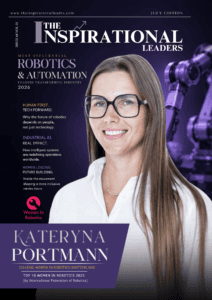
That distinction sits at the center of Kateryna Portmann’s work. Recognized among the Top 10 Women in Robotics 2025 by the International Federation of Robotics, Portmann has emerged as one of the most influential voices shaping how robotics and industrial AI move from innovation into meaningful adoption. As Senior Product Manager at ANYbotics and Co Lead of Women in Robotics Switzerland, she operates at the intersection of technology strategy, industrial transformation, and human centered leadership.
Her career has been defined not simply by understanding robotics systems, but by understanding the environments in which those systems must succeed. From healthcare robotics and connected care solutions to autonomous inspection robots operating in complex industrial facilities, Portmann has consistently focused on one question: how do you transform sophisticated technology into something organizations can trust, adopt, and scale?
She also contributed to the Greater Zurich Area Robotics White Paper, helping shape the region’s strategic positioning in global industrial robotics.
That perspective has become increasingly important in 2026, as robotics transitions from experimentation into operational infrastructure across industries worldwide.
A Career Built Between Innovation and Adoption
Long before robotics became one of the world’s fastest moving industries, Portmann was already navigating environments defined by transformation and complexity.
Her professional journey began in consulting, where she developed a strong understanding of how organizations make decisions during periods of structural change. That experience would later shape her approach to product leadership and industrial adoption. Rather than viewing technology in isolation, she learned to evaluate how people, systems, business priorities, and operational realities interact with one another.
Over time, she became increasingly drawn to a challenge that continues to define deep technology sectors today: why do some groundbreaking innovations struggle to achieve widespread real world impact? That question guided her transition into product leadership.
Across startups, scale ups, and organizations evolving into publicly listed companies, Portmann gained firsthand exposure to the full lifecycle of innovation, from early stage concepts to global deployment. Living and working across Europe, Asia, the Middle East, and the United Kingdom further deepened her understanding that technology adoption is rarely just technical. Culture, organizational behavior, communication, and trust often determine whether innovation succeeds or stalls.
“Technology only creates impact when it is clearly understood and trusted,” she explains. That philosophy now underpins much of her leadership approach in robotics and industrial AI.
Robotics Has Entered a New Industrial Era
For years, robotics was viewed largely as a future facing technology, promising, impressive, but still somewhat experimental for many industries. That perception has changed dramatically. According to Portmann, robotics in 2026 is no longer operating at the edge of industrial operations. It is becoming embedded directly into them.
Industries worldwide are simultaneously facing labor shortages, aging infrastructure, rising operational complexity, stricter safety expectations, and increasing pressure to improve efficiency. Robotics and AI have increasingly become practical tools for addressing these challenges in measurable ways.
At ANYbotics, Portmann works closely with autonomous legged robots designed to operate in demanding industrial environments, from offshore energy facilities to large scale manufacturing sites. These systems are no longer functioning merely as automated inspection tools. They are evolving into intelligent operational assets capable of interpreting environments, detecting anomalies, supporting predictive maintenance, and contributing to broader industrial decision making systems.
This evolution represents a significant shift within industrial robotics. Robots are increasingly becoming part of an operational intelligence layer that continuously monitors and optimizes industrial environments rather than simply executing repetitive tasks.
Portmann believes the implications of this transformation extend far beyond automation itself. Robotics is rapidly becoming a bridge between physical assets and digital intelligence, creating ecosystems where data, AI, predictive analytics, and operational workflows interact continuously.
Yet despite rapid technological advancement, she believes the industry’s biggest obstacle remains surprisingly human.
“The bottleneck is rarely capability,” she says. “It’s clarity.”
Why Clarity Has Become a Strategic Advantage
One of the defining themes throughout Portmann’s career has been her belief that the success of robotics depends heavily on communication.
In highly technical industries, it is often assumed that innovation alone drives adoption. Portmann challenges that assumption directly. She argues that organizations frequently underestimate how difficult it is for decision makers, operators, and industrial stakeholders to translate technical complexity into operational value. When value becomes abstract, adoption slows regardless of how advanced the technology may be.
This insight has shaped her product leadership philosophy. At its core, her work focuses on aligning engineering capability with business understanding and operational realities. She believes the strongest product strategies are those that bridge technical sophistication with practical outcomes industrial organizations can clearly recognize and act upon.
One example illustrates this particularly well. While working on industrial inspection robotics, Portmann helped reposition the narrative surrounding a robotic solution away from technical specifications and toward downtime reduction and operational continuity. The technology itself did not fundamentally change. The framing did.
The result was substantial. Enterprise sales cycles shortened by nearly 30 percent because executives and operational leaders could immediately understand the system’s business value within the context of their own operational priorities.
That experience reinforced a lesson she continues to emphasize today: clarity is not merely a communication skill, it is a competitive advantage.
“In robotics and AI, product strategy is not just messaging,” she explains. “It’s alignment.”
When engineering teams, field operators, leadership stakeholders, and business objectives operate with shared understanding, adoption accelerates significantly. Without that alignment, even exceptional technology risks underutilization.
Human Centered Robotics in Industrial Environments
Although robotics and AI are often associated with automation replacing human work, Portmann’s perspective is notably different. Her approach centers not on removing people from operations, but on improving how humans and intelligent systems work together.
That belief has roots in her earlier experience at Hocoma AG, where she helped develop global connected care and rehabilitation robotics solutions. Working in healthcare reinforced the importance of trust, usability, and human experience in technology adoption. Those lessons continue to shape how she approaches industrial robotics today.
She consistently emphasizes that industrial adoption depends on empathy as much as engineering. Operators, technicians, and frontline workers must understand how robotics systems improve their environments rather than complicate them. If technology introduces uncertainty instead of confidence, resistance naturally follows.
This becomes especially important as AI becomes more deeply integrated into industrial systems. Organizations are increasingly deploying intelligent technologies capable of autonomous monitoring, predictive analysis, and operational optimization. However, without transparency and trust, even highly capable systems struggle to gain long term acceptance.
Portmann believes future ready robotics leaders must therefore operate across multiple dimensions simultaneously. Technical innovation alone is no longer enough. Leadership today also requires operational understanding, organizational awareness, ethical responsibility, and the ability to guide people through change.
That balance has become one of the defining characteristics of impactful leadership within industrial AI.
Responsible AI and the Importance of Inclusion
Beyond her role in product strategy, Portmann has become an influential advocate for responsible AI governance and inclusion within robotics. As Co Lead of Women in Robotics Switzerland and Lead of the Robotics Initiative at Women in AI Governance, she actively works to expand representation and ethical dialogue across deep technology sectors.
Her advocacy stems from a belief that the future of robotics cannot be shaped effectively through narrow perspectives alone.
“Without diverse voices shaping robotics,” she says, “the industry risks reinforcing existing biases.”
That viewpoint has become increasingly relevant as robotics systems begin influencing critical infrastructure, industrial safety, workforce management, and broader operational decision making processes.
Portmann argues that responsible AI in industrial settings requires far more than compliance frameworks. It demands transparency, accountability, interdisciplinary collaboration, and governance structures capable of evolving alongside technology itself.
Cybersecurity, interoperability, data governance, and explainability are all becoming essential parts of industrial robotics deployment. As robotics ecosystems become more interconnected, the consequences of poor governance also grow more significant.
In her view, trust is now one of the industry’s most valuable currencies. Organizations that build trustworthy systems technically, operationally, and ethically will ultimately scale faster and more sustainably.
Adaptability in a Rapidly Evolving Industry
Few industries evolve as rapidly as robotics and AI. New frameworks, AI models, simulation environments, hardware partnerships, and automation capabilities continue emerging at extraordinary speed.
Yet Portmann approaches this pace with notable discipline. She believes adaptability depends on balancing curiosity with strategic focus. Curiosity drives continuous learning, while discipline keeps organizations focused on long term value instead of short term hype.
Rather than chasing every emerging trend, she evaluates innovation through a practical lens: does it solve a meaningful operational problem in a scalable way?
That mindset has helped her navigate diverse organizational environments, from agile startups to mature industrial enterprises, while maintaining strategic clarity amid constant technological change.
Humility also plays a major role in her leadership philosophy. Some of the most important insights, she notes, often come not from executive discussions but from field operators, engineers, and younger professionals experiencing operational challenges firsthand. Listening carefully to those perspectives creates stronger products, better alignment, and more resilient innovation strategies.
This collaborative mindset reflects a broader shift happening throughout robotics itself. Progress increasingly depends not on isolated breakthroughs from single organizations, but on interconnected ecosystems of companies, researchers, AI frameworks, simulation platforms, and hardware software partnerships working together.
The Rise of Ecosystem Driven Robotics
One of the most transformative developments Portmann sees shaping the future of robotics is the acceleration of collaborative ecosystems. Industrial robotics is becoming far more interconnected than in previous decades. Open source frameworks, vendor agnostic architectures, shared AI tooling, and strategic technology partnerships are accelerating innovation at unprecedented speed.
Collaborations involving companies such as NVIDIA are helping robotics systems leverage accelerated simulation environments, AI compute infrastructure, and advanced machine learning capabilities that dramatically improve how robots learn and adapt. This shift is changing the economics and accessibility of robotics development itself.
Open source innovation, in particular, is lowering barriers to experimentation while increasing transparency across the industry. At the same time, enterprises are demanding greater interoperability between systems, platforms, and operational environments.
Portmann believes future industrial success will increasingly depend on modular architectures and unified ecosystems capable of scaling across complex industrial operations. The robotics companies that succeed long term will not simply build powerful machines. They will build ecosystems organizations can integrate, trust, and continuously evolve.
Leadership Beyond Technology
As robotics matures, the definition of leadership within the industry is evolving as well. Historically, influence often centered around invention and technical expertise. Today, Portmann believes impactful leadership depends equally on the ability to guide adoption and alignment across diverse stakeholders.
The most effective leaders now operate across interconnected domains that include technology, business strategy, organizational behavior, and operational execution. This interdisciplinary leadership model reflects the reality of modern industrial AI deployment.
Robotics initiatives no longer succeed through engineering excellence alone. They require cross functional coordination, operational understanding, governance structures, and communication strategies capable of aligning entire organizations around shared objectives.
Portmann believes leaders who can simplify complexity without oversimplifying reality will define the next era of robotics transformation.
“Robotics today is inherently interdisciplinary,” she explains. “Progress requires many voices at the table.”
That principle also shapes how she mentors emerging professionals entering the field.
Shaping the Future of Industrial AI
Looking ahead, Portmann sees robotics becoming progressively more autonomous, predictive, and deeply integrated into industrial decision making systems.
Robots will increasingly function as intelligent operational partners capable of continuously monitoring environments, generating actionable insights, and supporting closed loop optimization systems. AI driven robotics will move beyond isolated automation toward becoming a foundational layer within industrial infrastructure itself.
Yet despite rapid advances in AI, automation, and digital infrastructure, she believes the industry’s defining challenge remains remarkably consistent: trust.
Not trust built through marketing narratives or technological hype, but trust earned through reliability, usability, transparency, and measurable operational value.
For Portmann, the future of robotics will not ultimately be shaped by who builds the most advanced systems. It will be shaped by who helps industries understand, adopt, and use those systems effectively and responsibly.
And in an era where industrial AI is moving from possibility to infrastructure, that distinction may define the next chapter of technological progress itself.