
In financial services, some of the most important successes are the ones people never notice. A salary arrives on time. A mortgage payment clears without delay. A business settles an international transaction without interruption. A customer travelling overseas pays for a service without giving a second thought to whether the payment will go through. These moments may seem routine, but they rely on a vast and complex infrastructure operating behind the scenes. When everything works as expected, it is almost invisible. When it fails, the consequences can be immediate and far-reaching.
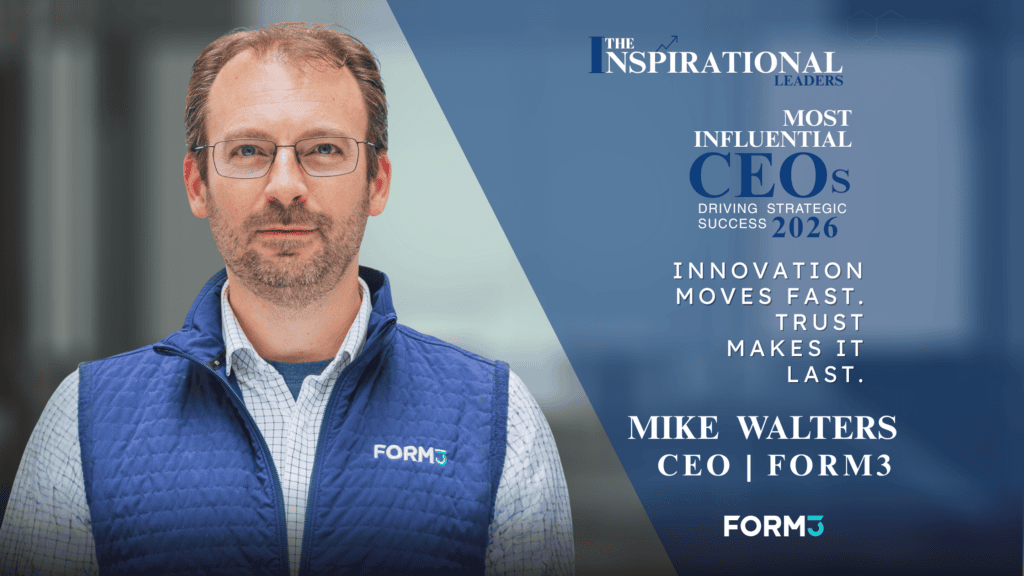
For Mike Walters, CEO of Form3, this reality has shaped both his leadership philosophy and the company’s mission. While much of the fintech industry is focused on disruption, innovation, and speed, Mike believes that long-term success begins with something more fundamental: trust.
Trust between businesses and customers. Trust between partners and providers. Trust between regulators and institutions. Trust between leaders and their teams.
It is a concept that appears throughout every aspect of financial services, and one that Mike believes has become increasingly important as the industry undergoes rapid technological transformation. New technologies may create opportunities, but unless people trust the systems behind them, those opportunities rarely achieve their full potential.
This perspective has guided Form3’s growth from its earliest days. As financial institutions around the world seek to modernise ageing payments infrastructure, the company has built its reputation on helping banks and fintechs adopt modern, cloud-native technology without compromising resilience, security, or operational confidence. For Mike, innovation and trust are not competing priorities. They are inseparable.
Why Trust Remains the Most Valuable Currency
Throughout his leadership journey, trust has remained one of Mike’s most important guiding principles. In an industry where organisations manage critical financial transactions every second of every day, trust cannot be treated as an abstract concept. It directly influences how businesses operate, how customers engage with services, and how institutions manage risk.
Trust takes time to build and only moments to lose. That reality shapes how Mike approaches leadership. While many discussions around growth focus on speed, scale, and expansion, he believes successful organisations must also create confidence among customers, employees, regulators, investors, and partners. Growth without confidence is difficult to sustain. Innovation without credibility rarely succeeds.
At Form3, trust begins internally. Rather than attempting to control every decision, Mike focuses on creating an environment where specialists can excel. Payments is an exceptionally technical field requiring deep expertise and operational understanding. Leadership, in his view, is often less about directing every outcome and more about creating the conditions that allow talented people to apply their knowledge effectively.
This philosophy has influenced the way Form3 has been built. Expertise is valued. Ownership is encouraged. Teams are trusted to solve complex problems and take responsibility for outcomes. Alongside trust sits another principle that Mike considers equally important: consistency.
Markets evolve. Economic conditions change. Technology advances rapidly. Yet organisations still require a clear understanding of what they stand for. At Form3, that principle is simple but powerful: payments cannot fail.
While the statement sounds straightforward, the consequences behind it are significant. Missed salary payments, delayed mortgage transfers, or the inability to access money while travelling can have a meaningful impact on people’s lives. These are not merely technical issues. They are real-world problems affecting real people.
That understanding has helped create a culture where resilience is not treated as a compliance exercise. It is embedded into every decision the company makes.
Seeing Payments Through a Different Lens
Before founding Form3, Mike spent years working within financial services and witnessed firsthand the challenges banks faced when attempting to modernise payments infrastructure.
Many institutions found themselves trapped between expensive choices. They could attempt to build systems themselves, often requiring significant investment and complexity, or they could rely on collections of legacy software that had evolved over decades and become increasingly difficult to manage. Neither approach felt sustainable.
At the same time, the founding team recognised a different trend emerging outside the financial sector. Industries such as streaming and e-commerce were demonstrating how cloud-native technologies could deliver platforms that operated continuously while supporting enormous scale and resilience. These examples prompted a broader conversation about why payments infrastructure could not evolve in the same direction and whether financial services could benefit from adopting the same architectural principles.
Those discussions became one of the foundations upon which Form3 was built. From the beginning, the founding team believed technology should never exist simply for its own sake. Instead, it should help shape business strategy, enabling financial institutions to respond more intelligently to changing customer expectations, evolving regulation and new commercial opportunities. Rather than treating payments as a collection of disconnected systems, the vision was to create a resilient cloud native platform that would allow technology and business strategy to evolve together. That philosophy continues to define Form3’s platform-first approach today.
For Mike, building a platform-first business was never simply an engineering decision. It reflected a broader belief that technology should actively shape how organisations compete, innovate, and grow, rather than being introduced later to support decisions that had already been made. By aligning technology with commercial strategy from the outset, Form3 built an infrastructure capable of evolving alongside customer needs, regulatory change, and the wider payments ecosystem.
The vision challenged conventional thinking at the time. Public cloud infrastructure was still viewed with scepticism in many financial circles. Convincing major financial institutions to trust cloud-native technology for mission-critical payments required more than technical expertise. It required belief, persistence, and evidence. For Mike, those early experiences reinforced a lesson that continues to influence his leadership today: meaningful change often begins long before consensus exists.
Conviction Before Consensus
One of the defining experiences of Mike’s career came during the early years of Form3, when cloud-native payments infrastructure remained an unfamiliar concept for many financial institutions. Today, cloud adoption is widely accepted across financial services. At the time, however, asking major banks to trust public cloud infrastructure for critical payment operations was considered ambitious by many observers.
Questions around security, resilience, governance, and operational control were constant. The scrutiny was intense. Yet rather than viewing those concerns as obstacles, Mike saw them as opportunities to demonstrate what was possible. The experience reinforced his belief that leadership sometimes requires maintaining conviction before others fully recognise the potential of an idea.
Many of the most significant changes in business begin this way. New approaches rarely arrive with universal agreement. They emerge because individuals and organisations are willing to challenge assumptions and explore alternatives when existing models no longer meet future needs.
For Mike, leadership is not about resisting scrutiny. It is about being prepared for it. Conviction only becomes valuable when it is supported by execution, evidence, and a willingness to prove that an idea can work at scale. That lesson remains central to Form3’s evolution and continues to shape how the company approaches innovation today.
Creating a Culture That Supports Innovation
Innovation is frequently discussed as though it exists independently from organisational culture. Mike sees the relationship very differently. The products a company creates are often direct reflections of how that company operates internally. Communication structures, decision-making processes, accountability models, and team dynamics all influence the quality of outcomes.
Technology becomes most valuable when it reinforces good business decisions, strengthens accountability and enables people to perform at their best. On its own, however, technology cannot create a strong culture or replace thoughtful leadership. It cannot compensate for cultural weaknesses or replace effective leadership. If an organisation lacks ownership, clarity, or accountability, introducing new tools simply amplifies existing problems. Conversely, when culture is healthy, technology becomes a force multiplier. This belief has influenced how Form3 structures its teams.
Rather than pursuing scale for its own sake, the company prioritises focused teams with clearly defined responsibilities. People understand what they own. They know where they can make decisions. They are encouraged to take accountability for outcomes. Ownership creates momentum.
It allows organisations to move faster without sacrificing quality and enables innovation to emerge from those closest to the problems being solved. As AI becomes increasingly integrated into business operations, Mike believes these principles become even more important.
Technology should reinforce strong decision-making rather than undermine it. New tools should enhance accountability, not weaken it. The challenge for leaders is ensuring that technological progress strengthens the behaviours that make organisations successful in the first place.
Most importantly, Mike believes businesses must never lose sight of the human element. Technology can optimise processes, analyse data, and automate tasks. Human judgement remains essential when dealing with ambiguity, context, and situations that fall outside predefined rules. The more capable technology becomes, the more valuable thoughtful human leadership becomes alongside it.
Why Resilience Drives Growth
Many organisations view resilience and growth as separate objectives. Mike sees them as deeply connected. Financial institutions will only scale with partners they trust to operate critical infrastructure reliably and securely. Without resilience, sustainable growth becomes increasingly difficult. This perspective has shaped Form3’s strategic direction.
As instant payments continue to gain momentum around the world, customer expectations surrounding uptime, fraud prevention, operational continuity, and reliability continue to rise. Financial infrastructure is no longer evaluated solely on functionality. It is evaluated on its ability to perform consistently under pressure.
To support these expectations, Form3 invested heavily in multi-cloud architecture. The objective was straightforward: remove single points of failure and ensure continuity even in the event of significant disruption. Rather than relying on one provider, the company built infrastructure capable of maintaining operations across multiple environments.
This approach reflects a broader philosophy. Resilience should not be viewed as a defensive measure. It should be viewed as an enabler of growth. The stronger the foundation, the greater the confidence organisations have in expanding, innovating, and serving new markets.
The Future of Financial Infrastructure
Customer expectations around payments have changed dramatically over the past fifteen years. Today, consumers expect transactions to be instant, seamless, and reliable. Businesses expect real-time settlement. Financial institutions are exploring new forms of digital money and increasingly sophisticated payment experiences.
Yet Mike believes the most important questions are not necessarily about which innovation wins. They are about whether the underlying infrastructure is prepared to support them.
Account-to-account payments continue gaining momentum. Stablecoins, tokenised deposits, and central bank digital currencies are attracting increasing attention from policymakers and industry leaders. New payment models continue to emerge.
However, many of these innovations are being layered onto infrastructure that was never originally designed to support them. Faster money does not automatically solve slow systems. In many cases, it simply exposes weaknesses more quickly.
For Mike, the organisations that succeed in this environment will be those that view infrastructure as a strategic asset rather than a cost centre. The ability to support real-time settlement, interoperability, resilience, and scalability will become increasingly important as financial ecosystems evolve. Those that fail to modernise may discover that every new innovation simply reveals limitations that already existed.
Leading Through Complexity and Change
Modern CEOs face challenges that extend far beyond traditional business considerations. Rapid technological change, geopolitical uncertainty, regulatory scrutiny, cybersecurity threats, and evolving customer expectations all require attention simultaneously.
Artificial intelligence introduces yet another layer of complexity. Many organisations focus on how AI can improve productivity. Mike believes leaders must think more broadly.
The more significant question concerns relevance. As customer relationships, decision-making processes, and commerce itself evolve through increasingly agentic systems, organisations must consider how their role within those ecosystems changes.
Success will depend not simply on adopting AI but on understanding how AI reshapes the broader environment in which businesses operate.
At the same time, leaders are becoming increasingly aware that digital infrastructure remains connected to physical realities. Recent global events have challenged assumptions surrounding cloud infrastructure, highlighting the importance of diversification and operational resilience. Regulators are also paying closer attention to concentration risks and cloud dependency.
These developments reinforce a critical lesson. Overreliance on any single provider creates vulnerability. Diversification, whether through technology architecture, partnerships, or operational planning, is becoming an essential leadership strategy.
Leadership Beyond Financial Performance
For Mike, meaningful leadership extends beyond financial results. It is about creating environments where people can perform at their best while contributing to something larger than themselves.
Strong leadership is not about having every answer. It is about building organisations where trusted teams can make informed decisions, solve meaningful problems, and take ownership of outcomes.
Transparency plays a central role in this philosophy. Periods of growth require clarity. Periods of challenge require honesty. Both demand long-term thinking.
Over recent years, the fintech sector has experienced significant market shifts and economic cycles. Navigating those changes responsibly requires leaders who can provide direction without losing sight of reality.
Culture remains equally important. Trust, accountability, curiosity, and continuous learning all contribute to organisational strength. These qualities help create teams capable of adapting to changing circumstances while remaining focused on long-term objectives.
Ultimately, meaningful leadership is measured not only by what an organisation achieves but by how it enables people to achieve it.
A Blueprint for the Next Generation of Leaders
Reflecting on the future, Mike’s advice to aspiring executives centres on intellectual curiosity and adaptability. The organisations that succeed over the long term are rarely those that remain attached to established approaches simply because they have worked in the past. Instead, they are the ones willing to continually reassess assumptions and respond thoughtfully to changing conditions.
Transformation is rarely about technology alone. Technology matters enormously, but people, culture, execution, and leadership remain equally important.
The most effective leaders create clarity during uncertainty. They build resilient teams. They encourage collaboration. Most importantly, they focus on solving problems rather than creating workarounds.
Avoiding complacency is essential. Resilience is not about assuming nothing will fail. It is about preparing for failure thoughtfully and ensuring systems, teams, and organisations can respond effectively when challenges arise.
As payments become faster, financial systems become more connected, and artificial intelligence reshapes the way businesses and consumers interact, the pressure to innovate will only intensify.
Yet Mike Walters remains convinced that the fundamentals will not change. Trust, resilience, accountability, and the ability to solve meaningful customer problems will continue to separate successful organisations from those that struggle to adapt.
In an industry built on confidence, technological progress may create new opportunities, but it is trust that ultimately determines whether those opportunities endure. And for Mike Walters, that trust remains the foundation upon which lasting success is built.