
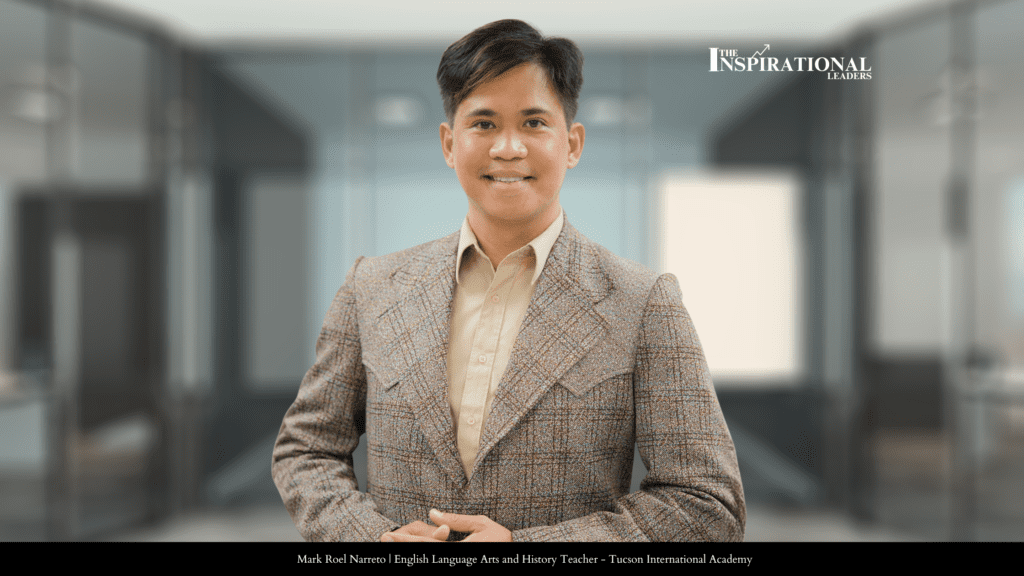
In an age where information is abundant but understanding is scarce, the role of an educator has evolved into something far more profound than instruction. It is no longer enough to teach facts or deliver curriculum education today demands the ability to cultivate discernment, challenge assumptions, and shape individuals who can think independently in a world saturated with competing narratives. At this critical intersection of storytelling, critical thinking, and cultural awareness stands Mark Narreto, an English Language Arts and History teacher at Tucson International Academy, whose journey into education reflects both personal conviction and a broader reimagining of what it means to teach.
Narreto’s path is anything but conventional. Before stepping into the classroom, he spent over a decade in the Philippines as a television and radio journalist, reporting from environments where truth was not only contested but often dangerous to pursue. His experiences in crime scenes, conflict zones, and political landscapes exposed him to the complexities of power, the fragility of truth, and the consequences of misinformation. Yet, rather than allowing these realities to distance him from society, they ultimately drew him closer to a different kind of responsibility—the responsibility to educate.
Today, his classroom is not just a place of learning, but a space of transformation. It is where literature becomes lived experience, history becomes dialogue, and students are encouraged not just to absorb information, but to interrogate it. His work reflects a belief that education is one of the most powerful tools available to shape not only knowledge, but perspective, empathy, and the capacity to engage meaningfully with the world.
A Foundation Rooted in Culture, Legacy, and the Value of Learning
For Mark Narreto, the origins of his educational philosophy can be traced back to his upbringing in Davao City, Southern Philippines—a cultural environment where education was not taken for granted, but deeply revered. Within his family and community, learning was seen as a transformative force, a pathway to opportunity, and a means of overcoming socioeconomic limitations.
“I was raised in a family and a culture that treated education like a priceless gift—something precious passed from one generation to the next,” he shares. This perspective shaped not only his respect for knowledge, but also his understanding of its purpose. Education was not merely about personal advancement; it was about responsibility, growth, and the ability to create a better future.
Surrounded by relatives who were educators, Narreto was exposed early to the quiet yet profound influence teachers have on individuals and communities. Their work, often understated, demonstrated the power of shaping minds and guiding lives. This influence planted the seeds of a future in education, even as his initial career path took him elsewhere.
The Journalist’s Journey: Witnessing Reality and Reconsidering Impact
Narreto’s entry into journalism marked a significant chapter in his life—one that would ultimately shape his approach to education in ways he could not have anticipated. With a degree in Mass Communication, he immersed himself in the world of media, spending more than a decade as a television and radio reporter in the Philippines.
His work placed him at the forefront of unfolding events, covering stories that ranged from crime and conflict to politics and social issues. These experiences demanded not only technical skill, but emotional resilience and ethical clarity. Reporting from such environments required him to observe, interpret, and communicate realities that were often complex and difficult.
However, over time, the profession revealed its darker dimensions. The erosion of press freedom, the persistence of political impunity, and the increasing risks faced by journalists began to weigh heavily on him. As colleagues faced threats and silencing, the question of purpose became increasingly urgent.
Rather than continuing on a path that was becoming increasingly perilous, Narreto chose to redirect his energy toward a different form of impact. His return to education was not an escape—it was a deliberate decision to contribute in a way that would shape future generations.
Reimagining the Classroom: From Passive Learning to Active Experience
Narreto’s transition into teaching was marked by a willingness to challenge traditional methods and reimagine what learning could look like. Early in his teaching career, he encountered a familiar challenge—students who were disengaged, unresponsive, and disconnected from the material.
“If I do lectures, I noticed that I only get blank stares, minimal participation, and responses that barely scratched the surface,” he reflects. Recognizing that traditional lecture-based approaches were insufficient, he made a conscious decision to change direction.
One of the most transformative moments came when he introduced role-based learning into his classroom. By assigning students the roles of historical figures and literary characters, he shifted the focus from passive observation to active participation. Students were no longer simply learning about events—they were experiencing them.
This approach, rooted in experiential learning, fundamentally changed the classroom dynamic. Students began to engage more deeply, express their ideas more confidently, and develop a stronger connection to the material. Drawing from his background in theater pedagogy, Narreto incorporated performance, simulation, and creative expression into his lessons, creating an environment where learning became immersive and meaningful.
Innovation Through Perspective: Blending Journalism, Technology, and Creativity
Innovation in education is often associated with technology, but for Narreto, it begins with perspective. A defining moment in his teaching came when he observed students engaging more actively with a trending news story than with the lesson at hand. Rather than redirecting their attention, he chose to build on their interest.
By asking, “How would a historian view these events?” he transformed a moment of distraction into an opportunity for critical analysis. This simple shift demonstrated that innovation is not always about introducing new tools—it is about rethinking how learning is approached.
Narreto integrates technology thoughtfully into his classroom, using digital platforms to enhance engagement without overshadowing the learning process. Students create podcasts, produce videos, and develop multimedia presentations that allow them to reinterpret literary texts and historical events. These activities position students as creators, encouraging them to take ownership of their learning.
At the same time, his journalism background informs his emphasis on inquiry and critical thinking. Students are encouraged to question sources, verify information, and analyze bias—skills that are essential in navigating today’s information landscape.
Teaching Students to Question: Building Critical Consciousness
Central to Narreto’s teaching philosophy is the belief that education should empower students to question rather than accept information at face value. A pivotal classroom moment illustrated this principle when a student confidently relied on a textbook as the ultimate source of truth.
By asking, “Who wrote the textbook?” Narreto initiated a deeper exploration of perspective, bias, and representation. This question became a gateway to discussions that challenged assumptions and encouraged students to think more critically.
In both literature and history, he emphasizes the importance of multiple perspectives. Students learn to compare sources, analyze interpretations, and understand that knowledge is shaped by context. This approach not only deepens their understanding, but also equips them with the tools to navigate a world where information is abundant but not always reliable.
Overcoming Modern Challenges: Engagement, Relevance, and Information Overload
The modern classroom presents unique challenges, particularly in maintaining engagement in an environment filled with distractions. Students are accustomed to instant access, multimedia content, and constant stimulation, making traditional teaching methods increasingly ineffective.
Narretto addresses this by creating learning experiences that are interactive, relevant, and purposeful. By connecting historical events and literary themes to contemporary issues, he helps students see the relevance of what they are learning. Themes such as justice, identity, and power become more than abstract concepts—they become lenses through which students can understand the world around them.
Additionally, he emphasizes the importance of information literacy. In an age of misinformation, students must learn to evaluate sources, identify bias, and think critically about the information they encounter. This focus not only enhances their academic skills, but also prepares them for responsible engagement in society.
Moments That Matter: Witnessing Transformation in the Classroom
For Narreto, the true impact of teaching is often revealed in moments of personal growth. One such moment involved a student who struggled with confidence and avoided participation. Through a collaborative performance project, the student gradually became more involved, contributing ideas and supporting his peers.
When an unexpected opportunity arose, the student chose to step forward and perform—overcoming his fear and demonstrating newfound confidence. “It was a small moment, but it carried so much weight,” Narreto recalls.
This experience underscores the transformative power of education. It highlights the importance of creating an environment where students feel supported and empowered to take risks.
Balancing Discipline and Expression: Where Rigor Meets Creativity
Narreto’s approach to teaching is defined by a careful balance between academic rigor and creative expression. While he emphasizes the importance of analytical skills, he also recognizes the need for students to engage with material in ways that are meaningful and personal.
By integrating creative tasks into his lessons, he allows students to explore content through performance, visual representation, and storytelling. However, these activities are always grounded in evidence and critical thinking, ensuring that creativity enhances rather than replaces academic rigor.
Education as a Force for Global Understanding
As a global educator, Narreto views his role as extending beyond academic instruction. He sees education as a means of preparing students to navigate an interconnected world, where cultural understanding and empathy are essential.
Through discussions that explore diverse perspectives, he encourages students to engage thoughtfully with global issues. These experiences help students develop a sense of responsibility and an awareness of their place within a larger community.
Guiding Future Educators: Purpose, Connection, and Adaptability
Narreto’s advice to aspiring educators reflects the values that have guided his own journey. He emphasizes the importance of maintaining a clear sense of purpose, particularly during challenging moments.
He also highlights the significance of building relationships with students, recognizing that trust and connection are fundamental to effective teaching. By creating an environment where students feel valued, educators can foster engagement and growth.
A Vision for the Future: Education Without Boundaries
Looking ahead, Narreto envisions an educational system that is more connected, dynamic, and responsive to the needs of the modern world. He sees a shift toward skills-based learning, where critical thinking, collaboration, and adaptability are prioritized.
He also envisions a greater integration of creativity and innovation, allowing students to explore ideas and express themselves in diverse ways. Technology, in this vision, serves as a tool to enhance learning while preserving the essential human elements of teaching.
Conclusion: A Journey That Continues to Shape Futures
Mark Narreto’s journey from journalism to education reflects a profound commitment to shaping how individuals understand and engage with the world. His work demonstrates that teaching is not merely about imparting knowledge—it is about empowering individuals to think critically, act responsibly, and contribute meaningfully to society.
In a time where truth is often contested and perspectives are constantly evolving, educators like Narreto play a vital role in guiding the next generation. Through his approach to teaching, he continues to create spaces where learning is not only meaningful, but transformative.
And in doing so, he reminds us that education, at its core, is not just about what we know—but about how we choose to understand, question, and shape the world around us.