
Commercial aviation has long been associated with movement, connectivity, and economic growth. Yet behind every flight route, airport expansion, and global network lies a more complicated reality that the industry can no longer afford to ignore. The future of aviation is now being shaped not only by passenger demand or technological advancement, but by questions of resilience, energy security, environmental responsibility, and the ability of nations to build systems capable of sustaining long term growth. For leaders operating at the intersection of infrastructure and aviation, the challenge is no longer theoretical. It is operational, financial, and deeply strategic.
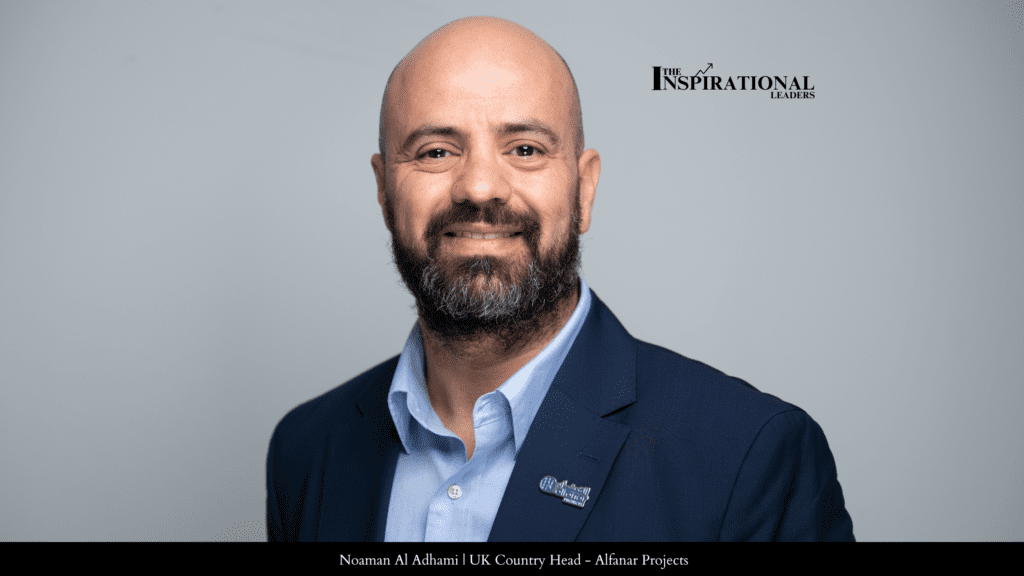
Noaman Al Adhami understands this shift firsthand.
As UK Country Head at Alfanar Projects, Noaman is leading one of Europe’s most advanced Sustainable Aviation Fuel developments, Lighthouse Green Fuels (LGF), a flagship project based in Teesside that aims to transform biogenic waste and residues into large scale SAF production. The project is not positioned as a future concept or an experimental pilot. It is being developed as critical industrial infrastructure designed to address some of aviation’s most pressing realities: decarbonisation, fuel security, supply resilience, and long term sustainability.
Under his leadership, Lighthouse Green Fuels has progressed through Front End Engineering Design completion and is targeting Final Investment Decision by the end of 2027, with operations expected in 2031. Once operational, the facility is expected to produce around 135,000 tonnes of Sustainable Aviation Fuel annually, equivalent to approximately 180 million litres of SAF each year. The impact extends beyond emissions reduction alone. The project represents a broader shift in how aviation fuel itself is sourced, produced, and integrated into national infrastructure.
For Noaman, the significance of this transition goes beyond environmental ambition. Aviation continues to grow globally, and with that growth comes increasing pressure on supply chains, fuel systems, and national energy strategies. The sector’s historic dependence on imported fossil derived jet fuel has exposed vulnerabilities that recent geopolitical and economic disruptions have made impossible to ignore.
The United Kingdom alone imports a substantial portion of its jet fuel supply, creating exposure to external market volatility and supply disruptions. In Noaman’s view, projects like Lighthouse Green Fuels are as much about strengthening long term resilience as they are about reducing emissions.
That perspective has shaped the way he approaches leadership. Rather than treating sustainability as a standalone initiative, he sees it as part of a much broader industrial transformation involving infrastructure, logistics, energy systems, policy frameworks, and commercial viability. It is a leadership philosophy grounded less in abstract targets and more in execution.
“Leadership now is about delivering real, physical infrastructure that addresses both sustainability and fuel security at the same time,” he explains.
That mindset has become increasingly important as aviation enters one of the most significant transitional periods in its history.
Aviation’s Next Chapter Requires More Than Ambition
For decades, aviation operated within a relatively stable framework built around conventional fuel supply chains and predictable infrastructure models. Today, that landscape is changing rapidly.
Rising global demand for air travel continues to place pressure on the sector, while environmental expectations from regulators, governments, investors, and consumers are intensifying simultaneously. At the same time, supply chain disruptions, geopolitical instability, and energy market volatility have exposed weaknesses within traditional fuel dependency models.
According to Noaman, one of the industry’s biggest mistakes would be treating these issues independently. Decarbonisation cannot be separated from resilience. Sustainability cannot be discussed without considering supply security. And infrastructure investment cannot succeed without long term commercial viability.
This is precisely why Sustainable Aviation Fuel is becoming such a critical focus area globally. Unlike future technologies that may require entirely new aircraft systems or decades of infrastructure redesign, SAF offers a pathway that can work within existing aviation frameworks while significantly reducing lifecycle emissions. For long haul aviation particularly, Noaman believes SAF will remain the most practical and scalable solution for the foreseeable future.
Yet scaling SAF is not straightforward. Developing large scale facilities requires substantial investment, reliable feedstock supply, advanced technology integration, supportive policy environments, and long term revenue certainty. It also requires patience and coordination across multiple industries.
That complexity is what makes projects like Lighthouse Green Fuels particularly significant. Located in Teesside, LGF is designed to convert approximately 1.5 million tonnes of agricultural and forestry residues annually into Sustainable Aviation Fuel. By using waste based feedstocks, the project introduces a fundamentally different production model compared to traditional fossil derived fuel systems.
The facility is also designed to integrate with regional carbon capture and storage infrastructure, further increasing its environmental impact and potentially enabling net negative emissions.
For Noaman, however, the project’s importance lies not only in emissions reduction figures. It represents proof that large scale industrial decarbonisation can be commercially structured, operationally realistic, and strategically beneficial for national infrastructure.
Building Complex Infrastructure Requires Long Term Thinking
Much of Noaman’s career has been shaped by building operations and infrastructure projects in challenging and evolving environments. Having worked across major shifts within the energy sector, he sees strong parallels between previous industrial transitions and the current transformation underway in aviation. The difference, he notes, is that aviation operates at the centre of global economic connectivity, making the consequences of delay or failure far more visible.
That perspective has influenced the way he approaches project development. At Lighthouse Green Fuels, the emphasis has been on getting the fundamentals right early rather than chasing speed at the expense of long term viability.
This includes selecting the appropriate production pathway, securing the right technology licensors, understanding market dynamics, building operational capability, and ensuring there is a practical route toward commercial delivery.
The project uses gasification and Fischer Tropsch technology, processes that have historically been used within other industrial applications. Rather than relying on entirely unproven systems, the approach adapts established technologies for low carbon fuel production using sustainable feedstocks.
For Noaman, this balance between innovation and operational realism is critical. Infrastructure projects of this scale cannot rely solely on vision. They require disciplined execution, technical credibility, and the ability to coordinate numerous moving parts simultaneously. “These projects have multiple moving parts and aligning them is often the hardest part,” he says.
That coordination extends across engineering, policy, financing, logistics, environmental compliance, feedstock sourcing, and stakeholder engagement. It is one reason why leadership in this space increasingly requires cross sector understanding rather than narrow specialization.
The Relationship Between Aviation and Energy Is Changing
Historically, fuel was often viewed as a supporting operational input within aviation. Today, that assumption is changing. According to Noaman, one of the most important strategic shifts taking place within the sector is the growing recognition that fuel itself has become a long term national and industrial consideration.
The dependence on imported fossil based jet fuel has created vulnerabilities that extend far beyond emissions. Price volatility, geopolitical instability, and supply disruptions have all highlighted the risks associated with overreliance on external energy systems. Producing Sustainable Aviation Fuel domestically introduces an alternative model that improves resilience while supporting environmental objectives.
In the case of Lighthouse Green Fuels, using UK based waste materials to produce fuel domestically creates both industrial and economic advantages. The project is expected to contribute significantly to regional economic development, including the creation of around 2,000 construction jobs, more than 300 permanent operational roles, and thousands of additional opportunities across the wider supply chain.
For regions such as Teesside, projects like LGF also contribute to broader industrial regeneration efforts. Noaman believes this is an important part of the conversation that is sometimes overlooked. Sustainability initiatives become far more scalable when they are also economically productive.
When projects strengthen domestic capability, create jobs, improve resilience, and support industrial growth alongside environmental objectives, they move from being policy ambitions to strategic national assets. That broader perspective continues to shape how Alfanar Projects approaches the aviation transition.
Collaboration Has Become Essential to Progress
No single organisation can transform aviation independently. The scale of the challenge now facing the sector requires coordination between infrastructure developers, energy producers, airports, logistics providers, regulators, policymakers, investors, and technology partners.
For Noaman, collaboration is no longer optional. It is structural. Projects like Lighthouse Green Fuels depend on interconnected systems functioning together. Waste supply chains, processing facilities, transport infrastructure, carbon capture systems, and aviation fuel distribution networks all need to operate within a coordinated framework.
If one element fails, the broader system becomes affected. That interconnectedness means progress often depends less on isolated innovation and more on alignment. Government frameworks play an important role in creating direction and confidence for investment. Industry, however, must ultimately deliver execution.
The relationship between those two sides is particularly important within SAF development. While the UK has established a strong framework in several areas, Noaman now believes that the final component needed to enable large scale deployment is a revenue certainty mechanism.
Projects involving multibillion pound investment require long term visibility and financial predictability. Without those conditions, scaling production at the pace required becomes increasingly difficult. At the same time, collaboration across sectors also improves operational problem solving.
Over time, partnerships mature, communication improves, and stakeholders become more aligned around shared objectives. That process can be complex, but it is often what allows major infrastructure projects to move from concept into reality.
Sustainability Must Be Framed Correctly
One of the recurring themes throughout Noaman’s leadership philosophy is the importance of framing sustainability in practical rather than purely ideological terms. If sustainability is approached only as an additional cost burden, progress inevitably slows. If it is understood as part of building a stronger, more resilient industrial system, investment decisions become clearer. This distinction matters.
In Noaman’s view, SAF should not be positioned simply as a compliance mechanism or environmental obligation. It represents an opportunity to modernize aviation infrastructure while improving long term stability. That broader framing is becoming increasingly relevant as airlines, governments, and infrastructure developers attempt to balance growth with emissions reduction.
Aviation demand is expected to continue expanding globally. The challenge is ensuring that future growth occurs within systems capable of supporting it sustainably. This is why scalable industrial projects matter.
Noaman sees facilities like Lighthouse Green Fuels not as isolated developments, but as models that can potentially be replicated across different markets and regions. The company is already exploring opportunities for expansion and future development phases.
For aviation leaders, the objective is no longer simply discussing long term sustainability ambitions. It is about building practical pathways capable of delivering measurable outcomes.
Technology Is Enabling Smarter Infrastructure Development
Emerging technologies are also changing the way aviation infrastructure projects are planned, developed, and managed. For Noaman, however, innovation does not necessarily mean abandoning proven systems entirely.
In many cases, the most effective approach involves adapting existing industrial technologies to meet new sustainability objectives. The production processes being implemented at LGF build upon industrial foundations that have already demonstrated scalability historically. What changes are the feedstocks, environmental outcomes, and operational integration. This creates greater confidence from both technical and investment perspectives. At the same time, digital tools are increasingly improving how projects are designed and operated.
Enhanced modelling capabilities, better performance visibility, operational analytics, and more advanced data systems are helping reduce risk while improving efficiency across complex infrastructure environments. Flexibility also plays a growing role. The ability to process different feedstock types, adapt to changing supply conditions, and optimize operational performance over time contributes significantly to long term resilience. Noaman believes this combination of proven industrial foundations and evolving digital capability will continue shaping how future aviation infrastructure is delivered.
Leadership During Industrial Transition
Periods of large scale transformation place enormous pressure on leadership. For Noaman, navigating that environment requires more than technical expertise or operational experience alone. The quality of the team becomes equally important.
Projects like Lighthouse Green Fuels involve long timelines, regulatory complexity, engineering challenges, financing considerations, and external uncertainty. Sustaining momentum across those conditions depends heavily on culture and shared purpose. “On projects like this, you need people who genuinely believe in what you’re trying to achieve,” he says.
That belief changes the level of commitment individuals bring to their work. Noaman places strong emphasis on trust, ownership, and creating an environment where teams are empowered to contribute rather than simply execute instructions.
Micromanagement, in his view, slows progress. When people understand the broader purpose behind a project and are given the responsibility to deliver meaningfully within it, performance changes.
Leadership then becomes less about control and more about enabling capability. That philosophy has become increasingly important within industries navigating complex transitions where adaptability, coordination, and long term thinking are essential.
Building Aviation’s Future Through Execution
Looking ahead to 2026 and beyond, Noaman believes Sustainable Aviation Fuel will become one of the defining forces shaping the aviation industry over the next decade. As large scale projects continue progressing toward commercial operation, SAF production will increasingly move from policy discussion into industrial reality.
At the same time, energy resilience and domestic production capability will become more strategically important for governments and aviation ecosystems worldwide. The relationship between energy infrastructure and transportation systems will continue deepening, particularly as carbon capture integration and broader industrial decarbonisation efforts accelerate.
Longer term technologies such as hydrogen and electric aviation are expected to continue developing, but for long haul aviation, Noaman sees SAF remaining the most practical near term pathway capable of supporting substantial emissions reduction at scale. For leaders across the industry, the challenge is balancing long term ambition with immediate deliverability.
The future of aviation will not be shaped by vision statements alone. It will be shaped by projects capable of securing investment, navigating regulation, coordinating stakeholders, integrating infrastructure, and operating commercially at scale. That reality continues to define Noaman Al Adhami’s approach.
His focus remains firmly grounded in execution, industrial capability, and building systems that can support aviation’s future responsibly. As the global aviation sector enters one of the most significant transitions in its modern history, leaders like Noaman are helping shift the conversation away from whether change is necessary toward how it can actually be delivered. And increasingly, that distinction may determine which industries, economies, and organisations are truly prepared for the future of global air travel.