
There are moments in the evolution of every profession when incremental improvement is no longer enough. Moments when the pace of change becomes so profound that the profession must pause, reflect, and ask a more fundamental question: What should we become next?
For procurement, that moment is now. Across the world, organizations are operating in an environment defined by disruption, complexity, and unprecedented interconnectedness. Geopolitical uncertainty, economic volatility, technological acceleration, sustainability expectations, and evolving stakeholder demands have reshaped the landscape in which businesses operate. Supply chains have become more intricate, risks more dynamic, and opportunities more expansive. In this environment, procurement has emerged from the background and stepped firmly into the strategic spotlight.
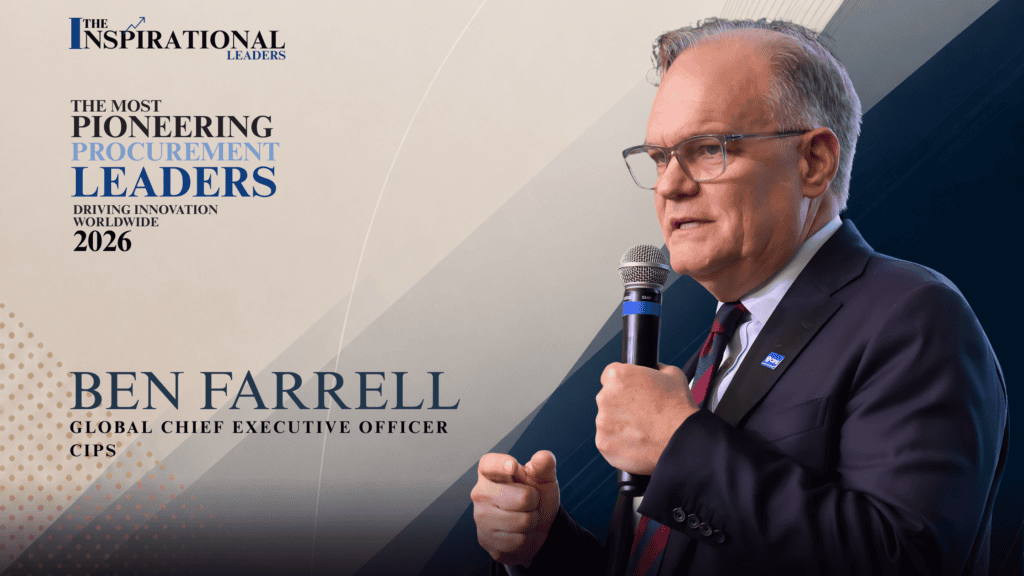
Few leaders have had a clearer view of this transformation than Ben Farrell, Chief Executive Officer of the Chartered Institute of Procurement & Supply (CIPS). With a leadership journey spanning military procurement, commercial leadership, organizational transformation, and global professional development, Farrell has spent decades observing how organizations create value, navigate uncertainty, and build lasting success. Those experiences have shaped a perspective that extends far beyond procurement itself.
Today, as CEO of the world’s largest professional body serving procurement and supply professionals, Farrell is helping lead one of the most important conversations taking place in global business. Through CIPS and its worldwide community, he is challenging traditional assumptions about procurement, exploring what leadership will look like in the future, and helping define the role procurement professionals will play in shaping organizations, economies, and societies. For Farrell, the future of procurement is not simply about improving processes or adopting new technologies. It is about expanding influence, creating value, and embracing a broader purpose.
A Leadership Journey Built on Curiosity and Perspective
Great leadership is rarely formed by a single experience. More often, it is shaped by a lifetime of learning, observation, and an openness to new perspectives.
Throughout his career, Farrell has had the opportunity to serve in military procurement, lead within commercial environments, and engage with professionals, academics, policymakers, and business leaders across the globe. Those experiences have provided him with a unique vantage point from which to observe both the evolution of procurement and the broader forces reshaping organizations worldwide.
One lesson has remained constant throughout that journey: leadership is a discipline that never stops evolving. Farrell often reflects on one of the earliest lessons he learned in the Army—study leaders and study leadership. That curiosity has remained with him throughout his professional life and continues to influence how he views the future. Rather than focusing solely on procurement expertise, he has developed a broader understanding of how leadership, strategy, technology, resilience, and human behavior intersect.
This perspective has led him to a powerful conclusion. Procurement is entering a defining period of transformation. What was once regarded as a function focused primarily on sourcing, contracts, and cost management is rapidly becoming something far more influential. The profession is evolving into a discipline that sits at the crossroads of strategy, sustainability, technology, risk management, innovation, and enterprise performance. For Farrell, this transformation represents one of the most exciting opportunities in modern business.
The Rise of Procurement as a Strategic Force
For decades, procurement’s success was largely measured through savings, efficiency, and supplier management. While those responsibilities remain important, they no longer define the profession.
Farrell believes procurement has reached a point where its influence extends well beyond commercial transactions. Today’s procurement leaders are increasingly involved in shaping organizational strategy, strengthening resilience, driving innovation, supporting sustainability goals, and managing complex networks of stakeholders.
The role has evolved because the world itself has evolved. Organizations now operate within highly interconnected ecosystems where suppliers, partners, customers, regulators, governments, and communities are all connected in ways that were unimaginable just a generation ago. Procurement professionals often sit at the center of these networks, uniquely positioned to connect different parts of the enterprise and unlock opportunities that others may not see.
As Farrell explains, the decisions made by procurement leaders today can influence outcomes not only for businesses but also for governments and entire nations. That reality demands a new type of leadership—one that combines commercial excellence with strategic thinking, technological fluency, sustainability awareness, and the ability to influence decisions at the highest levels of an organization. The future Chief Procurement Officer, in Farrell’s view, will not simply manage supply chains. They will help shape the future direction of the organizations they serve.
Leading Through Uncertainty
If there is one characteristic Farrell believes will define successful leaders in the years ahead, it is the ability to navigate uncertainty. For much of modern business history, leadership was often associated with certainty. Leaders were expected to have answers, provide direction, and create stability. Yet the realities of today’s world demand something different.
Economic volatility, geopolitical disruption, technological transformation, climate challenges, and shifting societal expectations have created an environment where uncertainty is no longer occasional—it is constant. In such a world, leadership is less about knowing every answer and more about helping others move forward despite ambiguity. Farrell believes procurement leaders are uniquely equipped for this challenge.
Every day, procurement professionals balance competing priorities, manage complex stakeholder relationships, and make decisions in environments where information is often incomplete. They work across organizational boundaries, anticipate risks, and identify opportunities amid uncertainty.
The most effective leaders are not those who eliminate uncertainty; they are those who create clarity for others while operating within it themselves. They connect seemingly unrelated developments, recognize emerging patterns, and help organizations respond proactively rather than reactively.
In an increasingly complex world, this ability has become one of the most valuable leadership capabilities of all.
Trust: The Ultimate Strategic Enabler
While technology continues to transform business at an extraordinary pace, Farrell believes the most important leadership principle remains unchanged. Trust. “Trust is the ultimate strategic enabler.”
This belief sits at the heart of Farrell’s leadership philosophy and has been reinforced throughout his experiences in both military and business environments. Again and again, he has seen that high-performing teams, successful organizations, and resilient partnerships are built upon trust.
In a world increasingly driven by data, automation, and artificial intelligence, it is tempting to assume that technology will become the defining differentiator. Farrell disagrees. The qualities that matter most remain deeply human. Integrity. Authenticity. Transparency. Consistency. The ability to inspire confidence and bring people together around a shared purpose.
As organizations become more interconnected and collaborative, influence often matters more than authority. Procurement leaders must work across departments, industries, governments, and global supply networks. Their success depends on their ability to build relationships, foster collaboration, and earn the confidence of diverse stakeholders. Farrell believes the leaders who stand apart in the future will not simply be the most technically capable. They will be the most trusted.
Technology, Innovation, and the Power of Mindset
Artificial intelligence is transforming industries around the world, and procurement is no exception. Yet Farrell sees the greatest opportunity not in the technology itself but in what the technology enables.
During recent engagements with procurement professionals across the ASEAN region, he observed something remarkable. The most impressive organizations were not necessarily those with the most advanced technology. They were the ones embracing a new mindset.
Rather than focusing solely on processes and procedures, these leaders were thinking differently. They were prioritizing outcomes over activities, purpose over process, and value creation over transactional efficiency. That shift in thinking represents a profound evolution in the profession.
For years, procurement was often perceived as a support function focused on controlling costs and managing suppliers. Today, innovative procurement teams are actively shaping business performance, influencing strategic decisions, and driving organizational growth. They are demonstrating that procurement can be a creator of value rather than simply a manager of spend.
Farrell believes this change in perception may ultimately prove more important than any technological breakthrough.
The future of procurement will not be defined solely by artificial intelligence, automation, or digital platforms. It will be defined by a profession willing to challenge assumptions, embrace innovation, and confidently demonstrate its broader contribution to society.
Building Resilience Through People and Partnerships
Recent years have provided countless reminders that resilience is not a luxury—it is a necessity. Supply chain disruptions, geopolitical instability, economic uncertainty, and unexpected crises have tested organizations across every industry. Through these experiences, Farrell has identified one lesson that stands above all others: resilience cannot be added after a crisis occurs. It must be built into the organization from the beginning. This requires a more balanced approach to performance.
Efficiency remains important, but organizations must also prioritize adaptability, visibility, preparedness, and collaboration. Procurement leaders play a critical role in creating these capabilities by strengthening supplier relationships, improving transparency, and enhancing risk management practices.
Yet Farrell believes resilience ultimately comes down to something even more fundamental. People. Partnerships. Trust. Organizations that invest in these foundations are better positioned to navigate uncertainty and continue creating value regardless of the challenges they face.
Sustainability as a Driver of Long-Term Value
One of the most significant shifts taking place within procurement today is the growing recognition that sustainability and commercial success are not competing priorities.
Farrell sees sustainability as a powerful driver of long-term value creation, resilience, and competitive advantage. Increasingly, procurement teams are becoming custodians of organizational sustainability objectives, helping businesses integrate environmental, social, and governance considerations into their decision-making processes. The key lies in moving beyond short-term thinking.
Organizations that focus exclusively on immediate cost savings often overlook broader opportunities to create sustainable value. By considering whole-life value, strengthening responsible supplier relationships, and embedding sustainability into sourcing decisions, businesses can reduce risk, enhance reputation, and create more durable outcomes. For Farrell, responsible procurement is not simply about compliance. It is about making smarter decisions that generate lasting benefits for organizations, communities, and future generations.
Inspiring the Next Generation
Despite procurement’s growing influence, Farrell believes the profession still faces an important challenge. Too many people discover procurement by accident. Throughout his travels and conversations around the world, he has repeatedly encountered professionals who tell him they “fell into procurement” rather than intentionally pursuing it. Yet what makes this observation particularly interesting is that those same individuals almost always express a deep passion for their work. To Farrell, this represents both an opportunity and a responsibility.
The profession has an incredible story to tell—one that extends far beyond contracts and sourcing. Procurement now offers opportunities to influence strategy, sustainability, innovation, technology, resilience, and organizational performance. It provides ambitious professionals with the chance to make a meaningful impact across entire enterprises.
Attracting future talent therefore requires more than recruitment campaigns. It requires organizations to create environments where people can learn continuously, develop leadership skills, gain exposure to meaningful challenges, and connect their work to a larger purpose. Most importantly, it requires cultures built on trust, empowerment, inclusion, and growth. These are the environments where future leaders emerge.
The Great Conversation
Perhaps no initiative better captures Ben Farrell’s vision than the CIPS Great Conversation. What began as a global dialogue has evolved into a movement involving tens of thousands of procurement professionals, business leaders, academics, policymakers, governments, and stakeholders from around the world. At its core lies a simple but profoundly important question:
What should the future of procurement look like? The discussions have explored technology, leadership, sustainability, capability development, organizational influence, and the future identity of the profession itself. Some contributions have been so far-reaching that participants have even suggested renaming the profession to better reflect the breadth of responsibilities modern procurement leaders now carry.
For Farrell, the Great Conversation represents something bigger than professional development. It is an invitation. An invitation for procurement professionals everywhere to actively shape the future rather than simply react to it. The future of procurement, he believes, should not happen to the profession. It should be shaped by the profession.
A Defining Moment for Procurement Leadership
As procurement enters one of the most transformative periods in its history, Farrell’s message to aspiring leaders is both clear and inspiring. Recognize the significance of this moment.
Procurement today influences resilience, sustainability, innovation, economic performance, and strategic decision-making in ways previous generations could scarcely have imagined. The opportunities to create value and shape outcomes have never been greater.
Farrell encourages professionals to think beyond functional boundaries, embrace technology, deepen their commercial understanding, and build meaningful relationships across disciplines. Yet above all, he urges leaders to preserve the human qualities that have always mattered most: integrity, trust, curiosity, courage, and the ability to bring people together around a shared purpose.
The future will belong to those willing to challenge conventional thinking, embrace change, and confidently articulate the value procurement brings to organizations and society. It will belong to leaders who understand that influence is earned through trust, that innovation begins with mindset, and that leadership is ultimately about helping others succeed.
For Ben Farrell, procurement’s greatest opportunity is not simply to evolve—it is to lead. And for those prepared to seize that opportunity, the possibilities are extraordinary. His advice, distilled into two powerful words, captures the spirit of both his leadership philosophy and the future he envisions for the profession: Be Bold.