

Corporate integrity has become one of the defining business priorities of the modern era, but the meaning of the term has evolved significantly over the past decade. Once viewed primarily through the lens of regulatory compliance and internal governance, integrity today sits at the center of operational resilience, brand reputation, digital trust, and strategic decision-making. Organizations are no longer navigating isolated legal obligations within single jurisdictions. They are operating in an environment where privacy laws, artificial intelligence regulation, cybersecurity obligations, ESG expectations, and cross-border accountability frameworks are expanding simultaneously, often without consistency between markets.
For many businesses, the challenge is no longer simply understanding the law. It is understanding how to build systems, cultures, and governance structures capable of adapting to laws that continue to evolve at unprecedented speed. The companies succeeding in this environment are not necessarily those attempting to achieve theoretical perfection. They are the ones creating practical, sustainable compliance structures that can operate effectively across multiple regions, business units, and regulatory expectations.
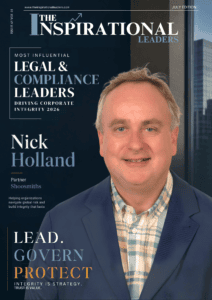
Nick Holland, Partner at Shoosmiths, has spent years helping organizations navigate exactly this complexity. His work sits at the intersection of global compliance, privacy, cybersecurity, AI governance, and corporate accountability, advising clients on how to approach risk in a way that is commercially realistic while remaining aligned with rapidly changing regulatory expectations.
What distinguishes his perspective is its practicality. In a field often dominated by rigid interpretations and theoretical frameworks, Holland focuses on what organizations can realistically operationalize. His approach recognizes that compliance cannot exist separately from culture, leadership, or business strategy. It must function within the realities of how organizations operate, scale, and make decisions.
That philosophy has become increasingly relevant as companies face mounting pressure to manage emerging technologies, supply chain accountability, and board-level scrutiny in ways that are both globally informed and operationally sustainable.
Corporate Integrity as a Cultural Framework
For Nick Holland, corporate integrity begins long before policies, audits, or enforcement mechanisms enter the picture. At its core, he views integrity as a cultural commitment embedded within the organization itself.
“I would define corporate integrity as the means by which organisations embed within their culture the need to comply with local laws in the countries in which they operate and put in place a governance structure to maintain compliance.”
This perspective shifts integrity away from being a reactive legal exercise and places it firmly within leadership and organizational behavior. Compliance, in his view, cannot succeed if it exists only within legal departments or isolated governance teams. It must be reflected across the organization through decision-making processes, accountability structures, training, and leadership communication.
The responsibility for establishing that culture, he believes, sits squarely with the C-Suite and the Board. Without leadership sponsorship, compliance efforts often become fragmented, inconsistent, or performative. Policies may exist on paper, but they fail to influence day-to-day behavior.
“This can only be led from the C-Suite,” he explains, emphasizing that leadership must actively communicate and reinforce the organization’s focus on integrity and accountability.
This emphasis on tone from the top has become increasingly important as organizations face greater scrutiny from regulators, customers, investors, and employees alike. Corporate integrity is no longer judged solely by whether an organization technically complies with the law. It is increasingly measured by whether the organization demonstrates genuine commitment to ethical and responsible practices across its operations.
A Regulatory Landscape Defined by Convergence
One of the most significant shifts shaping legal and compliance functions today is the convergence of regulatory frameworks across different domains. Artificial intelligence regulation, data privacy, cybersecurity obligations, ESG reporting, and governance requirements are no longer developing independently. Instead, they increasingly overlap, creating a far more interconnected compliance environment.
Holland identifies AI governance as one of the defining challenges of this era. While organizations are rapidly adopting AI technologies to improve efficiency and competitiveness, the regulatory structures governing these technologies remain relatively nascent and fragmented.
“AI regulation and governance” has become a major focus, he notes, but many organizations are still struggling with how to resource, monitor, and comply with emerging laws in this area.
The challenge is compounded by the fact that regulations continue to differ significantly across jurisdictions. Privacy, data governance, and AI frameworks may share similar objectives globally, but enforcement mechanisms and legal expectations remain highly regionalized. This creates operational difficulties for organizations operating internationally, particularly those attempting to implement unified compliance structures across multiple countries.
At the same time, compliance itself is becoming increasingly continuous and data-driven. Organizations can no longer rely on periodic reviews or static governance models. Laws evolve too quickly, and regulatory expectations are expanding too frequently.
“It is crucial to have in place a structure to monitor new laws as they are ever increasing,” Holland explains, highlighting the growing importance of systems capable of tracking and adapting to regulatory change in real time.
This shift has elevated compliance from a supporting legal function into a strategic business capability. Boards are increasingly appointing senior compliance leaders, recognizing that governance and risk management now influence operational resilience, market trust, and long-term business performance.
Balancing Compliance with Commercial Reality
One of the more practical aspects of Holland’s philosophy is his recognition that compliance must remain achievable if it is to be effective. Organizations frequently attempt to create governance frameworks that aspire to complete compliance across every jurisdiction and regulatory category. In practice, however, these frameworks often become unsustainable.
“It is impossible to be 100% compliant,” he says candidly. “Better to be 80% and achieve that rather than 100% but failing horribly in getting close to that.”
This perspective reflects a broader principle that runs throughout his advisory work: compliance structures must align with operational reality. Many organizations accumulate extensive policies and procedures that are technically comprehensive but rarely followed consistently. When governance frameworks become disconnected from how businesses actually function, they create additional risk rather than reducing it.
Holland instead encourages organizations to focus on core principles and practical policies that align with their culture and commercial objectives. Governance structures should be maintainable, scalable, and capable of functioning globally without becoming overly burdensome.
Of equal importance is organizational consistency. “Practice what they preach” is a phrase that strongly defines his approach. Companies cannot credibly promote integrity externally while failing to operationalize it internally. Sustainable compliance requires alignment between policy, culture, and behavior.
Managing Complexity in a Global Compliance Environment
The sheer volume of global regulations remains one of the greatest challenges facing organizations today. Privacy laws, cybersecurity obligations, AI governance frameworks, and cross-border transfer requirements continue to expand across jurisdictions, creating an environment where many businesses struggle simply to identify what applies to them.
“The old saying ‘you don’t know what you don’t know’ is very apt for organisations trying to comply globally,” Holland observes.
His response to this challenge is rooted in prioritization and risk management. Rather than attempting to solve every issue simultaneously, organizations must first understand their own culture, operational footprint, and risk appetite. From there, they can identify the areas where compliance is most critical and focus resources accordingly.
This is where external expertise becomes particularly valuable. Holland serves as an external Global Data Protection Officer for several clients, helping organizations stay ahead of privacy, cybersecurity, and AI regulations while building governance structures capable of adapting to future developments.
Another recurring issue he identifies is the failure to maintain compliance processes after initial implementation. Many organizations address a single regulatory challenge, resolve the immediate concern, and then fail to establish systems for ongoing oversight. In a constantly changing legal environment, that approach quickly becomes outdated. Governance, in his view, must be continuous rather than reactive.
The Growing Challenge of AI Governance
Artificial intelligence represents one of the most transformative and complex developments facing legal and compliance professionals today. Organizations are integrating AI into operations at an extraordinary pace, often without fully understanding how these systems are being used, who is using them, or what risks they create.
“Understanding AI and how it is being used, by whom, what are the risks and the nascent laws is a real issue for most organisations.”
This uncertainty creates both operational and legal challenges. Companies must now manage issues ranging from data usage and algorithmic bias to transparency obligations and intellectual property concerns, all while navigating regulations that remain under active development.
To address this, Holland emphasizes the importance of establishing leadership structures capable of overseeing AI usage effectively. Awareness is the first step. Organizations need visibility into the AI tools operating across their environments before meaningful governance can occur.
At Shoosmiths, this challenge is addressed in part through AI Comply, a global AI governance tool designed to help organizations understand how AI is being used while streamlining governance and mitigating risk. The objective is not simply regulatory compliance, but creating structures that allow organizations to adopt AI responsibly without undermining operational efficiency.
Technology as Both Solution and Risk
Technology itself is transforming the legal profession and the broader compliance ecosystem. Legal teams now rely on a growing range of digital tools for privacy management, anti-money laundering processes, fraud prevention, training, and compliance monitoring.
According to Holland, these tools are reshaping how risk is identified and managed across organizations. Automation and digital platforms improve efficiency, increase visibility, and allow compliance functions to operate at greater scale. However, he remains cautious about overreliance on technology.
“The key issue is always going to be to ensure legal professionals are not overly reliant on technology and that there is a human input into managing risk and compliance.”
This balance between technological capability and human judgment has become increasingly important in a world where AI systems can process information rapidly but still lack contextual understanding, ethical reasoning, and strategic nuance. Technology may strengthen compliance operations, but leadership and accountability remain fundamentally human responsibilities.
Leadership and the Importance of Tone from the Top
Throughout Holland’s perspective on governance and compliance, one theme appears consistently: leadership determines culture.
Without executive sponsorship, he argues, creating sustainable ethics and accountability frameworks becomes almost impossible. Employees take cues from leadership behavior, priorities, and resource allocation. When compliance is visibly supported at board level, organizations are far more likely to embed it successfully across operations.
“There needs to be sponsorship from the Board which is communicated to all within the organisation.”
This is particularly evident in areas such as privacy and cybersecurity, where failures can quickly become public crises. Holland spends significant time advising executive teams on the importance of treating these issues proactively rather than reactively.
As he points out, every organization will eventually face incidents such as data breaches. The objective is not to assume these events can be avoided entirely, but to prepare effectively so organizations can respond responsibly and minimize impact. “It is about hoping for the best but preparing for the worst.”
A Defining Experience in Global Privacy Governance
One experience that significantly shaped Holland’s perspective involved a large technology outsourcing matter between two major US companies nearly twenty years ago. At the time, global privacy regulation remained relatively underdeveloped, particularly in the United States.
Despite the absence of mature regulatory structures, both organizations involved shared a commitment to handling data responsibly. Over the course of approximately a year, discussions with European privacy regulators led not only to a workable solution for the companies themselves, but also contributed to the development of what later became the Binding Corporate Rules process within the European Union.
For Holland, the experience reinforced a critical lesson: when organizations genuinely commit to compliance and governance, meaningful progress becomes possible even within uncertain regulatory environments.
“In short it takes two to tango in any deal and if both companies have the right culture of compliance anything is achievable.”
The Future of Legal Advisory in an ESG Driven World
As businesses place increasing emphasis on ESG and ethical operations, the role of legal advisors is evolving alongside them. Legal counsel is no longer confined to interpreting regulations or managing disputes. Advisors are increasingly expected to guide organizations on governance, ethics, supplier relationships, employee treatment, and accountability frameworks.
For Holland, this evolution also requires legal firms themselves to operate consistently with the principles they advocate externally. ESG and ethical governance cannot simply be advisory topics; they must be reflected within organizational practice.
The ability to audit and demonstrate compliance will also become increasingly important. Stakeholders now expect organizations to show measurable progress rather than relying solely on stated commitments.
Practical Advice for the Next Generation
For emerging legal professionals, Holland sees compliance and governance as one of the most dynamic and globally relevant areas of law today.
“It is a great area to be involved in as the law is constantly evolving, is global and you have to adapt and pivot depending on your client.”
His advice reflects the same philosophy that shapes his own work: maintain a global perspective, understand client culture, stay informed about evolving laws, and prioritize practical implementation over theoretical perfection. Most importantly, he emphasizes sustainability. Compliance advice must not only solve immediate issues but also remain manageable over time.
Building Integrity That Can Endure
Nick Holland’s approach to corporate integrity is ultimately defined by realism. In an environment where regulations evolve continuously and risks emerge faster than organizations can fully predict, perfection is rarely achievable. What matters instead is whether businesses create structures, cultures, and leadership frameworks capable of adapting responsibly over time.
That requires more than legal expertise. It requires practical judgment, commercial understanding, leadership alignment, and the ability to translate complexity into systems that organizations can genuinely sustain.
As global business becomes increasingly interconnected, the organizations that succeed will not necessarily be those with the largest compliance manuals or the most aggressive governance rhetoric. They will be the ones capable of embedding integrity into how they operate every day, across every jurisdiction, technology, and decision.
In that sense, corporate integrity is no longer simply about avoiding risk. It has become a defining measure of how organizations build trust, maintain resilience, and prepare for the future.