
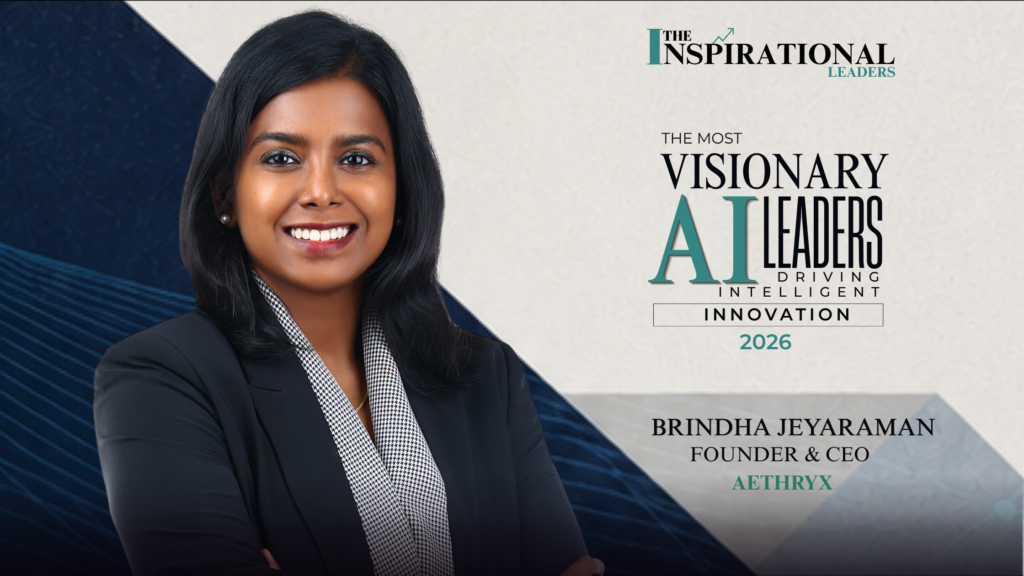
Artificial intelligence is moving far beyond experimentation. Enterprises are no longer exploring isolated use cases or testing proof of concepts; they are embedding intelligent systems into decisions that influence customers, operations, financial outcomes, and long term strategy. As AI becomes increasingly autonomous, however, one challenge has emerged above all others. The question is no longer how intelligent these systems can become, but how organisations can ensure they remain accountable, transparent, and worthy of trust once they begin operating at scale.
For Dr. Brindha Jeyaraman, Founder and CEO of Aethryx, solving that challenge has become both a professional mission and an entrepreneurial purpose. Over nearly two decades, she has built an exceptional career spanning artificial intelligence, data engineering, cloud platforms, enterprise architecture, and AI governance within highly regulated financial environments. Working across engineering, architecture, and governance gave her an unusually comprehensive perspective on enterprise AI. She learned that building intelligent systems was only one part of the equation. Ensuring those systems could be governed responsibly, aligned with business objectives, and trusted by both organisations and regulators was equally critical. That understanding continues to shape not only her leadership philosophy but also the vision behind Aethryx.
The inspiration to establish the company emerged from a recurring challenge she encountered throughout her career. As organisations accelerated their adoption of generative and agentic AI, governance practices remained largely dependent on manual reviews, fragmented documentation, and periodic compliance exercises. Those approaches were designed for traditional systems, not for AI agents capable of planning, interacting with external tools, exchanging information, and making decisions in real time. The gap between technological progress and governance readiness was becoming increasingly difficult to ignore. Rather than accepting it as an industry limitation, Dr. Brindha recognised it as an opportunity to build the missing operational layer that modern enterprises urgently needed.
Founded on that conviction, Aethryx is developing practical infrastructure that enables organisations to automate AI risk and compliance while governing intelligent agents throughout their execution. Its approach transforms responsible AI from a collection of policies into an operational capability embedded directly within enterprise workflows. By helping organisations strengthen oversight, automate governance, monitor agent behaviour, and generate continuous evidence of compliance, Aethryx empowers businesses to innovate with confidence instead of uncertainty. Under Dr. Brindha’s leadership, the company is contributing to a future where governance evolves alongside intelligence, enabling enterprises to scale AI responsibly rather than forcing them to choose between innovation and accountability.
Behind this vision lies a leadership philosophy shaped not by industry trends, but by years of practical experience across the full lifecycle of enterprise AI. Throughout her journey, Dr. Brindha repeatedly observed that lasting innovation depends on far more than sophisticated models or advanced technology. It requires disciplined engineering, clear governance, cross functional collaboration, and a deep understanding of how AI creates value within real organisations. Those principles continue to guide both her leadership and Aethryx’s growth, positioning the company at the forefront of one of artificial intelligence’s most important priorities: building the trust infrastructure that will enable intelligent innovation to flourish for years to come.
Where Technology Meets Accountability
Every stage of Dr. Brindha’s career added a new perspective to how artificial intelligence creates value inside large organisations. She has contributed to the design of production AI systems, built enterprise scale cloud and data platforms, and led AI governance initiatives within highly regulated financial institutions. Rather than seeing these as separate disciplines, she came to understand that they form different parts of the same ecosystem. A technically sophisticated model delivers limited business value if it cannot be deployed reliably, understood by decision makers, or governed consistently throughout its lifecycle.
Working across diverse transformation programmes also exposed her to the difference between successful innovation and innovation that struggles to scale. Some organisations invested heavily in advanced technologies yet found themselves constrained by fragmented governance, disconnected processes, or limited visibility into how AI systems were operating after deployment. Others achieved stronger outcomes because engineering, business strategy, risk management, and governance evolved together from the beginning. Those experiences reinforced an important belief that continues to shape her leadership today: sustainable innovation is built by integrating technology, people, processes, and accountability rather than treating them as independent priorities.
That understanding became even more significant as generative and agentic AI began transforming enterprise environments. Unlike earlier AI applications that primarily generated insights for human review, modern AI agents increasingly plan tasks, access enterprise systems, coordinate with other agents, and execute multi step activities with growing levels of autonomy. While these capabilities create enormous opportunities for productivity and business transformation, they also introduce new questions around permissions, oversight, security, explainability, and accountability. Dr. Brindha recognised that enterprises needed more than stronger AI models. They needed an entirely new operational approach to governing intelligent systems as they worked in real time.
It was this industry shift that inspired the evolution of Aethryx from an entrepreneurial vision into a purpose driven technology company. Rather than adding another governance framework or compliance checklist, Aethryx is focused on building the operational infrastructure that allows organisations to innovate responsibly without slowing progress. Its AI Governance Automation Platform enables enterprises to automate AI inventories, risk assessments, regulatory mappings, approvals, attestations, and audit evidence, helping governance become an integrated business capability instead of a manual administrative process. Complementing this is AssureTrust, the company’s runtime governance platform, which monitors AI agents during execution, evaluates changing risk, enforces permissions and policies, introduces human approval where required, and creates continuous evidence of how important AI driven decisions are made.
For Dr. Brindha, this represents a fundamental shift in how responsible AI should be approached. Governance should not exist as documentation created after technology has already been deployed. It should operate alongside intelligent systems, continuously adapting as those systems evolve. By embedding governance directly into enterprise operations, organisations gain the confidence to innovate faster while maintaining transparency, regulatory readiness, and meaningful human oversight. In her view, the organisations that lead the next generation of AI will not simply be those developing the most advanced technologies, but those capable of making intelligence both powerful and trustworthy.
Leading Beyond the Technology
Being recognised among The Most Visionary AI Leaders Driving Intelligent Innovation 2026 is not, in Dr. Brindha’s view, about predicting the next technological breakthrough. It is about understanding what must exist around artificial intelligence for it to create sustainable business value. Visionary leadership means looking beyond the capabilities of models and asking more fundamental questions: How will AI reshape decision making? Who remains accountable for its actions? How can organisations trust systems that are becoming increasingly autonomous? For her, answering those questions requires balancing ambition with execution, ensuring that innovation is always supported by governance, transparency, and measurable business outcomes.
This philosophy has been shaped by years of working across engineering, enterprise architecture, governance, and regulated financial services. Each role reinforced the importance of connecting disciplines rather than allowing them to operate independently. Engineers, business leaders, risk specialists, compliance teams, and executives often approach AI from different perspectives, yet meaningful transformation only occurs when those perspectives are aligned around a common objective. Dr. Brindha believes one of a leader’s most important responsibilities is creating that shared understanding, translating technical complexity into practical business decisions while ensuring that ethics and accountability remain part of every conversation rather than an afterthought.
The qualities that have guided her throughout this journey are equally practical. Curiosity enables continuous learning as technologies evolve. Resilience provides the discipline to navigate uncertainty, refine ideas, and adapt as evidence changes. Clarity allows complex technical concepts to be translated into business priorities that teams can confidently execute. Above all, she values intellectual honesty, recognising that responsible leadership requires challenging assumptions, distinguishing promising demonstrations from enterprise ready capabilities, and making decisions based on evidence rather than enthusiasm. In an industry evolving at extraordinary speed, she believes credibility is built not by claiming certainty, but by asking better questions and remaining willing to learn.
Building AI That Enterprises Can Trust
While artificial intelligence continues advancing at an extraordinary pace, Dr. Brindha believes the next phase of innovation will be defined less by larger models and more by smarter enterprise ecosystems. Agentic AI capable of planning, coordinating with other systems, accessing tools, and executing complex workflows will fundamentally reshape industries ranging from financial services and healthcare to manufacturing and supply chains. At the same time, organisations will increasingly deploy specialised and multimodal models across public clouds, private environments, and edge infrastructure, making interoperability, policy consistency, identity management, and observability essential capabilities rather than optional enhancements. Equally important is the emergence of AI assurance, where organisations continuously evaluate not only model performance but also agent behaviour, resilience, security, fairness, compliance, and operational reliability.
These industry shifts directly influence the work being carried out at Aethryx. Rather than treating governance as a manual compliance exercise performed after deployment, the company embeds governance throughout the AI lifecycle. Its AI Governance Automation Platform enables organisations to automate inventories, risk assessments, regulatory mappings, approvals, attestations, and audit evidence, while AssureTrust extends governance into runtime by monitoring agent behaviour, enforcing policies and permissions, triggering human approvals when required, and creating traceable evidence of critical decisions. This integrated approach allows organisations to innovate without sacrificing accountability, ensuring governance becomes an operational capability that supports business growth instead of restricting it.
For Dr. Brindha, the greatest challenge facing AI leaders today is not the pace of technological change itself, but the widening gap between experimentation and enterprise readiness. Disconnected data, fragmented accountability, evolving regulations, and increasing pressure to demonstrate business value often slow adoption more than the technology itself. She believes organisations that treat governance, continuous evaluation, and cross functional collaboration as strategic capabilities rather than administrative obligations will be best positioned to scale AI with confidence. In the years ahead, competitive advantage will belong not only to those building the most intelligent systems, but to those building systems that businesses, regulators, employees, and customers can consistently trust.
Preparing Organisations for an Intelligent Future
For Dr. Brindha, successfully integrating artificial intelligence has never been about introducing another technology platform. It begins with understanding the business problem that needs to be solved and defining the value AI is expected to create. Organisations that start with technology instead of business objectives often produce impressive demonstrations that struggle to deliver measurable impact. Sustainable adoption requires clarity around who benefits, how decisions will improve, what data supports those decisions, and how success will be measured over time.
She also believes organisations must rethink the way work itself is designed. AI should not simply be layered onto existing processes without reconsidering how people, technology, and decision making interact. Some activities can be automated with confidence, while others will always require human judgement, experience, and accountability. Creating that balance demands more than technical implementation. It requires meaningful human oversight, where decision makers have the authority, context, and visibility to intervene whenever necessary. At the same time, governance and engineering should progress together, ensuring every AI system has defined ownership, appropriate risk classification, continuous monitoring, and clear escalation pathways as it moves from experimentation into production.
Beyond implementation, Dr. Brindha believes organisations should embrace AI as an opportunity to strengthen institutional learning. Cross functional collaboration, carefully managed pilot programmes, continuous evaluation, and transparent post implementation reviews allow businesses to refine both technology and operating models before scaling them across the enterprise. In her experience, long term value is created not by automating existing work alone, but by redesigning how organisations make decisions, manage accountability, and continuously improve through evidence based learning.
A Legacy Built on Responsible Innovation
Looking ahead, Dr. Brindha envisions artificial intelligence becoming an increasingly capable collaborator across industries, supporting everything from operational workflows and customer engagement to strategic decision making. As AI agents become more autonomous, however, she believes autonomy must always be accompanied by equally strong mechanisms for identity, permissions, oversight, traceability, and governance. Intelligence without accountability will never earn lasting trust, making responsible execution one of the defining priorities for the future of enterprise AI.
That vision continues to guide the long term direction of Aethryx. The company is building governance infrastructure that enables organisations to automate AI risk and compliance, apply consistent controls across diverse models and cloud environments, govern intelligent agents throughout execution, and generate credible evidence of how important AI driven decisions are made. Rather than existing as policies reviewed once a year, governance becomes an active capability that travels alongside every AI system throughout its lifecycle, allowing innovation to scale confidently across industries and regulatory environments.
For aspiring AI professionals and entrepreneurs, Dr. Brindha’s advice reflects the same practical philosophy that has shaped her own journey. Technical expertise remains essential, but meaningful innovation demands far more than understanding algorithms. Future leaders must develop strong foundations across engineering, data, security, software architecture, and domain expertise while staying closely connected to the real world challenges organisations face. Entrepreneurs, meanwhile, should validate genuine customer problems before building products, remain disciplined about measurable outcomes rather than market hype, and build reputations grounded in integrity, resilience, and honest communication.
Ultimately, the legacy Dr. Brindha hopes to leave extends beyond technology itself. She wants to help transform responsible AI from an aspirational concept into an operational discipline embedded within organisations worldwide. She also hopes her journey encourages more women, technologists, and interdisciplinary leaders to shape the future of artificial intelligence. For her, In the years ahead, intelligence alone will not define the organisations that lead. Trust, accountability, and responsible execution will. Through Aethryx, Dr. Brindha Jeyaraman is helping ensure the future of AI is built on all three.