
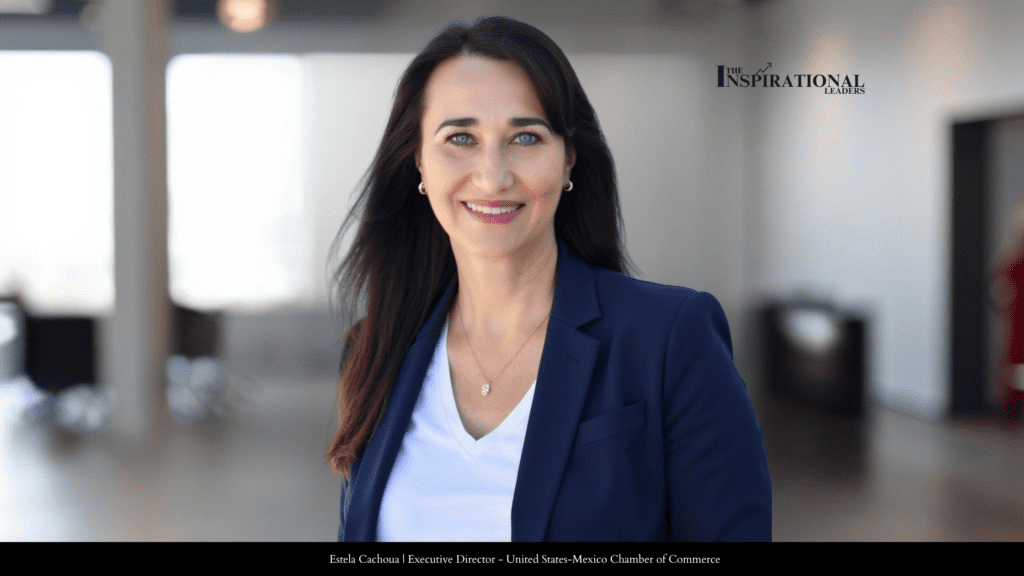
Estela Cachoua: Strengthening Cross Border Partnerships and Shaping the Future of Global Trade
Digital Version Global trade today depends not only on economic agreements and supply chain infrastructure but also on the leaders who understand how to connect institutions, markets, and people across borders. Among those leaders is Estela Cachoua, Executive Director of the United States–Mexico Chamber of Commerce, Inter-American Chapter. Through decades of experience in international banking and economic collaboration, she has developed a leadership approach rooted in trust, cultural understanding, and long term strategic thinking. Her career reflects a deep commitment to strengthening relationships between organizations, industries, and nations, particularly between the United States and Mexico. Her professional journey demonstrates how cross border experience can shape a broader vision for economic cooperation. Over the years, she has worked at the intersection of finance, trade, and international partnerships. These experiences have given her unique insight into the complexities of global markets and the importance of building strong professional networks that allow collaboration to thrive even in challenging environments. A Career Built on Global Financial Expertise Estela Cachoua began her professional career in Mexico within the banking sector. From the early stages of her career, she developed an interest in international finance and the relationships that drive economic activity between countries. Her work in banking allowed her to understand the operational and regulatory frameworks that shape financial institutions across different markets. A significant chapter of her career was her time at HSBC Bank, where she spent nearly two decades working with financial institutions across Latin America and the Caribbean. During these years she gained extensive exposure to the dynamics of global finance. The role required constant interaction with international partners, regulatory bodies, and financial leaders who were operating within different economic environments. Working with global institutions across multiple countries brought valuable lessons about how markets operate under varying regulatory frameworks and cultural expectations. Managing relationships with dozens of international financial institutions required careful communication, strategic thinking, and a strong understanding of economic trends that influence global markets. These experiences helped her recognize that international business is not only about financial transactions. It is equally about trust, credibility, and the ability to navigate cultural differences while maintaining professional alignment among diverse stakeholders. One of the defining aspects of her work during this period involved guiding institutional relationships during times of financial uncertainty. Global markets periodically experience volatility, and navigating those conditions requires both technical expertise and confidence in leadership. During moments of market instability, financial institutions depend on clear communication and disciplined decision making. These experiences strengthened her resilience and taught her the importance of maintaining transparency when organizations face uncertainty. The Transition from Banking to Economic Diplomacy After many years in international banking, Estela made a transition that expanded her professional perspective even further. She moved into a leadership role with the United States–Mexico Chamber of Commerce, Inter-American Chapter. The transition represented more than a change in industry. It also marked a shift from focusing primarily on financial institutions to working within an organization dedicated to economic diplomacy and cross border collaboration. The Chamber plays a vital role in bringing together business leaders, policymakers, entrepreneurs, and industry experts who share a common interest in strengthening economic ties between the United States and Mexico. In her role as Executive Director, she works to facilitate dialogue and cooperation among organizations that operate within complex global supply chains and international trade networks. The position allows her to draw upon her extensive background in finance while expanding her influence across multiple industries. Through conferences, trade forums, and collaborative events, she helps create opportunities for leaders to exchange ideas and develop partnerships that support economic growth. Her work reflects a broader vision of international cooperation. By connecting business leaders and institutions from both countries, she contributes to a network that encourages innovation, investment, and long term collaboration. The Power of Professional Networks Throughout her career, Estela has consistently emphasized the importance of building strong professional networks. In global business environments, success often depends on the ability to connect the right individuals and organizations at the right moment. Relationships form the foundation upon which partnerships and opportunities develop. She believes that networking goes far beyond exchanging business cards or attending events. True professional networks are built on trust, credibility, and mutual respect. Over time, these connections become valuable channels for collaboration and problem solving. A principle that she often shares with emerging professionals is that success in international business is influenced not only by who one knows but also by who recognizes and trusts one’s expertise. Reputation and reliability play essential roles in opening doors to new opportunities. Her own career reflects this philosophy. By maintaining strong relationships with financial institutions, corporate leaders, and policy experts across multiple countries, she has created a professional ecosystem that supports ongoing collaboration and economic dialogue. Leading Through Cultural Understanding Working between Mexico and the United States has provided Estela with a deep understanding of cultural dynamics in international business. Cross border collaboration requires more than technical expertise. It also requires sensitivity to how people communicate, negotiate, and build trust within different cultural environments. Business relationships often depend on interpersonal understanding as much as strategic planning. By recognizing cultural nuances and respecting diverse perspectives, leaders can create stronger partnerships that endure beyond individual projects or transactions. Her leadership approach begins with listening carefully to stakeholders and identifying their core objectives. Whether she is working with government representatives, corporate executives, or entrepreneurs, she focuses on understanding the priorities that drive their decisions. Once those priorities are clear, she works to develop strategies that align interests and encourage cooperation. This ability to bridge perspectives has helped her build long lasting relationships across industries and institutions. When individuals feel respected and understood, collaboration becomes more productive and sustainable. Leadership in a Complex Global Trade Environment Global supply chains and trade networks are evolving rapidly. Technological advancement, geopolitical developments, and economic shifts have created an environment where leaders must constantly adapt to new realities. In this context, Estela believes that modern leaders must cultivate several key capabilities. Strategic