
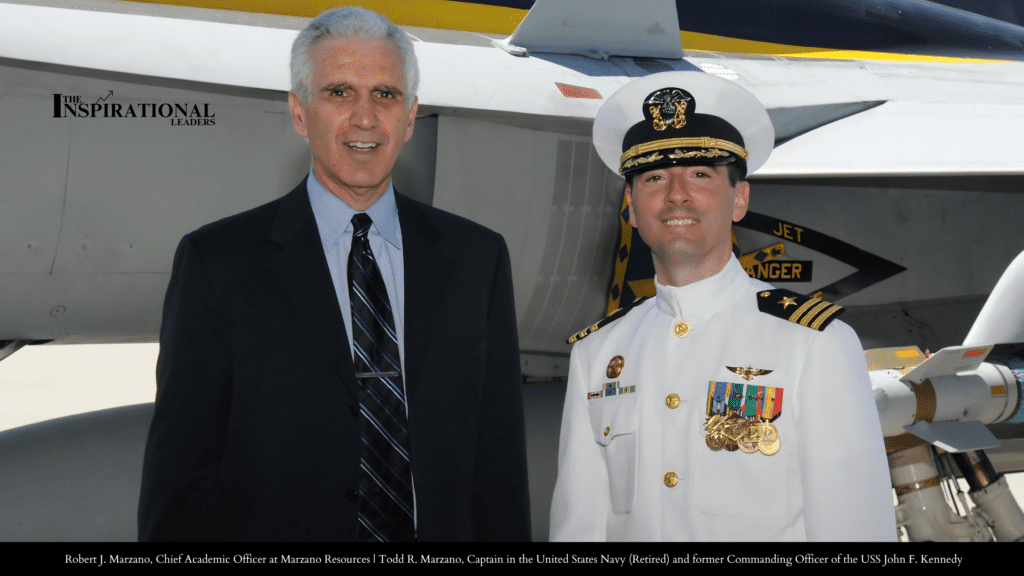
At a time when leadership is often defined by personality, perception, or positional authority, Robert J. Marzano, Chief Academic Officer at Marzano Resources, and Todd R. Marzano, Captain in the United States Navy (Retired) and former Commanding Officer of the USS John F. Kennedy, present a perspective that is both grounded and transformative.
Their work challenges one of the most deeply embedded assumptions in leadership thinking – that effectiveness is primarily a function of individual traits. In its place, they offer a model built on discipline, structure, and execution: Tactical Leadership.
This is not a theoretical construct shaped by abstraction. It is the result of nearly 90 years of combined experience across two environments where performance matters deeply – K–12 education and military operations. It is informed by observation, refined through practice, and designed to address a fundamental challenge:
How do you create systems that consistently produce results, regardless of who is leading them?
Two Distinct Paths, One Converging Realization
The foundation of Tactical Leadership lies in the convergence of two highly accomplished yet fundamentally different careers. Their journeys were different—but their conclusions were strikingly similar.
Robert J. Marzano has spent close to six decades in the field of education, shaping the way schools approach leadership, instruction, and system-wide improvement. His work has extended across all 50 states, where he has collaborated with educators and district leaders to translate research into actionable frameworks. Through his extensive body of work – including multiple books on school and district leadership – he has consistently focused on bridging the gap between theory and real-world application.
Todd R. Marzano’s journey, by contrast, was forged in one of the most demanding leadership environments in the world. Over a 30-year career in the United States Navy, he served as a naval aviator, executing more than 800 aircraft carrier landings – many in high-risk combat environments over Iraq and Afghanistan. These were not routine operations. They involved launching and landing high-performance F-18 fighter jets on moving aircraft carriers, often under challenging conditions, including night operations and adverse weather. They required precision, discipline, and absolute trust in both training and systems.
In the latter part of his career, Todd transitioned into large-scale command roles, serving aboard nuclear aircraft carriers and amphibious assault ships. He ultimately became the first Commanding Officer of the USS John F. Kennedy, one of the most advanced nuclear aircraft carriers ever constructed. Across these roles, leadership was not conceptual – it was operational. Decisions carried immediate consequences. Performance was non-negotiable. It was through observing Todd’s experiences that Robert began to ask deeper questions. Why was the military so effective at training individuals to perform extraordinarily complex tasks with consistency? Why did it succeed in environments where the margin for error was minimal? And in contrast, why did education – despite decades of evolving leadership theories – continue to struggle with persistent challenges such as inconsistent academic performance, chronic student apathy, and parent dissatisfaction? This contrast became the starting point for a new way of thinking.
Challenging the “Great Leader” Narrative
At the center of their work is a critical examination of the Great Man/Great Woman theory of leadership. Rooted in 19th-century thinking and strongly associated with historian Thomas Carlyle, this theory proposes that history is shaped by extraordinary individuals – leaders born with inherent traits such as intelligence, courage, and charisma. According to this perspective, leadership is largely innate rather than developed.
Over time, this idea has influenced leadership models across industries, including education. Even today, many frameworks emphasize traits, behaviors, or dispositions that define effective leaders. While compelling, this approach presents a fundamental limitation.
If leadership success depends on exceptional individuals, it becomes difficult to replicate or sustain. Organizations may achieve success under strong leaders, but those outcomes often diminish when those individuals leave.
In education, this pattern is particularly evident. Many schools that achieve exceptional results do so because of highly dedicated leaders whose personal commitment drives performance. However, these successes are often difficult to sustain over time or replicate in other contexts. Robert and Todd Marzano argue that this reliance on individuals is inherently unstable. Instead, they propose a shift toward process-driven leadership, where success is built on systems that consistently produce results – regardless of who is in charge.
Process Over Person: A Foundational Shift
One of the most significant distinctions between military and educational leadership lies in how success is structured. In the military, leadership is defined by processes, protocols, and systems. Training is standardized, execution is structured, and outcomes are continuously monitored. Leaders operate within clearly defined frameworks that guide decision-making and ensure consistency.
This does not diminish the importance of individual capability. Rather, it ensures that performance does not depend solely on it. In contrast, education has often relied on conceptual leadership models – frameworks that describe what leaders should be, but not always how they should operate in practice. Tactical Leadership addresses this gap by emphasizing repeatable processes. It shifts leadership from being personality-driven to execution-driven, ensuring that outcomes are consistent, measurable, and scalable.
High Reliability: Learning from Zero-Failure Systems
A central pillar of Tactical Leadership is the concept of high reliability organizations (HROs). These are organizations that operate in environments where failure carries significant consequences – such as military combat operations, air traffic control systems, nuclear power plants, transportation networks, and commercial aviation.
What distinguishes these organizations is not the absence of errors, but their ability to:
Anticipate potential failures
Detect issues early
Respond quickly and effectively
Contain the impact of errors
In these systems, reliability is engineered through structured processes and continuous monitoring. Robert and Todd observed that while such rigor is standard in high-stakes industries, it is often absent in education. Tactical Leadership introduces this mindset into educational systems.
For example, when evaluating a school’s effectiveness in implementing collaborative teacher teams, performance is not assessed subjectively. Instead, it is measured across defined levels – from Not Attempting to Sustaining – with each level representing specific actions, evidence, and outcomes. This structured approach ensures clarity, accountability, and continuous improvement.
Short Command Tenure: Strength of Systems Over Individuals
Another key insight comes from the military’s approach to leadership tenure. Commanding officers typically serve in their roles for only two to three years. This is not a limitation – it is a design. This practice ensures that leadership effectiveness is not tied to individuals, but to the systems they operate within. It also promotes broader experience, adaptability, and prevents over-reliance on any single leader.
In education, however, leadership continuity is often pursued through long tenures. Successful leaders are retained as long as possible, with the expectation that their presence will sustain performance. While this can provide stability, it may also indicate dependence on individuals rather than systems. Tactical Leadership challenges this notion, emphasizing that true organizational strength lies in processes that endure beyond individual leadership.
Personal Responsibility: The Core of Leadership Execution
Despite its structured systems, military leadership places a profound emphasis on personal responsibility. Leaders are trained to adopt a mindset where outcomes – success or failure – are directly tied to their decisions. This principle is reinforced through a culture that values ownership, accountability, and continuous improvement.
A key tool in this process is the After Action Review (AAR). Conducted after every mission, the AAR is a structured reflection built around four critical questions:
What was supposed to happen?
What actually happened?
Why did it happen?
What will we do differently next time?
This process ensures that every experience becomes a learning opportunity. It creates a disciplined approach to improvement, where reflection is systematic rather than incidental. In education, adopting this level of accountability represents a significant shift – one that moves leadership from reactive problem-solving to intentional performance refinement.
The Pillars of Tactical Leadership
At its core, Tactical Leadership is built upon three foundational pillars, each designed to reinforce a culture of excellence and continuous growth.
1. Personal Responsibility and Growth
Leadership begins with self-awareness. The ability to reflect, adapt, and improve is not optional – it is essential. Tactical Leadership emphasizes the importance of leaders who not only set expectations but also model them.
By fostering a culture where individuals take ownership of their actions and commit to continuous improvement, organizations create environments where accountability is the norm, not the exception.
2. High Reliability Mentality
Consistency is the cornerstone of effective systems.
A high reliability mindset ensures that leaders are not operating on assumptions but on data-driven insights. By continuously monitoring performance and aligning actions with clearly defined outcomes, organizations can maintain focus and direction. This approach transforms leadership from reactive to proactive, enabling institutions to stay ahead of challenges rather than simply responding to them.
3. Mission Thinking
Perhaps the most distinctive element of Tactical Leadership is its emphasis on mission-oriented execution. In the military, every objective is approached as a mission – clearly defined, meticulously planned, and rigorously executed. This structure provides clarity, alignment, and accountability at every stage. Translating this into education involves defining:
Purpose: Why the mission matters
End State: What success looks like
Theory of Action: How success will be achieved
Monitoring Protocols: How progress will be tracked
After Action Review: How outcomes will be evaluated
This framework ensures that goals are not abstract aspirations but actionable plans with measurable outcomes.
A Vision for the Future
Looking ahead, Robert and Todd Marzano envision a future where leadership in education is no longer defined by individual brilliance but by collective effectiveness. Their legacy is not tied to a single institution or achievement. Instead, it lies in reshaping how leadership is understood and practiced – creating systems that empower educators, inspire students, and deliver consistent results.
They advocate for a shift toward intentional leadership development, where individuals are equipped with the tools, processes, and mindset needed to navigate complexity with confidence. In this future, schools are not just places of learning but ecosystems of growth – where leaders at every level are prepared to think critically, act decisively, and continuously improve.
Beyond Theory: A Lasting Impact
What sets Tactical Leadership apart is its practicality.
It does not rely on abstract ideals or fleeting trends. Instead, it offers a structured, evidence-based approach that can be implemented, measured, and refined over time. For educators and leaders seeking to make a lasting impact, this model provides a roadmap – one that prioritizes clarity over complexity, discipline over distraction, and purpose over perception.
A Legacy Built on Purpose
At its essence, the work of Robert and Todd Marzano is about more than leadership. It is about legacy. A legacy defined not by titles or accolades, but by the systems they leave behind – systems that continue to function, evolve, and succeed long after individual leaders have moved on.Through Tactical Leadership, they redefine what truly sustains impact—moving beyond individual brilliance to enduring systems. Because leadership is not measured by who leads, but by what continues to succeed in their absence.