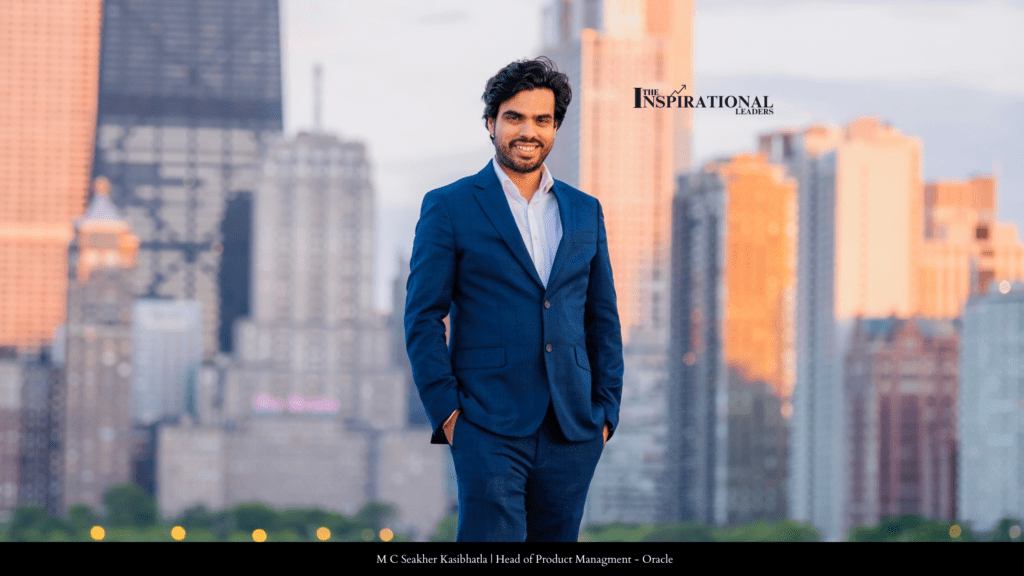
From Simulation to Scale: How M C Seakher Kasibhatla Is Building Products Where Reality Leads Innovation
Digital Version (A leadership journey shaped across 30+ countries, five industries, and the unforgiving moments where technology meets human reality.) There is a version of product management that exists in controlled environments – where variables are defined, systems behave predictably, and outcomes can be modeled with confidence. It is a version that rewards precision, structure, and clarity. But it is not where the most meaningful products are built. For M C Seakher Kasibhatla, Director of Product Management at Oracle, that realization did not come from theory – it came from experience. Over the course of a career that has spanned 30+ countries, five industries, and some of the most demanding operational environments, his journey has been shaped not by ideal conditions, but by moments where systems were tested against reality – and often found wanting. What follows is not just a progression of roles or achievements, but a deeper evolution in how products are understood, built, and scaled. From early days in simulation engineering to leading large-scale payment infrastructure at global scale, Seakher’s work reflects a consistent principle: technology only matters when it works for the people who rely on it in real conditions. There is a version of product management that exists in controlled environments – where variables are defined, systems behave predictably, and outcomes can be modeled with confidence. It is a version that rewards precision, structure, and clarity. But it is not where the most meaningful products are built. Those are shaped elsewhere – where systems meet unpredictability, where human behavior overrides assumptions, and where reality has a way of exposing every hidden flaw. For a leader whose career began as a simulation engineer at Ansys, this distinction became clear early, though not immediately. Simulation offered a world of control: define the inputs, run the model, and trust the output. It was elegant in its logic and satisfying in its predictability. But it also operated within boundaries – conditions that rarely mirrored the complexity of real-world environments. What simulation couldn’t teach was how to operate when those variables refused to cooperate. The shift began with exposure to a different way of thinking. Working alongside Steve Pilz, a product manager at Ansys, revealed a fundamentally different approach to problem-solving. Where simulation emphasized certainty, Pilz operated comfortably in ambiguity. He made decisions without complete information, navigated trade-offs in real time, and focused less on being correct and more on being useful to the end user. That distinction changed everything. It reframed product management from a discipline of control to one of adaptation – less about predicting outcomes and more about responding to reality as it unfolds. That curiosity – to understand how systems behave outside controlled environments – became the thread that carried forward into the next phase of the journey. From Theory to Tarmac: Where Real Systems Get Tested That transition took shape at gategroup, under the leadership of Rodney Duty, who led the Innovation and New Product Development group with a philosophy that extended beyond incremental improvement. It was an environment that encouraged exploration at the edges – where technology could be applied in ways that were not yet obvious, including early experimentation with Alexa-powered voice interfaces for warehouse operations. But the most defining lessons didn’t come from innovation labs. They came from exposure – direct, unfiltered, and often uncomfortable – to the environments where these systems actually lived. Spending a full day traveling nearly 18,000 miles without leaving airside, moving through airports across time zones, revealed a fundamental truth: the same system behaves differently depending on context. Infrastructure, operational culture, and human behavior reshape technology in ways that cannot be replicated in controlled testing environments. That insight was reinforced in moments that were far less observational and far more direct. In Germany, during a meeting with union representatives, the feedback was immediate and unfiltered: the product did not work for them. Not in theory, not in intention – but in practice. And later, during live deployments with easyJet crew, where the margin for error didn’t exist – 45 minutes to serve 180 passengers, in a high-pressure environment where even minor friction could cascade into operational failure. These weren’t isolated incidents. They were reality asserting itself. And from those experiences emerged not a framework, but a reflex: get close to the user before anything else. Because the gap between what a product is designed to do and what it actually does – under pressure, in imperfect conditions – is where most systems fail. The Breaking Point: When “Correct” Stops Being Enough The most defining shift came during the first live deployment with easyJet. On paper, the system was flawless. It met every requirement, passed every test, and performed exactly as designed within controlled conditions. It was, by all technical standards, correct. But an aircraft cabin is not a controlled environment. It is a confined, high-pressure space at 35,000 feet, filled with variables no system design fully anticipates – passenger devices creating wireless interference, constant movement, time constraints, and the cognitive load placed on crew members managing service in real time. The system required crew devices to maintain Bluetooth connections to payment terminals while synchronizing inventory continuously. In theory, it worked seamlessly. In reality, connections dropped. Inventory mismatches led to overselling. Crew members, under pressure to complete service, began bypassing the system entirely – relying on memory, improvisation, and speed. They weren’t failing the system. The system was failing them. That moment crystallized a principle that would shape every decision moving forward: “Correctness is a threshold. Usefulness is the actual goal.” A product that works in isolation but breaks under real conditions is not successful. True success lies in enabling the user to perform better – faster, more efficiently, and with less friction – regardless of environment. Designing for Reality: When Assumptions Break Down At gategroup, the challenge wasn’t just technological – it was contextual. The primary users were not customers, but airline crew, operating within tightly constrained service windows, where every additional interaction with a system