
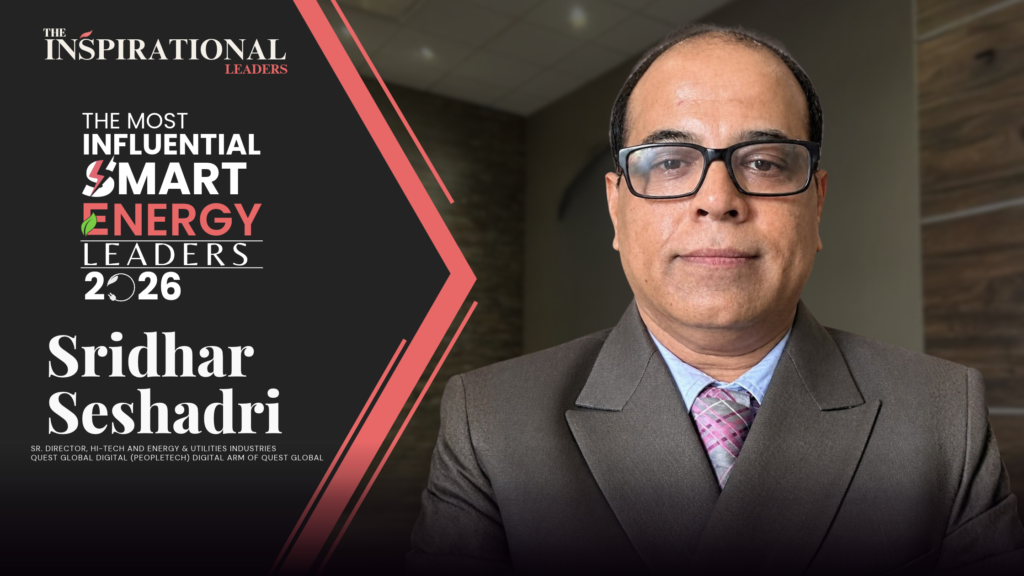

The transformation of the energy sector is no longer defined simply by the introduction of new technologies. It is increasingly about how effectively technology, engineering expertise, regulatory knowledge, data, and human judgment can work together to create energy systems that are more intelligent, resilient, efficient, and responsive. As electricity demand continues to evolve and utilities manage increasingly complex networks, the ability to understand the entire energy ecosystem has become essential.
For Sridhar Seshadri, this perspective has been shaped by three decades of experience across the energy and utilities industry, technology, consulting, and digital transformation. His work has involved a broad range of technology platforms supporting geospatial utility networks, outage management, meter data management, engineering, design, and operational decision making. This extensive exposure has given him a practical understanding of how digital technologies can connect different parts of the energy value chain and help utilities address both longstanding infrastructure challenges and emerging demands.
As Sr. Director, Hi Tech and Energy & Utilities Industries at Quest Global Digital, Peopletech, the digital arm of Quest Global, Seshadri brings together industry knowledge and technology thinking to explore how intelligent digital systems can support the next generation of energy infrastructure. His perspective places particular importance on understanding the grid from every angle, building secure and sovereign artificial intelligence environments, improving access to real time data, and ensuring that technology remains guided by human expertise.
His vision of smart energy extends beyond automation. It is about creating an ecosystem where data can be accessed quickly, assets can be understood before they fail, distributed energy resources can contribute to grid flexibility, and artificial intelligence can assist professionals without replacing human judgment.
Three Decades of Learning From the Energy Ecosystem
Over the course of his 30 year journey within the energy and utilities industry, Seshadri has worked with a wide range of technology products and platforms. His experience includes technologies from ESRI, Microsoft, Autodesk, Bentley, Hexagon, including InterGraph, as well as various geospatial utility network management and outage management solutions.
His work has also included meter data management platforms from organizations such as Itron and Landis + Gyr. Across these different technologies, one consistent theme has emerged: digital transformation delivers greater value when individual technologies are connected into a broader operational ecosystem.
One example from his experience is the development of a cost effective, open architecture geospatial portal application for a Nevada power organization. The solution brought together SAFE FME and Angular JS with Synergi load flow analysis, AutoCAD MAP 3D, and Microsoft Office products. Rather than viewing each technology as an isolated system, this approach demonstrated how multiple platforms could work together to create a more connected digital environment.
For Seshadri, this type of integration is fundamental to the evolution of smart energy. Utilities operate complex networks in which engineering information, geographic information, operational data, asset information, and customer requirements must intersect. Digital platforms can create value when they help organizations bring these different sources together and make them useful for decision making.
Understanding the Grid From 360 Degrees
The movement toward intelligent energy networks requires more than simply adding technologies to existing infrastructure. According to Seshadri, understanding the grid from 360 degrees is critical.
That understanding includes technology, engineering, compliance, regulatory requirements, operational processes, and the standards that govern utility infrastructure. He points to standards and frameworks associated with IEC, IEEE, NERC, FERC, CIP, ITU, ANSI, and ISA 95 as important considerations in building intelligent grid environments.
As more of the grid becomes digital, utilities gain greater opportunities to understand the condition and performance of substations, transformers, transmission feeders, and other assets. Digital substations, remote terminal unit connectivity, transmission feeder monitoring, and distribution management can all contribute to a more informed operational environment when they are implemented within appropriate technical and regulatory frameworks.
This broader understanding is important because smart energy cannot be separated from reliability and compliance. Technology must operate within the requirements of the industry while providing meaningful operational value. For Seshadri, the intelligent grid therefore represents a combination of digital capability, engineering understanding, regulatory awareness, and responsible implementation.
Where Artificial Intelligence Can Create Measurable Value
Artificial intelligence is becoming an increasingly important part of the energy conversation, but Seshadri sees its greatest value in practical applications that address specific operational challenges.
One area is the management of regulatory and compliance documentation. AI could help utilities automate aspects of keeping documents aligned with evolving requirements and information associated with organizations and standards such as NERC, FERC, the Department of Energy, NIST, IEC, IEEE, and ITU.
Beyond documentation, Seshadri identifies several areas where AI can provide measurable operational value. These include procedural driven offline AI that can assist utility workers when internet connectivity is unavailable, meter data management, workforce support, aging asset management, employee upskilling, digital twins, outage and incident management, renewable energy management, battery and charging systems, and environmental, sustainability, and government programs.
Digital twins can become particularly useful for understanding the condition of grid assets and supporting planning and design activities. Their integration with tools such as AutoCAD and other design platforms can help connect asset information with engineering workflows.
However, Seshadri emphasizes an important principle. AI should not be treated as an unquestionable authority. Human intervention remains essential. Utilities operate critical infrastructure, and decisions affecting reliability and public services require professional judgment.
He also highlights the importance of sovereign and secure AI architecture. In his view, AI can achieve greater value when it is implemented locally within a utility environment while protecting sensitive operational information and avoiding unnecessary exposure of utility networks to external public systems.
The Real Meaning of Real Time Data
For an intelligent energy system, data is valuable only when it can be accessed quickly enough to support the decision being made.
Seshadri challenges the idea that data received after a significant delay should automatically be considered real time. In transmission and meter applications, even a delay of several minutes can affect whether information is truly useful for immediate operational decisions.
Dynamic Line Rating is one example where timely data can make a meaningful difference. Utilities are exploring technologies that can improve the speed and availability of information from sensors and transmission infrastructure. Seshadri points to developments involving satellite enabled connectivity, Long Range Wide Area Network technologies, and industrial wireless connectivity as examples of approaches being explored to address this challenge.
Traditional processes can require sensor information to be collected, stored, downloaded, converted into files, uploaded to the cloud, and then transformed into another structured format. Such processes can create significant effort while still leaving utilities without genuinely immediate visibility into the health of a transmission line.
The objective, therefore, is not simply to collect more data. It is to shorten the distance between the physical asset, the information it generates, the analytical system interpreting that information, and the person responsible for acting on it.
Preparing for Distributed Energy and Commercial Electrification
The energy ecosystem is becoming more distributed as commercial and industrial organizations invest heavily in renewable energy, virtual power plants, and microgrids.
For these customers, capital expenditure and operating expenditure remain critical considerations. Reliability and affordability must be evaluated alongside sustainability and energy independence.
Seshadri sees AI as having an important role in helping commercial and industrial customers understand the potential return on investments in renewable energy systems. By considering consumption, pricing, usage, and the potential for electricity to be supplied back to the grid, intelligent models could help organizations understand how investments may be recovered over time.
Virtual power plants and microgrids can also complement both regulated and deregulated utilities by creating additional electricity resources that can support demand and response requirements. As these systems scale, battery management and charging management will become increasingly important areas for digital innovation.
The future energy system will therefore involve a more active relationship between utilities, businesses, distributed resources, and customers.
Moving From Reactive Maintenance to Intelligent Asset Management
Aging infrastructure is one of the persistent challenges facing utilities, and Seshadri adds another related concern: the aging workforce.
Artificial intelligence, Internet of Things technologies, predictive analytics, automation, and digital twins can contribute to a shift from reactive maintenance toward proactive asset management.
Instead of waiting for an asset to fail, intelligent systems can evaluate available information and identify indicators of potential failure. Utilities could develop health scores for assets and use these insights to prioritize maintenance and replacement activities.
Seshadri also sees opportunities for AI to support supply chain automation. If an asset such as a capacitor, transformer, or bus bar reaches a condition requiring replacement, an intelligent system could potentially recognize the need and initiate the relevant procurement process.
This approach connects asset intelligence with operational action. The goal is not simply to predict failure, but to create a chain of decisions that helps organizations respond before a failure becomes a larger reliability issue.
Planning for the Growing Energy Demand of AI
The expansion of artificial intelligence and data centers is introducing another significant consideration for the energy sector. High performance computing requires substantial electricity, creating new questions around capacity planning, infrastructure development, and efficient use of available resources.
Seshadri points to Distributed Resources Planning teams as an important part of this landscape. AI can support location need analysis, capacity planning, and grid need assessments by helping organizations understand where additional resources are required and where non wired initiatives may provide alternatives.
Interconnections, net metering, solar energy, and other distributed resources can contribute to addressing shortages associated with traditional generation. Intelligent planning can help utilities evaluate these resources in relation to actual grid requirements rather than treating them as isolated technologies.
As electricity demand grows, the ability to map demand, infrastructure, generation, and distributed resources together will become increasingly important.
Leadership That Connects Engineering, Technology, and Regulation
Smart energy transformation requires more than technical expertise. It requires leaders who understand how engineering, digital technologies, regulation, utilities, independent system operators, and customers interact.
Seshadri believes deep industry knowledge is essential. Leaders need to understand factors such as substation capacity, voltage, current management, and load management. They also need awareness of organizations such as NYISO and CAISO and an understanding of the regulatory environment within which utilities operate.
Compliance documentation, technology requirements, demand and response, pricing, and information systems all form part of the broader energy picture.
This perspective highlights an important characteristic of effective leadership in the smart energy sector: the ability to connect different disciplines rather than treating them independently. Technology decisions must make sense from an engineering perspective. Engineering solutions must operate within regulatory requirements. Investments must support reliability and affordability. And digital systems must ultimately help people make better decisions.
Looking Toward 2030 and Beyond
Seshadri’s vision for the energy ecosystem beyond 2030 is shaped by the continued growth of electricity demand, renewable energy, electric mobility, distributed generation, and new forms of digital infrastructure.
The replacement of conventional gas powered vehicles with electric vehicles is already changing energy consumption patterns. At the same time, virtual power plants and microgrids could become increasingly important for remote villages and populations located in regions where traditional energy infrastructure may be difficult to develop.
He also expects continued research and experimentation across renewable energy and other forms of electricity generation. As data centers and technology companies continue to create additional electricity demand, he anticipates continued attention toward nuclear and gas based generation alongside renewable resources.
Ultimately, the smart energy future will not be defined by a single technology. It will emerge through the combination of intelligent data, secure artificial intelligence, connected assets, distributed resources, engineering expertise, regulatory understanding, and human decision making.
Conclusion
The transition toward smart energy is fundamentally a transformation in how the energy ecosystem understands itself. Digital technologies can provide unprecedented visibility into assets, networks, demand, and operational conditions, but their value depends on how effectively organizations connect that information to meaningful action.
Sridhar Seshadri’s perspective reflects the importance of approaching this transformation from the ground up. His experience across energy and utilities, technology platforms, geospatial systems, meter data, engineering applications, and digital solutions has shaped a view of smart energy that is practical as well as forward looking.
For him, the intelligent grid is not simply a collection of advanced technologies. It is an interconnected environment where reliable data, appropriate standards, secure digital architecture, artificial intelligence, engineering knowledge, and human judgment work together.
As utilities face aging infrastructure, changing workforce dynamics, growing electrification, distributed energy resources, renewable generation, and rising demand from data intensive technologies, that integrated approach will become increasingly important.
The energy leaders shaping the next decade will therefore need to look beyond individual technologies and understand the entire system. They will need to know where data originates, how quickly it can be accessed, how securely it can be managed, how intelligently it can be interpreted, and how effectively people can use it to make decisions.
For Seshadri, this is where the real opportunity lies: using digital intelligence not simply to make energy systems more automated, but to make them more informed, resilient, responsive, and capable of meeting the evolving needs of the communities and industries they serve.