
Companies have never had more data at their fingertips, yet many leaders still hesitate before acting on it. Reports arrive instantly, dashboards update in real time, and artificial intelligence promises faster decisions than ever before. Even so, one question continues to determine whether any of it creates value: can the business know whether the information behind every decision is accurate and complete?
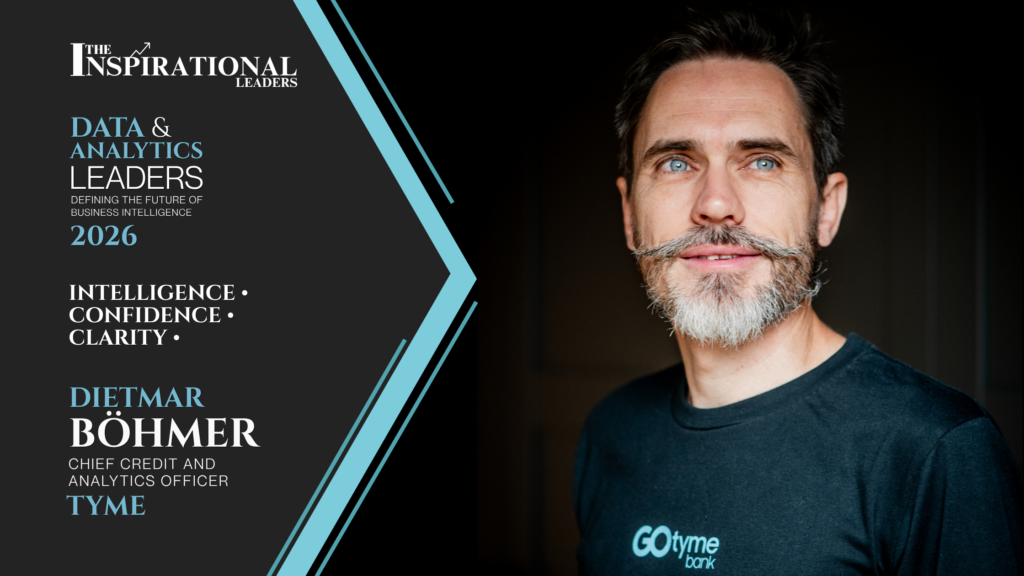
For Dietmar Böhmer, Chief Credit and Analytics Officer at Tyme, that distinction has defined much of his professional journey. Throughout his career, he has worked where business strategy, credit risk, enterprise data, and analytics intersect, helping organisations transform information into something far more valuable than reports or dashboards: decision-ready intelligence. In his view, technology only becomes meaningful when the people using it can understand, assess, and act on the information behind it.
That perspective has become increasingly relevant as artificial intelligence reshapes the financial services landscape. From his perspective, sustainable transformation rarely begins with algorithms. It begins with disciplined data management, clear governance, and a deep understanding of the business decisions technology is expected to support. Without those fundamentals, even the most sophisticated AI models risk producing outcomes that are technically impressive but commercially unreliable.
This philosophy is reflected in the way he leads analytics at Tyme. Rather than treating analytics as a purely technical function, he focuses on creating an environment where talented teams are empowered to question assumptions, experiment responsibly, and solve meaningful business problems. For him, innovation is not driven by data alone but by giving people the right tools, clear priorities, and the business context needed to make informed decisions. His approach ensures that technology remains focused on measurable business value rather than becoming an objective in itself.
Where Curiosity Became a Career
Dietmar’s interest in data did not begin with artificial intelligence or enterprise technology. Long before those became defining conversations across the business world, he was fascinated by a much simpler question: why do organisations with access to vast amounts of information still struggle to make confident decisions?
The answer revealed itself gradually through years of working with complex data environments, governance initiatives, and analytical programmes across the financial sector. Time and again, he observed the same pattern. Businesses were rarely short of information. What they often lacked was a clear understanding of whether their data was accurate, consistent, and relevant.
Working across different organisations and large scale transformation initiatives also broadened his perspective on the role technology plays in business. Some projects delivered exactly what organisations expected. Others did not. Looking back, the difference rarely came down to the technology itself. The real difference was whether the business had confidence in its data, clarity around ownership, and alignment on what success looked like.
That observation gradually became the principle around which his career evolved. Rather than focusing on technology for its own sake, Dietmar became interested in building systems, processes, and teams that could turn information into something leaders could depend on. It is a philosophy that continues to define his leadership today, where every technology conversation begins not with software, but with the business challenge it is meant to solve.
Building Intelligence That Businesses Can Depend On
As digital transformation accelerated across the financial sector, Dietmar’s responsibilities expanded alongside it. What began as helping organisations improve the way they managed information gradually evolved into leading broader conversations around enterprise data, analytics, credit risk, and governance. Although the technologies continued to change, the underlying challenge remained remarkably familiar: helping businesses make better decisions based on information they could act on.
That challenge has become even more significant with the widespread adoption of artificial intelligence. Across industries, organisations are eager to automate processes, generate predictive insights, and improve decision making through AI. Dietmar welcomes that progress, while recognising that enthusiasm often moves faster than preparation.
One principle has become increasingly clear: artificial intelligence is only as good as the data behind it. AI systems inherit the strengths and weaknesses of the information environments in which they operate. Yet many organisations still underestimate what this actually requires. If information is incomplete, inconsistent, or poorly governed, technology simply processes those weaknesses at greater speed.
This is why Dietmar has always viewed data management as much more than a technical function. In his experience, it is a business discipline that influences almost every part of an organisation. Credit decisions, customer relationships, operational efficiency, regulatory reporting, and long term strategy all rely on the same foundation. When different teams work with different versions of the truth, decision making slows, priorities become fragmented, and teams begin to question which information is correct.
Creating a reliable information environment therefore requires more than investing in new platforms. It calls for shared standards, clear ownership, disciplined governance, and a culture where data quality is regarded as everyone’s responsibility rather than the concern of a single department. Technology can accelerate progress, but confidence is built through consistency.
Working in banking has made that lesson impossible to ignore. Every lending decision carries consequences, not only for the institution but also for the customer behind it. For Dietmar, that res Well-governed models, refined through rigorous testing, make credit decisions that are faster, more consistent, and fairer at scale than individual discretion ever could. At Tyme, this is not theory: credit decisions are automated end to end, tested through ongoing validation, and improved with every loan the bank writes. The role of expertise is not to override those decisions, but to design better models, run better experiments, and build the capabilities and data foundations that make confident automation possible.
That balanced perspective continues to influence the way he approaches leadership. Innovation remains essential, but it must always be accompanied by accountability. New technologies will continue to emerge, regulations will continue to evolve, and customer expectations will continue to change. The organisations most likely to succeed will not simply be those adopting AI the fastest. They will be the ones that build reliable data foundations, combine technology with sound judgement, and create a culture where intelligent decisions can be made with confidence.
Turning Information Into Business Value
Ask Dietmar what makes a successful analytics programme, and the conversation is unlikely to begin with technology. Instead, he starts somewhere far more fundamental: What business problem are we trying to solve?
It is a question he has returned to over the years because, in his experience, organisations often become fascinated by data while losing sight of the decisions that data is meant to improve. Sophisticated dashboards, predictive models, and automated reporting certainly have their place, but they become meaningful only when they help people act with greater clarity, speed, and confidence.
This business-first mindset has shaped the way he approaches enterprise analytics. Every initiative, whether focused on credit, customer behaviour, operational performance, or risk management, should have a clear purpose. Technology should simplify decision making rather than complicate it. When analytics is aligned with business priorities, information stops being something organisations merely collect and becomes something they actively use to improve outcomes.
That philosophy is especially relevant in financial services, where every important decision carries consequences. Lending, risk assessment, customer onboarding, fraud prevention, and regulatory reporting all depend on information that is accurate, consistent, and available when it is needed. Small inconsistencies in data can have significant operational and commercial implications, making data integrity one of the industry’s most valuable assets.
Collaboration is another principle that Dietmar believes determines whether analytics initiatives succeed or fail. Enterprise data cannot be managed effectively by technology teams alone. Business leaders, risk specialists, analysts, compliance professionals, and operational teams all contribute different perspectives that strengthen decision making. Bringing those perspectives together creates a far more complete understanding of both the opportunities and the risks organisations face.
Governance as a Driver of Innovation
Governance is often associated with compliance, documentation, and regulatory obligations. Dietmar sees it rather differently.
For him, good governance creates the conditions that allow innovation to happen with confidence. Organisations are far more willing to embrace new technologies when they know the information supporting those technologies is accurate, well managed, and accountable.
This thinking closely aligns with principles such as BCBS 239, which has played an important role in strengthening risk data aggregation and reporting across the banking industry. While originally developed for financial institutions, Dietmar believes its underlying principles extend well beyond banking. Years of leading enterprise data initiatives have reinforced that view. Accuracy, consistency, completeness, timeliness, and accountability have become essential characteristics of high-quality information in every modern enterprise.
As artificial intelligence becomes increasingly embedded within business operations, these principles are proving more valuable than their authors could have anticipated. Generative AI is fundamentally about context: a model’s output is only as good as the context it is given. The lineage, metadata, and governance disciplines that BCBS 239 demands produce exactly that — data a machine can trace to its source, whose meaning is defined and whose quality is measurable. Organisations that invested in these foundations now find their data ready for AI to navigate and reason over, while those that neglected governance risk accelerating poor decisions rather than improving them.
For Dietmar, governance should therefore never be viewed as something that slows innovation. Quite the opposite. It provides the structure organisations need to adopt new technologies responsibly while keeping decisions explainable, consistent, and accountable. In an increasingly intelligent business environment, that confidence may prove to be one of the strongest competitive advantages an organisation can build.
Preparing Financial Services for What Comes Next
Technology will continue to evolve. Artificial intelligence will become more sophisticated, regulatory expectations will grow, and financial institutions will have access to more information than ever before. One lesson has remained consistent: the organisations most likely to succeed will not simply be those investing in the newest technologies. They will be the ones that know how to connect data, governance, analytics, and business strategy into one coherent operating model.
That philosophy is reflected in his work at Tyme, where data driven lending and customer centric banking continue to evolve rapidly. As Chief Credit and Analytics Officer, he approaches analytics, credit, and technology through the lens of business value, ensuring innovation supports better decisions, stronger governance, and improved customer outcomes rather than becoming an objective in itself.
Beyond technology, he also sees customer expectations reshaping the industry. People increasingly expect financial services to be faster, more transparent, and more personalised. Meeting those expectations requires organisations to combine credible analytics with responsible decision making, ensuring innovation improves both business performance and customer experience.
Looking ahead, Dietmar expects the relationship between business intelligence and artificial intelligence to become even closer. Greater automation does not reduce the importance of leadership. If anything, it increases it. As intelligent systems take on more analytical work, professionals will increasingly be responsible for providing context, exercising judgement, and ensuring that technology remains aligned with business objectives, regulatory expectations, and customer needs.
The same evolution applies to the next generation of data professionals. Technical expertise will always matter, but it is no longer enough on its own. Tomorrow’s leaders will need to understand how organisations operate, communicate effectively across functions, and translate analytical insight into practical decisions that improve business performance. The ability to bridge technology with commercial thinking, Dietmar believes, will become one of the profession’s defining strengths.
Continuous learning is therefore not simply a career advantage; it has become a professional responsibility. New technologies will continue reshaping the industry, but curiosity, adaptability, and a willingness to challenge established thinking will remain just as valuable as technical capability itself.
Leading With Trust as the Competitive Advantage
Throughout every stage of his professional journey, one principle has remained unchanged. The purpose of business intelligence has never been to build more sophisticated dashboards or deploy increasingly advanced algorithms. Its real value lies in helping people make sound decisions when those decisions matter most.
That conviction continues to shape Dietmar’s approach to leadership. Every successful transformation begins by understanding the business challenge before selecting the technology. Strong governance should enable innovation rather than restrict it. Artificial intelligence should strengthen human expertise rather than replace it. And sound information should remain the foundation upon which every important decision is built.
In a world where technology changes at extraordinary speed, trust has become one of the few competitive advantages that cannot be automated. Across his career, Dietmar has consistently demonstrated that lasting business success is created not simply by adopting intelligent technologies, but by ensuring those technologies are supported by reliable data, responsible governance, and thoughtful leadership.