
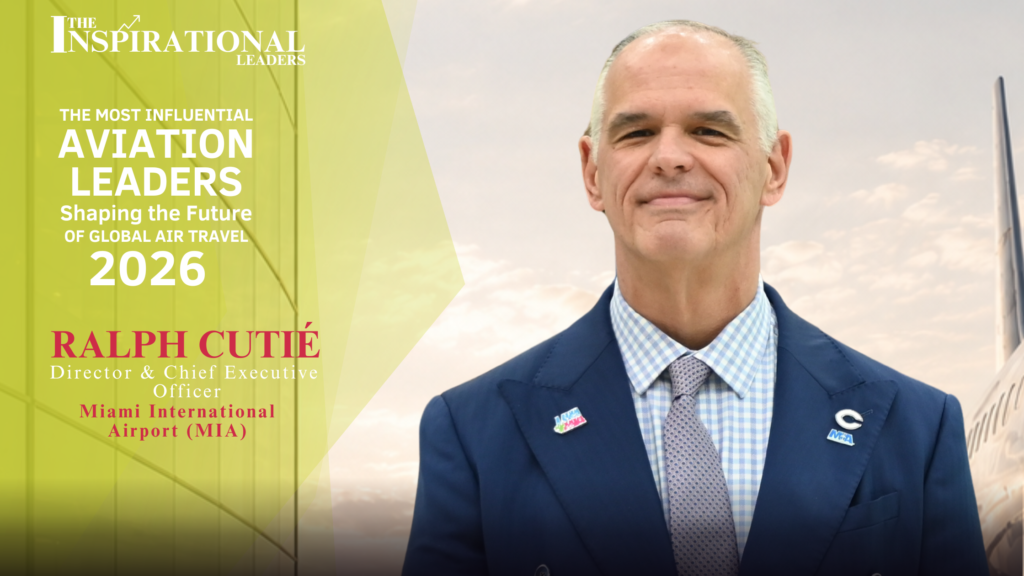
Every day, millions of passengers and countless tons of cargo move through airports that serve as critical connectors of the global economy. Behind these vast and complex ecosystems are leaders tasked with balancing operational excellence, technological innovation, infrastructure modernization, sustainability, security, and customer experience on an unprecedented scale. Few understand this responsibility better than Ralph Cutié, Director and Chief Executive Officer of Miami International Airport (MIA).
As global aviation continues to evolve, airports are no longer viewed simply as transportation facilities. They have become intelligent gateways that connect people, businesses, cultures, and opportunities across continents. Leading this evolution requires more than technical expertise; it demands vision, adaptability, and the ability to unite thousands of stakeholders around a common purpose.
For Ralph Cutié, these qualities have been developed through nearly four decades of public service and infrastructure leadership. Today, he oversees Miami International Airport and four general aviation airports in the Miami region-an aviation ecosystem that generates approximately $212 billion in annual business revenue and supports nearly 946,000 direct, indirect, related, and induced jobs. MIA itself serves more than 55 million passengers and handles over 3 million tons of cargo annually, making it one of the most significant international passenger and cargo gateways in the United States.
Yet beyond the impressive statistics lies a larger story-one centered on leadership, innovation, and a commitment to building an airport ecosystem capable of meeting the demands of the future while delivering exceptional value to travelers, businesses, and communities alike.
A Journey Defined by Infrastructure, Growth, and Continuous Learning
Long before he became one of aviation’s most influential leaders, Ralph Cutié built his career through a series of increasingly complex infrastructure and transportation projects that would shape his leadership philosophy and operational expertise.
His professional journey began within Miami-Dade County in 1990 as a Cost and Scheduling Specialist for the Miami-Dade Transit Department. From the outset, he demonstrated a strong understanding of project controls, scheduling methodologies, and infrastructure planning. As his responsibilities expanded, so did his impact. He advanced through multiple leadership roles, eventually managing engineering cost and scheduling functions and later serving as Chief of the Project Control Division.
Throughout this period, he contributed to some of South Florida’s most significant transportation initiatives, including the Metromover Extension Project, the Metrorail Extension to the Palmetto Expressway, and the Busway Extension to Florida City. These projects not only strengthened regional mobility but also provided invaluable experience in managing large-scale public investments, stakeholder coordination, and operational complexity.
His career continued to evolve through leadership positions within Miami-Dade County’s Office of Capital Improvements and later the Internal Services Department, where he managed scheduling and compliance for the County’s multi-billion-dollar Building Better Communities Bond Program. He also played a key role in developing standardized construction contracts that continue to support countywide infrastructure delivery today.
By the time he joined the Aviation Department’s executive leadership team, Cutié had accumulated nearly four decades of expertise in project management, construction administration, capital improvements, dispute resolution, and organizational leadership. These experiences provided a unique foundation for leading one of the world’s busiest aviation hubs.
Leadership Through Respect and Example
Despite overseeing one of the most complex airport systems in North America, Ralph Cutié’s leadership philosophy remains remarkably straightforward.
He believes leadership begins with respect.
Among the principles that guide him are lessons drawn from former U.S. President Dwight D. Eisenhower, whose views on leadership emphasize collaboration, trust, and mutual respect rather than authority for authority’s sake.
For Cutié, effective leadership is not about directing people from above. It is about creating an environment where individuals feel valued, empowered, and motivated to contribute their best work. Whether engaging with airport employees, government agencies, airline partners, contractors, or passengers, he approaches leadership through empathy, accountability, and service.
“Treat people with respect and compassion, and everything else will take care of itself.”
– Ralph Cutié
This philosophy has proven particularly valuable in aviation, where success depends on seamless coordination among hundreds of organizations and thousands of professionals working together toward a shared objective.
By leading through example and fostering a culture of collaboration, Cutié has built trust across stakeholders while maintaining focus on long-term strategic goals.
Elevating the Passenger Experience for a New Era
Passenger expectations have changed dramatically over the past decade. Today’s travelers expect efficiency, convenience, personalization, and seamless connectivity throughout every stage of their journey.
Recognizing these evolving expectations, Cutié has championed one of the most ambitious modernization efforts in Miami International Airport’s history.
A centerpiece of this transformation is the planned Gate D60 Expansion, which will introduce 17 new aircraft gates, expanded boarding areas, upgraded baggage handling capabilities, enhanced passenger circulation, and additional retail and dining experiences. Scheduled as part of a broader modernization strategy, the project represents a significant investment in both capacity and customer experience.
Yet the expansion extends beyond physical infrastructure. It reflects a broader vision to create an airport environment designed around passenger needs while preparing MIA for continued growth.
Additional projects within the airport-wide modernization initiative include the future Concourse K expansion, redevelopment of the Central Terminal, modernization of elevators, escalators, and moving walkways, extensive restroom renovations, and numerous facility upgrades designed to enhance comfort and convenience.
Together, these initiatives are creating a future-ready gateway capable of serving millions of travelers for decades to come.
Creating a Smarter Airport Ecosystem
As airports become increasingly interconnected, operational excellence depends on the ability to gather, analyze, and act upon real-time information.
Under Cutié’s leadership, Miami International Airport is investing heavily in intelligent infrastructure designed to improve efficiency, safety, and responsiveness.
One of the most significant examples is the development of MIA’s new Airport Operations Center and Digital Monitoring Hub-the first facility of its kind in the United States. Scheduled for completion in 2027, the center will leverage artificial intelligence, digital tower technology, advanced surveillance systems, and integrated data platforms to provide comprehensive visibility across airport operations.
The facility will enable faster decision-making, improved incident management, and enhanced coordination among multiple agencies responsible for maintaining airport safety and security.
Equipped with hurricane-resistant infrastructure, cyber-secure systems, and emergency-response capabilities, the center also strengthens operational resilience during crises and extreme weather events.
For Cutié, innovation is not simply about adopting new technologies. It is about applying those technologies strategically to improve service, safety, and reliability for travelers and employees alike.
Sustainability as a Core Business Strategy
The future of aviation depends not only on innovation but also on responsible growth.
At Miami International Airport, sustainability is fully integrated into modernization efforts rather than treated as a separate initiative. Every major infrastructure investment incorporates environmental considerations aimed at improving efficiency, reducing emissions, and enhancing resilience.
One of the most visible examples is MIA’s extensive solar energy initiative. Through a large-scale terminal re-roofing project, thousands of solar panels will be installed across airport facilities, generating substantial clean energy while supporting long-term operational efficiency.
The initiative forms part of a broader strategy to expand renewable energy capacity throughout terminals and parking structures. These investments will reduce energy consumption, lower operational costs, improve resilience against power disruptions, and contribute to regional climate objectives.
Importantly, these efforts demonstrate that environmental responsibility and operational excellence are not competing priorities. Instead, they can work together to create stronger, more sustainable infrastructure.
As aviation organizations worldwide seek practical pathways toward sustainability, Miami International Airport continues to establish itself as a model for balancing growth, resilience, and environmental stewardship.
Digital Transformation and the Future of Seamless Travel
Technology continues to reshape every aspect of the passenger journey, and Miami International Airport has emerged as a leader in implementing solutions that improve both convenience and security.
Through partnerships with federal agencies and technology providers, MIA has introduced biometric processing systems that significantly reduce passenger processing times while maintaining rigorous security standards.
Innovations such as CLEAR eGates allow eligible travelers to verify their identities within seconds, streamlining movement through security checkpoints. Enhanced Passenger Processing systems similarly accelerate international arrivals by leveraging biometric verification technologies that improve efficiency without compromising safety.
These advancements represent more than operational improvements; they signal a broader shift toward frictionless travel experiences where technology reduces complexity and allows travelers to move more seamlessly through the airport environment.
For Cutié, digital transformation is ultimately about enhancing the human experience through smarter systems and better information.
Preparing for Aviation’s Next Frontier
While current modernization efforts focus on today’s travelers, Cutié is equally focused on preparing for tomorrow’s aviation landscape.
One of the most exciting developments on the horizon is Advanced Air Mobility (AAM), including electric vertical takeoff and landing aircraft, commonly known as eVTOLs.
Recognizing the transformative potential of these technologies, Miami International Airport has taken a proactive role in supporting future air mobility initiatives. Through collaborations with organizations such as Wisk Aero, Archer Aviation, the Federal Aviation Administration, and transportation agencies, MIA is helping establish frameworks that will guide the safe integration of emerging aviation technologies.
These partnerships position Miami among the leading regions exploring how advanced air mobility can enhance connectivity, reduce congestion, and create new transportation possibilities.
While significant work remains, Cutié views these developments as part of a broader evolution that will reshape how people move within and between urban environments.
Looking Ahead: AI, Intelligent Airports, and Connected Passenger Experiences
As aviation enters a new era, artificial intelligence is poised to become one of the industry’s most transformative forces.
Miami International Airport is already demonstrating what that future may look like through its deployment of omnichannel hologram chatbots powered by geo-aware, agentic AI technology. These systems provide travelers with real-time, contextual information across multiple platforms and languages, creating a more intuitive and personalized airport experience.
Whether a passenger is planning a journey from home, seeking information through a mobile device, or navigating the terminal itself, the technology delivers consistent guidance tailored to individual circumstances.
This initiative reflects a broader shift toward intelligent airport ecosystems capable of integrating flight operations, security information, passenger services, retail experiences, and facilities management into a unified intelligence framework.
For an airport serving more than 55 million passengers annually, delivering accurate information at precisely the right moment can significantly improve both efficiency and customer satisfaction.
The future airport will not simply be larger or faster-it will be smarter, more connected, and increasingly responsive to the needs of every traveler.
Building a Lasting Legacy in Aviation
Being recognized among The Most Influential Aviation Leaders Shaping the Future of Global Air Travel in 2026 reflects more than operational achievements or infrastructure investments. It recognizes a leadership approach grounded in service, collaboration, innovation, and long-term vision.
Throughout his career, Ralph Cutié has demonstrated that meaningful leadership is built on consistency, integrity, and a willingness to embrace change while remaining committed to core values. From transportation infrastructure projects early in his career to overseeing one of the world’s most important international aviation gateways, he has continually focused on creating systems that serve people, strengthen communities, and support economic growth.
As global aviation continues to evolve, leaders will face increasing pressure to balance technological advancement, sustainability, operational excellence, and customer expectations. Those who succeed will be the ones capable of bringing these priorities together through thoughtful leadership and strategic execution.
For Ralph Cutié, the path forward is clear: continue investing in innovation, strengthen resilience, empower people, and build infrastructure capable of supporting future generations.
In doing so, he is helping shape more than the future of Miami International Airport. He is contributing to a broader vision for global aviation-one where intelligent technology, sustainable development, operational excellence, and human-centered leadership come together to create better journeys for travelers around the world.