
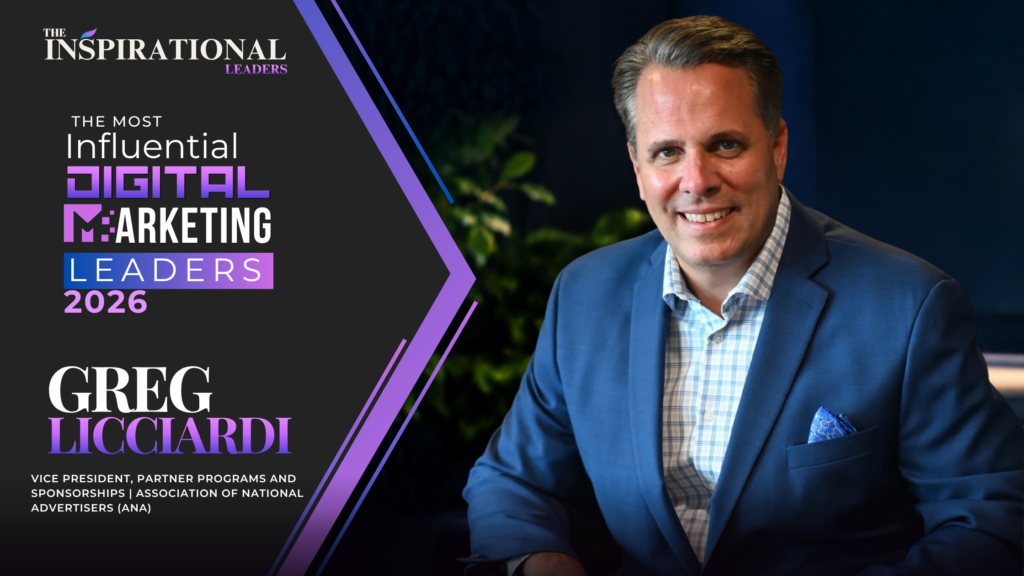
Marketing has never been only about visibility. A message can reach millions of people and still fail to matter if it reaches the wrong audience, appears in the wrong setting, or arrives at the wrong moment. For Greg Licciardi, Vice President of Partner Programs and Sponsorships at the Association of National Advertisers (ANA), that distinction has shaped a career across luxury advertising, premium media, partnerships, sponsorships, and digital marketing.
His experience across Holland Advertising and media brands including Yves Saint Laurent, Schott NYC, Travel + Leisure, Elite Traveler, and Worth Media Group showed him the value of strong branding and storytelling in environments where audiences are engaged and the context supports the message. Alongside his industry career, Licciardi has spent 11 years teaching Marketing at two leading universities, Fordham University and Seton Hall University, giving him an academic perspective that complements his extensive industry experience. Together, these experiences have reinforced the importance of context, relevance, and meaningful communication as marketing has become faster, more fragmented, and technology driven.
Today, AI, automation, data, dynamic content, and sophisticated media platforms can help marketers understand and reach consumers at scale. Yet more capability creates a fundamental question: what should marketers do with all that information?
Licciardi’s answer begins with relevance. His 5R framework-Right Person, Right Message, Right Time, Right Environment, and Right Outcome-offers a practical way to think about whether a marketing interaction is genuinely useful and meaningful. Developed from an everyday consumer experience and expanded through his book, Holy Grail of Marketing, the framework has become a lens through which he considers personalization, measurement, storytelling, partnerships, and the growing role of AI.
When the Right Message Is in the Wrong Place
Long before generative AI became part of everyday marketing conversations, Licciardi understood that context could determine whether creative work succeeded or struggled. His years in luxury advertising and media reinforced the connection between a brand, its audience, its surroundings, and the moment in which a message appears.
A company can invest heavily in a sophisticated campaign, but that investment can be weakened if the advertising reaches an audience outside the brand’s core market or appears in an environment that conflicts with the brand’s values. The creative may be excellent and the message may be appropriate, yet the overall interaction can still miss its intended outcome.
As automated systems increasingly influence campaign placement and optimization, this distinction matters.
Technology can make distribution faster and more efficient, but efficiency alone does not establish relevance. Marketers still need to consider whether the audience is engaged, whether the environment makes sense, and whether the message belongs there.
For Licciardi, the goal is not simply visibility. It is to create an interaction in which the person, message, timing, environment, and result work together.
The Everyday Moment That Became a Framework
The origins of the 5Rs are surprisingly simple. While working remotely, Licciardi became a regular Wendy’s customer. Around 11 a.m. on Fridays, Wendy’s advertisements began appearing in his social feed. The experience stood out because several conditions aligned at once.
The restaurant already knew he was a customer. The offers were relevant, the timing was close to lunch, and the social feed was an environment in which he was already engaged. When it was time to decide where to eat, he returned to Wendy’s.
That ordinary interaction prompted Licciardi to recognize the five conditions behind an effective marketing experience. The framework became the basis of Holy Grail of Marketing, where he presents the 5Rs as a connected system rather than a checklist.
The Right Person is not enough without the Right Message. The Right Message can still be overlooked if it arrives at the wrong moment. Even the right audience, message, and timing can lose their effect when the surrounding environment is inappropriate. Ultimately, all of these elements have to contribute to the Right Outcome.
A second example helped reinforce the idea. While researching his book, Licciardi encountered an e.l.f. Cosmetics campaign developed with The Weather Company and The Weather Channel.
The campaign connected weather information, location, timing, creative, and beauty behavior to make the communication more contextually relevant. The case study he cites reported a purchase-intent increase of more than 17 percent, while sales exceeded forecasted revenue targets.
For Licciardi, the significance of such examples is not that data alone creates successful marketing. It is what happens when information is connected to context and used to make an interaction more meaningful.
From Broad Personalization to Individual Relevance
Personalization has become an expected part of the customer experience, but Licciardi sees a gap between being technically targeted and being genuinely relevant. Automation has made it possible to reach broad consumer groups quickly, yet campaigns built around large segments can still feel remarkably similar from one person to another.
The opportunity emerging from AI is to move beyond broad personalization toward more curated experiences based on what an individual consumer has actually demonstrated through behavior.
Consider a customer who buys a pair of green pants from J.Crew. Rather than continuing to serve that person a standard J.Crew message, future communications could reflect the demonstrated interest by presenting complementary green products. The interaction becomes more specific because the brand is building on something the customer has already shown interest in.
The same principle can extend across a digital experience. A consumer purchasing a fuchsia lipstick, for example, might encounter complementary products, content, or recommendations during a later website visit or newsletter.
Instead of presenting every customer with the same experience, the brand can allow previous interactions to shape what comes next.
This is where personalization begins to resemble curation. AI can analyze behavior and identify patterns at a speed that would be difficult for people to manage manually. The strategic question, however, remains human: which signals actually matter, how should they influence the experience, and how do they connect with the brand’s larger positioning?
Licciardi describes personalization at scale as one of the significant opportunities created by AI. Its value lies not in making technology more visible, but in shortening the distance between demonstrated consumer interest and a useful next interaction.
More Data Does Not Automatically Mean More Understanding
As marketing technology becomes more capable, the role of human oversight does not disappear. Licciardi emphasizes the need to audit campaigns so that messaging and branding continue to appear in contextually relevant, high-engagement environments. That requires time and, in many cases, greater investment in people.
The same principle applies to measurement.
Modern marketers can track campaign activity in real time, making it possible to monitor and optimize performance while campaigns are running. Clicks and impressions remain useful indicators, but Licciardi points to consumer engagement, brand sentiment, and ultimately sales as more meaningful measures of effectiveness.
The shift matters. A campaign can generate attention without creating meaningful movement for the brand, while a smaller interaction may matter more if it changes perception, encourages engagement, or contributes to a purchase.
AI can analyze these signals and identify patterns, but measurement begins with deciding what the organization is trying to understand. Numbers become useful when they answer a business question rather than simply accumulate in a dashboard.
The question of measurement leads to one of Licciardi’s most important distinctions: data can reveal what happened, but it does not always explain why.
Understanding the Why
Consumers leave behind an enormous trail of information. Marketers can observe purchases, clicks, frequency, preferences, and other behaviors. Yet those signals do not automatically explain the circumstances, ambitions, frustrations, or motivations behind them.
Licciardi argues that marketers need to move beyond surface-level data and develop a better understanding of the people represented by those signals. That requires empathy and a willingness to consider individual situations rather than making assumptions from patterns alone.
This is where storytelling retains its importance.
Technology can help marketers determine who should receive a message, when it should appear, and potentially which content may be relevant.
But the marketer still has to shape the reason the audience should care. Licciardi refers to this as curating the “why.”
As AI becomes better at generating content, that responsibility becomes more visible. Producing more messages is not the same as producing better ones. A compelling message still needs perspective, context, purpose, and audience understanding.
For Licciardi, the message remains central. The tools surrounding it may change, but effective communication still depends on understanding the person on the other side of the screen.
Partnerships That Create More Than Visibility
Licciardi’s work also extends into partnerships involving marketers, media companies, thought leaders, and other organizations. His view is that collaboration becomes valuable when the combined result is greater than what either participant could have produced independently.
That requires more than putting two names together. Partners need to understand one another’s drivers, capabilities, objectives, and areas of opportunity. The goal is to find where different strengths complement each other.
Trust and respect matter within those relationships, but Licciardi notes that they take time to establish. Strong partnerships are built through understanding and shared execution rather than visibility alone.
Authenticity in the Age of AI
Influencer marketing is another area where Licciardi expects continued development. Creators have become important channels for connecting brands with audiences, while AI is introducing new forms of digital and synthetic influencers.
That evolution creates a greater need for auditing and management.
For brands, the question is not simply whether a creator can reach a large audience, but whether the creator is authentic and genuinely aligned with the brand’s ethos.
As platforms and technologies change how influence is created, alignment becomes increasingly important. A creator partnership is strongest when it makes sense within the brand’s story rather than functioning only as another route for distribution.
The Human Skills Behind the Technology
Licciardi does not describe the future of marketing as a choice between people and machines. Instead, he emphasizes the combination of AI capabilities with skills that remain distinctly human.
Storytelling, authentic perspective, research, organization, curation, judgment, creativity, and empathy continue to matter. His comparison to writing a strong book report is deliberately simple: research the subject, develop a point of view, organize the information, and communicate it in a compelling way.
AI can generate content, analyze vast quantities of data, and produce recommendations rapidly. But marketers still have to decide whether those outputs are authentic to the brand, consistent with its positioning, and meaningful to the intended audience.
Technology can accelerate the work. It cannot remove the responsibility for interpreting that work.
The 5Rs Beyond Marketing
Licciardi has also taken the ideas behind his marketing framework into a more personal direction. A bonus chapter in the Kindle edition of Holy Grail of Marketing, titled Holy Grail of Marketing YOU, applies the 5Rs to personal and professional development.
The starting point is the Right Person: understanding your own strengths, values, passions, and distinctive contribution. The Right Message is the ability to communicate that value with authenticity and purpose. The Right Time reflects preparation and the importance of being ready when opportunity appears. The Right Environment considers the people, communities, cultures, and relationships that influence growth. The Right Outcome asks what success actually means to the individual.
The application extends Licciardi’s central idea. Companies work to understand audiences, communicate value, build relationships, and create meaningful outcomes. People face many of the same challenges in their careers and personal lives.
The framework therefore reaches beyond advertising, offering a way to think about relevance, communication, preparation, relationships, and purpose.
What Comes Next for Marketing
Marketing tools will continue to change. AI will become more capable, while dynamic experiences and individualized communication become more sophisticated. Media, commerce, content, technology, and customer experience will continue to overlap.
Yet the fundamentals are unlikely to disappear.
Brands will still need to understand people. They will still need compelling stories. They will still need to earn attention and choose the environments in which their messages appear. And they will still need to answer the question that sits behind every effective interaction: why should this person care?
That is why Licciardi’s 5R framework remains relevant. It does not depend on a particular platform or tool. Instead, it provides a way to examine the quality of the relationship between a brand and its audience.
The Real Advantage Is Relevance
Greg Licciardi’s 5R framework began with a Friday lunch decision, but the idea behind it reaches far beyond that moment. It provides a simple way to examine something that has become increasingly difficult in a crowded digital environment: whether marketing is actually meaningful to the person receiving it.
AI can help marketers analyze behavior, personalize experiences, automate execution, generate content, and optimize campaigns. Those capabilities can change the scale and speed at which marketing operates. But they do not remove the need for human interpretation.
Someone still has to understand the person behind the data. Someone has to decide whether a message belongs in a particular environment. Someone has to recognize the difference between attention and connection. And someone has to understand the reason an audience should care.
For Licciardi, the future is therefore not about choosing between technology and human capability. It is about knowing how to bring them together.
The enduring lesson of the 5Rs is straightforward: effective marketing is not simply about reaching more people. It is about making the interaction more relevant to the people who matter. As the tools become more sophisticated, that principle may become less visible in the technology itself-but more important in the results it creates.