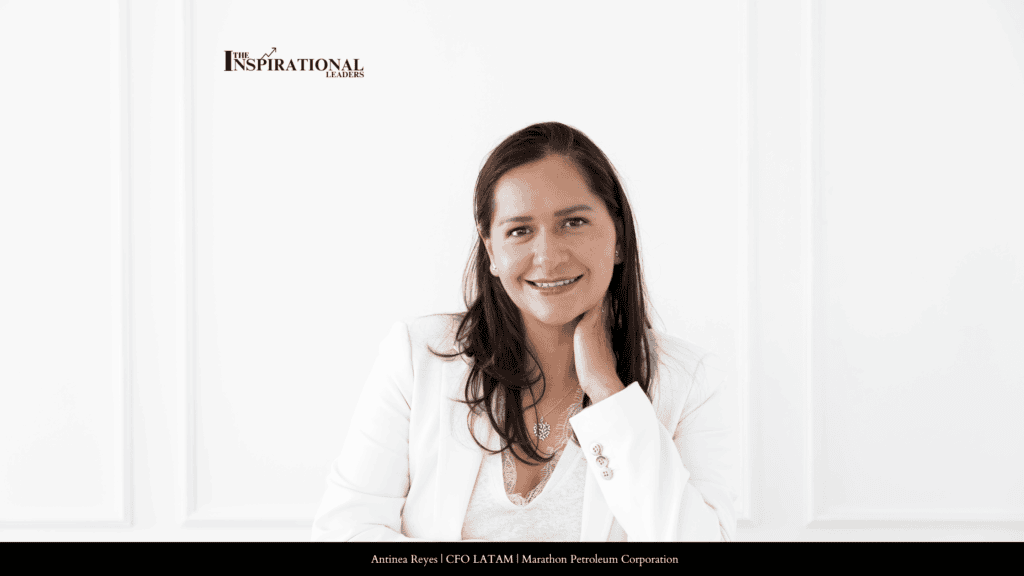
Antinea Reyes: Beyond the Numbers, Toward a Smarter Era of Finance Leadership
Digital Version Finance leadership has entered a new era, one where technical expertise alone is no longer enough to guide organizations through complexity. Markets are evolving faster than forecasting models can fully capture. Geopolitical uncertainty, technological disruption, and shifting workforce expectations are redefining how businesses operate and how leaders make decisions. In this environment, the executives creating the greatest impact are not simply the ones managing numbers. They are the ones shaping direction, building resilient teams, and making intentional decisions even when certainty is impossible. Few leaders embody this evolution as clearly as Antinea Reyes. With a career spanning organizations such as General Electric, The Estée Lauder Companies, and Marathon Petroleum Corporation, Antinea has built her leadership philosophy in some of the world’s most demanding and competitive business environments. Much of her professional experience has been rooted in Latin American markets, where volatility is not an exception but often the operating reality. Financial crises, hyperinflationary economies, and unpredictable commodity cycles shaped her understanding of leadership early in her career, forcing her to develop a perspective that extends far beyond traditional finance. For Antinea, finance has never been simply about reporting performance or managing spreadsheets. It has always been about understanding how organizations make decisions, how value is created, and how leadership influences both culture and long term outcomes. Those experiences taught her one of the most defining lessons of her career: in uncertain environments, leadership is not driven by perfect data. It is driven by judgment, adaptability, and people. “Decision making is not about perfect data, it is about strong judgment and the right teams,” she explains. That perspective has become central to the way she approaches leadership today. While many organizations still view finance primarily as a control function, Antinea believes its true role is far more strategic. Finance, in her view, should sit at the center of business direction, helping organizations navigate uncertainty while shaping growth, transformation, and innovation. Her journey has also been deeply influenced by another dimension that extends beyond corporate leadership. Antinea has become a passionate advocate for expanding opportunities for women, particularly across Latin America, where economic inequality and gender limitations still restrict the futures of many young girls. As Global Advisor to the Financial Empowerment and Policies wing of the G100, she works alongside other women leaders committed to advancing access, opportunity, and financial independence for future generations. For her, leadership is not only about performance metrics or business results. It is about creating environments where people can grow, contribute, and build better futures for themselves and others. Leadership Built Through Volatility and Complexity Some careers are shaped by stability. Others are shaped by constant transformation. Antinea’s belongs firmly to the latter. Operating across Latin American markets exposed her to conditions that demanded resilience at every level. Economic instability, inflationary pressure, currency fluctuations, and changing political environments required leaders to make high stakes decisions without always having access to perfect or complete information. These experiences fundamentally changed the way she understood leadership. In volatile environments, spreadsheets alone do not provide clarity. Data can be delayed, incomplete, or unreliable. What ultimately determines outcomes is the quality of judgment behind the decisions and the strength of the people making them. This realization reinforced her belief that organizations succeed when they are built around strong teams with diverse perspectives and the ability to navigate ambiguity confidently. It also strengthened her appreciation for the importance of surrounding yourself with the right people. Referencing Jim Collins’ well known insight from Good to Great, she reflects on a philosophy that has remained central throughout her career: “People are not your greatest asset. The right people are.” Working within globally recognized organizations exposed her to exceptional leaders who established high standards for excellence and execution. At the same time, she also encountered leadership styles that demonstrated exactly what leadership should not become. Those experiences became equally valuable, shaping her understanding of the type of environment she wanted to create for others. Over time, Antinea developed a leadership approach grounded in transparency, empowerment, and strategic clarity. Rather than leading through authority alone, she focuses on building alignment, encouraging independent thinking, and fostering accountability across teams. This philosophy became particularly important during one of the most defining moments of her career: leading a global organizational restructuring driven not by strategic expansion, but by financial constraint. The transformation impacted more than 50 CFO roles globally and carried enormous operational and leadership pressure. The decisions involved were not theoretical exercises. Every move carried real consequences for people, performance, and the future structure of the organization. There were difficult questions that could not be answered with certainty. Would the new operating model succeed? Had the organization underestimated the level of support required for execution? Would the cost savings ultimately compromise performance? In moments like these, Antinea learned that stability does not come from structure alone. It comes from leadership. She focused on maintaining clarity of purpose, ensuring teams understood what truly mattered, while also prioritizing transparency and empowerment. Rather than creating fear driven environments, she encouraged ownership and decisive action. The experience reinforced her belief that transformation succeeds when leaders trust capable people, communicate clearly, and remain adaptable under pressure. Redefining the Role of Finance Leadership As organizations continue to evolve, Antinea believes finance leaders must redefine how they contribute to business growth. Historically, finance has often been positioned as a back office function centered on control, reporting, and operational oversight. Antinea rejects that limitation entirely. For her, finance belongs at the front line of strategic decision making. “I’ve never believed in the concept of traditional finance,” she says. “Finance should not follow decisions, it should help shape them.” That mindset reflects a broader transformation taking place across global business leadership. Modern finance executives are now expected to connect financial insight directly to strategic direction. They must understand how technological disruption reshapes industries, anticipate market shifts before they occur, and allocate resources in ways that align execution with long term vision. This requires a