
A scientific breakthrough can be extraordinary; can it actually make a difference and change people’s life?
Between proving that something works in the labs and making it scalable lies a difficult stretch of decisions that rarely receives the same attention as discovery itself. Technology needs a market to make an impact. Intellectual property needs a strategy to become competitive. Researchers need to become part of a functioning company to excel ones true potential Capital has to arrive at the right time to support the growth. Priorities have to survive setbacks. And somewhere along the way, an idea that once generated in the research, has to prove that it belongs in the real world to make an impact
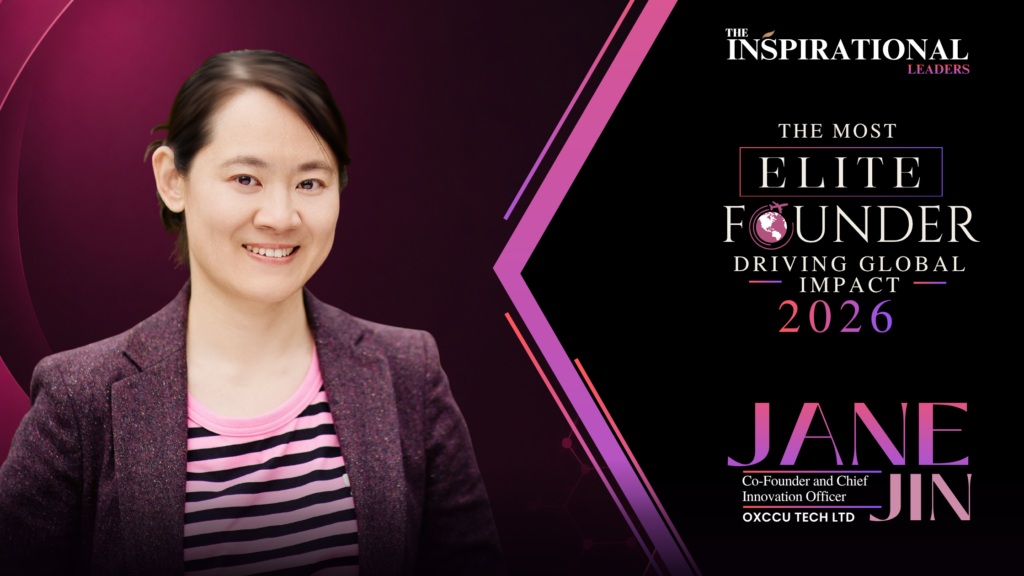
Jane Jin, Co-Founder and Chief Innovation Officer of OXCCU TECH LTD, has built much of her career in that space between scientific discoveries and market applications.
Her work today centres on a formidable challenge: developing technology that can contribute to the production of sustainable aviation fuel (SAF) from carbon dioxide and hydrogen. Yet OXCCU is only the latest chapter in a career spent examining what allows science to travel beyond its point of origin.
Jane traces part of that fascination to her PhD years at the University of Cambridge. While participating in The Cambridge Phenomenon book project, she had the opportunity to interview Nobel Prize winners, successful entrepreneurs and world-leading professors who had transformed university research into companies. She saw scientific achievement from another perspective—not simply as knowledge created, but as knowledge translated into something capable of reaching society.
Curiosity became a recurring theme in the choices that followed. Jane describes it as an urge to stretch her thinking, leave familiar territory and pursue opportunities with the potential for positive societal impact. That instinct took her away from a conventional academic path and closer to the uncertain world of technology commercialisation and entrepreneurship.
Learning What Makes an Idea Survive
Jane’s first major step outside academia brought her to Oakland Innovation on Cambridge Science Park, a technology innovation and market-intelligence consultancy later acquired by Sagentia Group plc. Between 2010 and 2014, she worked across more than 80 innovation consultancy projects, helping global clients identify technologies, products and businesses that could support new-market opportunities through routes including licensing, co-marketing and acquisition.
She later spent six years at Oxford University Innovation, working as a Licensing and Ventures Manager. There, the questions became even closer to the ones that would eventually define her role as a founder: Which discoveries should be protected? Which have commercial potential? Should a technology be licensed or developed through a new venture? Moreover, what will it actually take to move it forward?
Jane led the formation of five Oxford spinouts and served on boards of university spinout companies. One of the ventures she helped was Fluorok, which is developing HF-free approaches to fluorination, revolutionisng the way fluorochemicals are produced.
Those years gave her exposure to both sides of entrepreneurship. Some ideas became successful companies. Others disappeared within a few years.
The contrast shaped a straightforward view of what gives a spinout a fighting chance. Jane looks for three essentials: the right leadership, meaningful market demand and the ability to reach the market quickly.
Technology matters enormously, but she has learned not to confuse technical novelty with a viable company.
Taking an early-stage technology from a relatively immature state toward commercial readiness consumes money, time and attention. A venture can have exceptional science and still struggle if the market is too small, the team cannot execute or development takes so long that the opportunity moves elsewhere.
That experience now informs her work at OXCCU. Alongside developing the company’s intellectual-property strategy, Jane keeps close watch on developments in CO2 catalysis for sustainable fuels. Patent landscapes, scientific literature and competitors’ R&D activity are reviewed deliberately rather than occasionally. An innovation budget is allocated to this work each year.
For Jane, staying innovative also means knowing what is happening beyond the walls of your own laboratory.
The Kilogram That Changed the Scale of the Conversation
Deep-tech progress can look surprisingly small from the outside.
At OXCCU’s OX1 demonstration plant at Oxford Airport, the output is measured at one kilogram of liquid fuel per day. What matters is where that kilogram came from.
Delivered in September 2024, on schedule and within budget, OX1 represented a 1,000-fold increase in scale compared with the company’s laboratory operations. Using OXCCU’s patented catalyst and reactor design, the plant converts carbon dioxide and hydrogen directly into long-chain hydrocarbons for SAF.
It marked the moment when years of scientific development had to begin answering a different set of questions. Could the process move beyond laboratory scale? Could the team execute against real project constraints? Could the technology continue progressing toward something commercially meaningful?
Following on from pilot OX1, running at 1 tpa, OXCCU is now developing the first demonstration scale plant OX2, , a 20 tpa demonstration plant at Oxford Airport in the UK which it expects to have fully operational in early 2027.
For Jane, OX1 was not just only a technical milestone for OXCCU, but also a team operational success.
Scale-up has taught her to make priorities unmistakable. OXCCU operates with a rapid testmeasure -learn approach, while close coordination within its C-suite helps decisions move without unnecessary delay. The company also works with academic and commercial partners that bring relevant scale-up experience.
Being a start-up, in this context, can be an advantage. There are fewer layers between recognising a problem and acting on it. However, speed only works when everyone knows what matters most.
Jane learned that lesson partly because OXCCU experienced what happens when a early-stage start-up tries to make too many things matter at once.
When Opportunity Became a Distraction
In its earlier years, OXCCU was developing technologies for more than one market. Alongside its work in sustainable aviation fuel, the company had created a separate platform related to plastics.
The market opportunities were exciting. The resources available to pursue them were not unlimited.
For a small team, multiple promising directions gradually became multiple competing demands. Jane recalls the company becoming stretched across too many commitments. Pressure increased, and members of the team experienced stress and burnout.
The issue was not a shortage of ambition. The company simply had too many directions competing for the same limited resources.
Recognising that became a leadership test. The senior team revisited the strategy, narrowed its attention and moved quickly to regain momentum. OX1 still launched according to schedule, but the experience left Jane with a much sharper understanding of resilience.
In entrepreneurship, she has found, resilience is not simply persistence. Leaders have to remain capable of thinking clearly, while uncertainty is affecting everyone around them. If pressure begins to dominate decision-making, the organisation can lose valuable time precisely when clarity is most needed.
The experience also exposed one of the quieter disciplines of entrepreneurship: knowing when not to pursue an opportunity.
A founder may be surrounded by good ideas and still need to choose only one.
Where Innovation Sometimes Starts With Coffee
For someone responsible for innovation, Jane does not describe creativity as a grand corporate exercise.
Some of OXCCU’s most useful conversations are far more informal.
She regularly sits down over coffee with the company’s scientists and engineers to discuss experiments, new technical approaches and potential patent ideas. Colleagues have come to know these exchanges as her “Innovation Café.”
Behind the light-hearted name is a deliberate philosophy. Jane wants innovation to remain close to the people doing the scientific work rather than becoming a separate management function.
OXCCU’s team includes chemists and chemical engineers with complementary areas of expertise. Its co-founders share backgrounds in chemistry, but Jane places equal importance on curiosity, openness and a willingness to work through problems collectively.
Experimentation is encouraged, and the company introduced a staff Innovation Award to recognise meaningful contributions to its SAF product development. Jin also shares findings from patent and literature reviews with colleagues so that external developments can become part of internal scientific conversations.
The underlying principle is simple: people are more likely to contribute ideas when innovation is something they participate in, rather than something announced to them.
Culture Begins Earlier Than Most Founders Think
Jane’s experience building university spinouts has also made her particularly attentive to the earliest hiring decisions.
In science-led ventures, she sees real value in bringing the PhD researchers and postdoctoral scientists behind the original work into the company. At an early stage, much of the technology still needs to be refined, and the people who have spent years understanding its fundementals carry knowledge that cannot be replaced quickly.
But building a company requires more than assembling impressive CVs.
Jane believes the first 10 to 12 hires have an outsized influence on what an organisation eventually becomes.
At OXCCU, safety, teamwork, kindness and respect for colleagues’ abilities sit alongside hard work, ambitious thinking, innovation and humility. These values matter because commercialising deep technology forces disciplines to overlap. Scientists and engineers have to collaborate through prototyping rather than retreating into separate technical territories.
Finding people from industry who fit that environment has not always been easy. Jane has noticed that individuals who are open-minded and optimistic often adjust better to the uncertainty and pace of startup life.
That makes hiring slowly enough to choose well worth the effort.
A founder may spend years refining the technology, but the first dozen people can determine whether the organisation around it is capable of growing.
Building for a Problem That Cannot Simply Be Electrified Away
OXCCU’s technology is being developed against a particularly difficult decarbonisation challenge.
Jane expects sustainable fuels—including SAF and e-methanol derived from CO2 and other waste-carbon sources—to become increasingly important over the coming five to ten years. Aviation and deep-sea shipping face constraints that make energy-dense fuels particularly important, while regulatory developments in Europe and the UK are also increasing attention on lower-carbon alternatives.
Her interest in emerging science, however, extends beyond energy.
Jane trained as a discovery chemist at Pfizer R&D in 2004, when drug discovery could commonly span 10 to 15 years. Two decades later, she is watching artificial intelligence change how researchers approach scientific problems. In her interview, she points to developments including AlphaFold in protein-structure prediction and newer generative approaches to materials discovery as examples of how computational tools are accelerating parts of research.
She is also developing her own knowledge of using AI for innovation, data insights and operational efficiency.
For someone whose career has repeatedly involved evaluating new technologies, the response is characteristically curious rather than defensive. New tools are another reason to keep learning.
Impact Means Very Little If It Cannot Travel
Jane’s definition of impact was tested under very different circumstances during the COVID-19 pandemic.
At Oxford, she led the formation of OXSED, a social-venture spinout established to commercialise and distribute a rapid COVID-19 diagnostic test developed through the University of Oxford and the Oxford Suzhou Centre for Advanced Research in China.
Only five months after incorporation, OXSED was acquired by global health sciences company Prenetics.
Rather than viewing acquisition as a departure from the venture’s social purpose, Jane saw it as a way of accelerating that purpose. Prenetics brought a broader network; funding and resources that could help the diagnostic technology reach markets more quickly, including the low- and middle-income countries prioritised within OXSED’s mission.
The experience reinforced a belief she now carries into climate technology: commercial success and positive impact do not have to occupy opposing sides of a business.
In fact, lasting impact often depends on economic viability.
OXCCU illustrates the connection. A technology may offer a route to reducing aviation emissions, but environmental benefit can only become substantial if the resulting fuel can eventually be financed, produced and adopted at meaningful scale. Jane also considers the social dimension, including skilled employment and diversity in the team,
When evaluating an innovation, she returns to three fundamental questions: What problem for society is being addressed? How substantial is that problem? And is the proposed answer capable of scaling?
That final question may be the hardest.
An invention can be ingenious at small scale. Impact begins when ingenuity survives contact with economics, operations and reality.
Leadership before the Title
Jane’s experiences have also influenced how she thinks about women entering entrepreneurship and technical leadership.
She developed leadership responsibilities relatively early through school and university, but she is quick to acknowledge that much of what she understands today came through mistakes.
Her advice is therefore to practise leadership before waiting for a senior position.
At Oxford University Innovation, a manager encouraged her to pursue an initiative she cared about. Jane chose climate-tech innovation and went on to launch the Oxford Climate Tech and Sustainability Innovation Challenge, bringing researchers together with the wider Oxfordshire innovation community around the climate crisis.
She has also sought support deliberately throughout OXCCU’s growth. A female coach continues to challenge her to stretch her personal boundaries, while mentors across HR, health and safety, and commercial functions have contributed to her development as the company has moved from Seed to Series B.
For women who hesitate over whether they have the experience to start something ambitious, Jane favours preparation over waiting indefinitely.
Build a Plan A and a Plan B. Learn finance if finance is the gap. Study investment if investment feels unfamiliar. Find someone willing to challenge the limits you have quietly placed around yourself.
For Jane, feeling ready is less important than deliberately developing the skills and support needed to move forward.
Beyond the Breakthrough
Jane wants OXCCU to become one of the UK’s most successful companies, developing innovations capable of supporting future demand for sustainable aviation fuel, contributing to aviation decarbonisation and reducing dependence on fossil fuels.
It is an ambitious destination. Yet her career suggests she understands better than most how much sits between ambition and arrival.
She has watched scientific discoveries become companies and watched promising ideas fail. She has evaluated intellectual property, helped form spinouts, sat on their boards and experienced the pressure of building one herself. She has seen a young company lose focus because it pursued too much, and then watched the same team recover in time to deliver its demonstration plant.
There is no clean line through those experiences.
And perhaps that is what makes her story useful.
Years ago, while working on The Cambridge Phenomenon, Jane met great scientists and entrepreneurs who had taken discoveries beyond universities and into the world. Their example helped convince her that research did not have to end with research.
Today, she hopes OXCCU can provide a similar signal to another generation—particularly to female scientists considering entrepreneurship.
There will always be discoveries impressive enough to command attention. The rarer achievement is building the people, discipline, resilience and commercial pathway required to make those discoveries useful beyond the place where they were created.
Jane is still working through that challenge herself.
Her advice to the founders who may follow is correspondingly uncomplicated: keep learning, accept that mistakes will happen, and do not allow the absence of a perfectly mapped path to become a reason for standing still.
Because the breakthrough may be where the story becomes visible.
What happens after it is where impact is built.