
In leadership circles, transformation is often framed in terms of scale, innovation, and measurable growth. Yet some of the most enduring forms of impact are far less visible – built not in boardrooms or balance sheets, but in conversations. The kind that challenge assumptions, uncover unspoken expectations, and quietly reshape the foundation of human relationships.
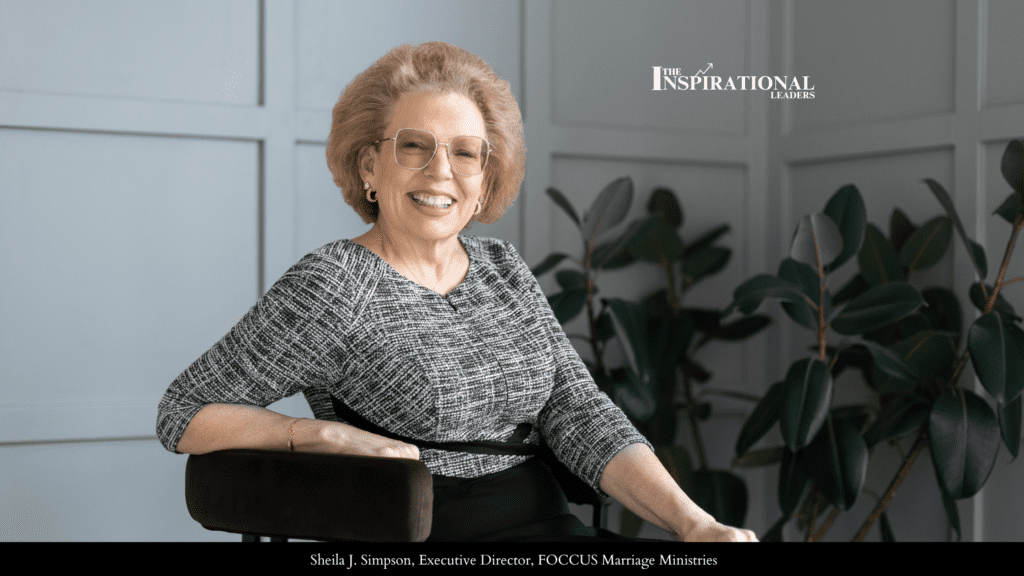
For Sheila Simpson, Executive Director of FOCCUS Marriage Ministries, this is where real change begins.
Her work does not rely on grand interventions or sweeping frameworks. Instead, it is rooted in something deceptively simple yet profoundly effective: creating space for intentional, honest dialogue. Across more than four decades, the organization she leads has reached millions of couples worldwide – not by telling them what to think, but by helping them learn how to talk to one another in ways that foster clarity, trust, and long-term understanding.
At the core of Simpson’s philosophy lies a belief that is both intuitive and deeply consequential: “the quality of our relationships shapes the quality of our lives.” It is a perspective that has guided her journey into relationship education and continues to shape her leadership of a global nonprofit committed to strengthening marriages, families, and ultimately, communities.
Where It Began: Recognizing the Gap Between Intention and Preparation
Sheila Simpson’s path into relationship education was not driven by a predefined career ambition, but by a pattern she could not ignore. Early in her professional life, she observed that many individuals entered marriage with genuine commitment and optimism, yet struggled when faced with the realities of sustaining a relationship over time.
The issue, she realized, was not a lack of desire – but a lack of preparation.
“I saw firsthand that many individuals enter marriage with good intentions but without the tools to navigate its complexities,” she explains. “That gap – between intention and preparation – drew me in.”
This insight became the foundation of her work. It reframed relationship challenges not as failures of character, but as missed opportunities for guidance and conversation. Couples were not unwilling – they were unequipped. And without the space to explore expectations, communication styles, and values early on, misunderstandings often surfaced later, when they were harder to navigate.
What began as observation evolved into purpose. Simpson came to understand that relationships do not exist in isolation; they shape and are shaped by the broader systems around them.
“When relationships are strong, families are stronger. When families are strong, communities flourish.”
This belief transformed her work into something larger than individual impact. It became a mission centered on strengthening the foundational units of society – one relationship at a time.
Redefining Relationship Education: From Information to Dialogue
For over 40 years, FOCCUS Marriage Ministries has approached relationship education with a philosophy that stands apart from traditional models. While many programs emphasize content delivery, FOCCUS centers its work on conversation.
“Strong marriages don’t happen by accident – they are built through intentional, honest conversations.”
This distinction is not merely philosophical – it is operational. Every aspect of the FOCCUS model is designed to move couples from passive learning to active engagement, ensuring that insights are not just understood, but experienced.
The process begins with a carefully designed relationship inventory, completed online by each couple. These inventories prompt individuals to reflect on critical aspects of their relationship, including communication patterns, financial expectations, personal values, and life circumstances. The questions are structured to encourage honesty and introspection, surfacing perspectives that might otherwise remain unspoken.
What follows is where the model truly differentiates itself.
Each couple receives a customized report highlighting both areas of agreement and areas where perspectives differ. Rather than presenting conclusions, the report acts as a catalyst – a starting point for deeper exploration.
Facilitators then guide couples through these insights in structured sessions. But their role is intentionally distinct from that of a traditional educator.
“They are equipped not to lecture, but to create safe space for conversation – to ask thoughtful questions and help couples engage more deeply with one another.”
This approach fundamentally shifts the learning experience. Couples are not being told what to do; they are being guided to understand each other. The conversations that emerge are often nuanced, sometimes challenging, but always rooted in mutual discovery.
The result is not simply increased awareness, but the development of communication skills that extend far beyond the program itself – skills that become part of how couples navigate their relationship over time.
The Multiplier Effect: Facilitators as Catalysts for Change
At the center of this model is a group often overlooked in traditional education frameworks: facilitators. Within FOCCUS Marriage Ministries, they are not secondary to the process – they are essential to it.
Drawn from diverse backgrounds, including clergy, counselors, therapists, and experienced couples, facilitators serve as guides, helping create an environment where honest dialogue can unfold. Their role is not to impose structure, but to hold space – ensuring that conversations remain productive, respectful, and meaningful.
Through the organization’s Online Facilitator Training for Adult Education – now available in 21 languages – these individuals are equipped with the skills needed to support couples effectively. They learn not only how to interpret the relationship inventories, but how to ask the kinds of questions that prompt deeper reflection.
Their impact extends far beyond individual sessions.
When a facilitator helps one couple strengthen their communication, the effects ripple outward – to families, to children, and to communities. As more facilitators are trained, this impact multiplies exponentially, creating a network of support that spans cultures and geographies.
In this sense, facilitators are not just participants in the process – they are catalysts for systemic change.
Values as Foundation: Moving From Assumption to Understanding
While communication is the vehicle through which relationships are strengthened, Simpson emphasizes that it is grounded in something deeper: values.
“Relationships are not sustained by feelings alone – they are grounded in shared values, mutual respect, and a commitment to grow together over time.”
Values-based education is central to the FOCCUS approach. It invites individuals to explore what they believe about commitment, family, communication, faith, and purpose – areas that often remain implicit, yet profoundly influence how relationships unfold.
When couples engage in conversations about these topics, they gain clarity – not only about each other, but about themselves. This clarity reduces ambiguity, allowing them to navigate challenges with a shared understanding.
“We consistently see that when couples engage in honest conversations about their values, it helps prevent future conflict – or equips them to navigate it more effectively.”
The shift that occurs is subtle but significant. Disagreements are no longer framed as conflicts to be won, but as opportunities for understanding.
“It shifts the focus from ‘winning’ to understanding.”
This mindset not only strengthens relationships, but fosters personal growth – encouraging individuals to become more reflective, intentional, and aligned in how they approach life.
Meeting Complexity With Intentional Design
The context in which relationships exist has evolved dramatically. Today’s couples navigate a landscape shaped by digital connectivity, shifting cultural norms, and increasingly diverse life paths.
“We are living in a time of increased complexity – busy schedules, digital distractions, financial pressures, and shifting cultural expectations all play a role.”
Recognizing this, FOCCUS has expanded its offerings to reflect the varied realities couples face. Its relationship inventories are tailored to specific contexts, including newly engaged couples, those who have been cohabiting, individuals seeking convalidation, mid-life couples, military families, and those in deacon formation, with additional tools in development.
This level of specificity ensures that couples feel seen – not as participants in a generic program, but as individuals navigating unique circumstances.
“This expansion reflects a core principle: one size does not fit all.” Yet even as the organization adapts, its core remains unchanged: helping couples engage in meaningful conversations that prepare them for the realities of marriage.
From Insight to Action: The Power of Real-Life Moments
One of the defining strengths of FOCCUS Marriage Ministries is its commitment to staying grounded in real-world experience. Its programs are shaped not only by theory, but by the lived realities of the couples and facilitators who engage with them.
“Real-life insight is central to everything we do.” This commitment is evident in how the organization approaches even the most practical aspects of relationships. Consider a simple question posed by a facilitator: “How much money can you spend without first discussing it with your partner?”
At first glance, the question appears straightforward. Yet the responses often reveal deeply embedded assumptions. One partner may answer $50, while the other feels comfortable making significantly larger purchases without consultation.
In that moment, a gap becomes visible – not as a point of conflict, but as an opportunity for understanding. “That moment is not about judgment – it is about awareness.”
It is through these moments – small, specific, and grounded in everyday life – that meaningful change begins. They create space for conversations that might otherwise be avoided, helping couples align expectations before they become sources of tension.
Bridging the Timeless and the Timely
As society evolves, so too must the tools designed to support relationships. Today’s couples face challenges that extend beyond traditional concerns, including the impact of technology on communication and trust.
FOCCUS has responded by integrating topics such as pornography, excessive gaming, online gambling, and digital distractions into its relationship inventories – acknowledging that these issues are not peripheral, but central to how individuals connect.
“These are not abstract concerns – they are real factors affecting trust and connection.” At the same time, Simpson remains clear that the foundation of strong relationships has not changed. “Our role is to bridge the timeless and the timely.” This balance – between enduring principles and contemporary realities – ensures that the organization’s work remains both relevant and grounded.
Leadership Through Impact, Not Instruction
Simpson’s approach to leadership reflects the same principles that define her work. It is not centered on authority, but on impact – on creating conditions where meaningful change can occur. “Focus on impact over information. Ask not only what you want people to know, but how you want their lives to change as a result.”
Central to this philosophy is the ability to listen. In a field defined by human experience, the most valuable insights often emerge not from expertise alone, but from attention – paying close attention to the needs, challenges, and perspectives of those being served. “Some of the most powerful insights come from paying attention to the experiences of those you serve.” This mindset positions leadership as a practice of facilitation – guiding, supporting, and enabling others to grow.
A Vision That Scales Through Conversation
Looking ahead, Simpson’s vision is both ambitious and grounded in simplicity. She envisions a future where relationship education is not peripheral, but foundational – where individuals and couples are equipped not just with knowledge, but with the ability to communicate effectively throughout their lives.
“My vision for the future of relationship education is one where conversation is central – where individuals and couples are not only informed, but equipped to communicate, understand, and grow together through every stage of life.”
Through the expansion of FOCCUS programs into 21 languages, this vision is already taking shape – making meaningful conversations accessible to couples across cultural and linguistic boundaries. At the heart of this expansion is a focus on facilitators. “When we equip them well, they become multipliers of impact.”
A Legacy Built One Conversation at a Time
As Sheila Simpson reflects on the legacy she hopes to build, her focus remains clear. “The legacy I hope to build is one of lasting impact – stronger couples, healthier families, and more connected communities.”
It is a legacy defined not by scale alone, but by depth – by the quality of the relationships strengthened and the lives transformed. At its core lies a truth that continues to guide her work: “Strong marriages start with better conversations.” And in those conversations – intentional, honest, and deeply human – lies the power to shape not only individual relationships, but the future of communities around the world.