
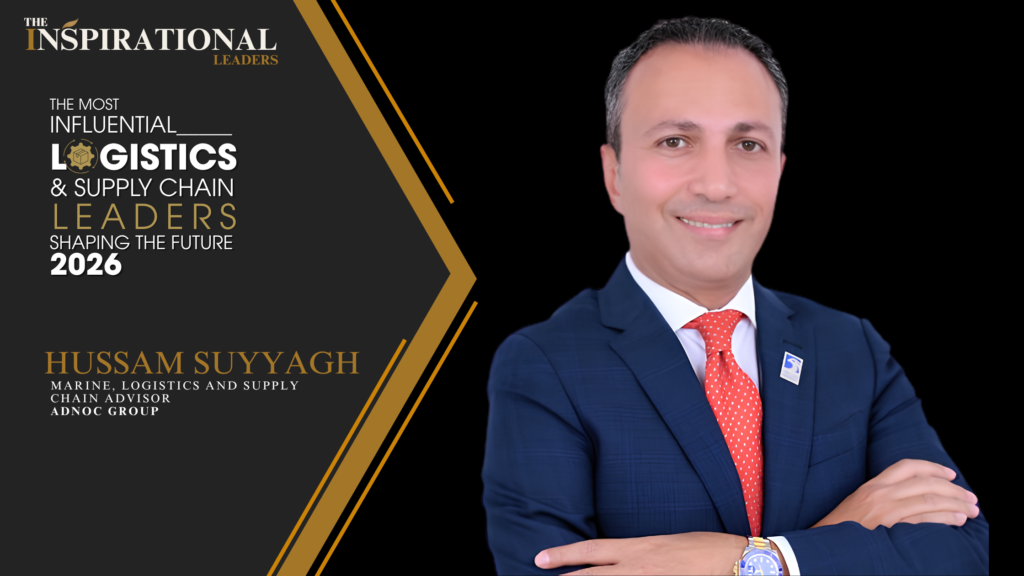
Captain Hussam Suyyagh | Global Marine, Logistics and Supply Chain Thought Leader
Before logistics entered the age of Artificial Intelligence, autonomous systems, digital twins, and connected ecosystems, Captain Hussam Suyyagh working as Marine, Logistics and Supply Chain Advisor | ADNOC Group mastered its most enduring lessons at sea.
The maritime environment revealed a fundamental truth that would ultimately shape his professional journey: global progress depends on the capacity to connect people, assets, technology, and markets efficiently across borders. What may appear simply as the movement of goods is, in reality, a complex network of decisions, relationships, infrastructure, and capabilities working in concert.
That insight became the foundation of a distinguished career spanning more than three decades across marine operations, energy logistics, aviation, digital ecosystems, and advanced technology. Throughout this journey, Suyyagh has done more than witness logistics evolve. He has helped shape initiatives that anticipate where the industry is heading, from digitally enabled logistics operations and AI powered platforms to autonomous marine technologies, drone command and control systems, and smart warehouse initiatives.
His career embodies the wider transformation reshaping the global industry. Logistics is moving beyond transportation and operational efficiency toward intelligent and interconnected ecosystems capable of predicting disruption, optimizing decisions, and adapting in real time.
For Captain Hussam, however, technology is only one dimension of that transformation. The defining challenge is cultivating the leadership, resilience, collaboration, and strategic vision required to turn emerging capabilities into sustainable operational value.
A Maritime Foundation That Inspired a Global Vision
Captain Hussam’s leadership philosophy was forged through the realities of maritime operations, where complexity and uncertainty are constant realities rather than occasional disruptions.
Life at sea taught him that successful operations depend on awareness, discipline, sound judgment, and the ability to respond when circumstances change. More significantly, it revealed the broader economic significance of logistics. Every vessel, warehouse, transportation network, and operational decision is part of a much larger chain that enables industries and communities to function. That perspective inspired him to envision logistics far beyond transportation alone.
Over more than three decades, his influence expanded across marine operations, energy logistics, aviation, and digital ecosystems. Each domain deepened his understanding of how physical operations and digital technologies can converge to create greater efficiency, resilience, and opportunity.
Several pioneering milestones define this journey. He has contributed to establishing a digitally enabled Logistics Operations Center for a leading global energy enterprise, leading AI powered logistics platforms, pioneering autonomous marine technologies, launching an AI Drone Command and Control Center, and advancing autonomous smart warehouse initiatives.
His professional influence also extends beyond individual organizations through leadership, governance, and participation in industry initiatives, including MARACAD, the Smart and Autonomous Systems Council, the Center of Excellence for Smarter Logistics, the Autonomous Mobility Council, international conferences, advisory boards, and innovation forums.
Together, these experiences have shaped a leadership philosophy rooted in anticipation. For Captain Hussam, leadership is not simply about sustaining today’s operational performance. It is about building tomorrow’s capabilities before the market recognizes that they are necessary.
When Supply Chains Become Strategic Command Centers
Traditional supply chains were designed primarily around efficiency. Organizations sought to move goods faster, reduce costs, optimize inventory, and maintain dependable transportation.
Today’s supply chain carries a far broader strategic mandate. Global markets are increasingly interconnected, while geopolitical developments, climate considerations, cybersecurity risks, customer expectations, and unexpected disruptions create a continuously changing operating environment. Efficiency remains important, but it can no longer stand alone.
Captain Hussam envisions next-generation supply chains operating as intelligent ecosystems, not isolated operational functions.
Transportation, warehousing, data platforms, digital infrastructure, strategic partnerships, and predictive intelligence will increasingly operate as interconnected components of one network. This convergence will enable organizations to achieve real time visibility across their supply chains and respond to emerging risks before they become major operational disruptions.
This evolution also elevates the strategic importance of supply chain management. Rather than positioning logistics merely as a cost center, leaders can activate it as a value creation engine capable of strengthening competitive advantage, supporting innovation, and contributing to economic resilience.
In this future model, the supply chain becomes more than a pathway between supplier and customer. It becomes an enterprise-wide strategic command capability.
Beyond Technology Silos: The Connected Logistics Era
The next logistics revolution will not be driven by one technology operating in isolation. Captain Hussam champions the convergence of Artificial Intelligence, autonomous systems, digital twins, advanced analytics, and connected operational ecosystems.
Artificial Intelligence can enable predictive planning, dynamic decision making, and real time optimization. Autonomous technologies can bring intelligence into physical operations through drones, autonomous vessels, and robotic logistics systems. Digital twins can empower organizations to model supply chain networks, test scenarios, simulate disruptions, and assess possible decisions before implementing them.
The influence of these technologies multiplies when they are purposefully connected.
An autonomous vessel, intelligent warehouse, predictive analytics platform, and drone system can each generate value independently. When integrated into a common operational ecosystem, however, they can exchange intelligence and orchestrate a much more responsive network.
Captain Hussam’s experience across smarter logistics and autonomous mobility initiatives has strengthened this conviction. The future will favor organizations capable of uniting their physical operations with digital intelligence.
The objective is never technology for its own sake. It is the ability to use technology to make operations more predictive, responsive, scalable, and resilient.
Leadership Lessons Forged Under Pressure
The sea also forged another defining dimension of Captain Hussam’s leadership: decision making under uncertainty.
Marine operations require leaders to remain alert to changing conditions and make informed decisions even when circumstances are evolving. Those lessons remain equally relevant throughout his career, including during large transformation programs where uncertainty can be just as consequential as it is in physical operations.
Three enduring principles guide his approach.
The first is situational awareness. Leaders must see conditions clearly and distinguish facts from assumptions. The second is decisiveness balanced with adaptability. Decisions cannot always await perfect information, but leaders must remain prepared to adjust when new evidence emerges.
The third is trust reinforced by accountability.
Complex organizations cannot depend on one person making every decision. Teams need the confidence, competence, and authority to act when conditions change.
For him, leadership under pressure is not about possessing every answer. It is about creating clarity when circumstances are unclear, maintaining stability when pressure rises, and empowering people to advance with confidence.
Resilience Is Built Before the Crisis
Supply chain resilience has become a strategic priority, but Captain Hussam frames it as more than a response to disruption. Resilience must be embedded across the organization before disruption occurs.
He identifies five interconnected pillars: visibility, digitalization, diversification, adaptability, and talent.
Visibility provides the foresight required to identify emerging problems. Digitalization creates the infrastructure for faster and more intelligent decision making. Diversification provides flexibility across suppliers, transportation modes, and critical resources. Adaptability enables organizations to respond rapidly as circumstances change.
Talent remains the human foundation connecting all four.
Technology can improve visibility and efficiency, but people determine how effectively organizations respond when reality moves beyond the scenarios anticipated by systems. Human judgment, leadership, creativity, and collaboration remain indispensable.
The objective, therefore, should not be to build organizations that somehow avoid disruption altogether. That is unrealistic.
The more ambitious goal is to build organizations capable of absorbing shocks, adapting quickly, learning from challenges, and emerging stronger.
The Next Competitive Advantage: Intelligent Action
The logistics industry has spent much of the past decade digitizing processes and creating greater visibility. Captain Hussam defines the next stage as a shift from digital information toward intelligent action.
Analytics can reveal what is happening. Automation can improve how processes are executed. Artificial Intelligence can increasingly determine what should happen next.
His experience with AI enabled logistics platforms, autonomous marine systems, smart warehousing, and drone command centers gives him an authoritative, practical perspective on this transition.
AI, he believes, will progressively evolve from being a decision support capability toward becoming an operational decision engine embedded throughout the supply chain ecosystem.
By 2030, advanced logistics networks could be orchestrated through interconnected command centers capable of continuously optimizing routing, maintenance, inventory positioning, workforce allocation, and operational risk management across Air, Land, and Sea.
This redefines the meaning of data-driven competitiveness.
Access to data alone will no longer differentiate leaders. Organizations will need to transform data into intelligent action quickly, consistently, and at scale.
The advantage will belong to those capable of moving from information to decision and from decision to execution faster than their competitors.
Influence Across Borders, Disciplines, and Cultures
Technology creates new possibilities, but transformation ultimately succeeds through people.
Captain Hussam’s career has involved collaboration with global technology companies, energy operators, maritime organizations, regulators, and innovation partners across different regions. These experiences have strengthened his conviction that major transformations are rarely accomplished by individuals working alone.
They are delivered by diverse teams united around a shared purpose.
His approach is to articulate a clear strategic vision, create alignment around common outcomes, and build an environment where diverse perspectives are actively valued.
For him, diversity is not simply something organizations need to accommodate. It becomes a genuine competitive advantage when people with different experiences and expertise contribute toward the same objective.
This principle will become even more important as logistics evolves into a connected ecosystem. The future will require collaboration among technology providers, operators, regulators, infrastructure organizations, and other stakeholders.
Leaders who can bring these groups together will be uniquely positioned to convert innovation into sustainable value.
Sustainability Embedded in Performance
Sustainability is moving beyond a separate corporate objective into the design of future logistics operations.
Captain Hussam advocates approaches will be those that improve environmental performance while simultaneously strengthening operational efficiency.
Electric and hybrid mobility solutions, autonomous transportation systems, AI driven route optimization, smart logistics infrastructure, and integrated planning platforms can help reduce emissions and resource consumption while improving how assets and networks are managed.
His work involving autonomous ready electric vessels, future mobility solutions, digital logistics optimization, and smart infrastructure demonstrates this integrated philosophy.
Sustainability, in this context, is not simply about compliance. It becomes part of operational strategy and a potential source of competitive advantage.
The strongest organizations will increasingly be those capable of balancing economic value, operational performance, resilience, and environmental responsibility rather than treating these objectives as separate priorities.
The Global Leader the Next Decade Will Demand
The coming decade will change not only how logistics operates but also what leadership within the industry requires.
Captain Hussam highlights three forces shaping this evolution: autonomous operations, intelligent ecosystems, and accelerated disruption.
Artificial Intelligence will support increasingly autonomous decision making. Digital twins and connected platforms will bring physical and virtual operations closer together. At the same time, geopolitical shifts, climate pressures, cybersecurity challenges, and evolving customer expectations will continue to increase complexity.
This environment calls for influential leaders who combine operational expertise with technological literacy and strategic foresight.
Tomorrow’s leaders must understand both the physical realities of vessels, warehouses, transportation networks, and field operations and the digital systems increasingly controlling and optimizing them.
They must also remain deeply human in their leadership.
Leadership in a volatile environment is not about knowing everything. It is about navigating uncertainty, asking the right questions, building trust, connecting diverse stakeholders, and continuously adapting.
The ability to transform challenges into opportunities will become a defining characteristic of effective leadership.
Preparing the Leaders Who Will Build the Future
For young professionals entering marine logistics and supply chain management, Captain Hussam offers advice that is practical and forward-looking: master the fundamentals while preparing for technological change.
Operations, safety, risk management, supply chain principles, and customer value creation remain essential. These foundations provide the operational understanding necessary to evaluate whether new technologies actually solve meaningful problems.
At the same time, digital literacy is becoming indispensable.
Professionals entering the industry should build fluency with data analytics, automation, Artificial Intelligence, and emerging logistics platforms. Future leaders may need to move comfortably between conversations about algorithms and discussions about vessels, warehouses, transportation networks, and operational risk.
Yet technical expertise alone will not define leadership.
He emphasizes earning leadership before receiving authority. Integrity, resilience, curiosity, adaptability, and a commitment to serving others are qualities that technology cannot replace.
The most influential professionals will be those capable of bridging operational knowledge with technological intelligence.
From the Sea to a Smarter Future
Captain Hussam Suyyagh’s journey began in an environment where uncertainty was unavoidable and decisions carried immediate consequences. More than three decades later, those formative maritime lessons continue to shape how he approaches the future of logistics.
The tools have evolved. The operating environment has expanded. Artificial Intelligence, autonomous systems, digital twins, smart infrastructure, and connected command centers are creating possibilities that were difficult to imagine when his journey began.
Yet the fundamentals remain remarkably consistent.
Awareness still matters. Sound judgment still matters. Resilience still matters. Trust still matters. And perhaps most importantly, leadership still requires the ability to prepare people and organizations for what lies ahead.
His journey demonstrates how a foundation in marine operations can evolve into a broader vision for intelligent, integrated supply chains across Air, Land, and Sea.
The future of logistics will not be defined simply by moving faster. It will be about seeing earlier, deciding smarter, adapting quicker, and creating systems capable of learning from an increasingly unpredictable world.
From the sea where his journey began to the intelligent ecosystems shaping tomorrow, Captain Hussam’s influence remains anchored on one enduring principle: leaders who prepare for the future before it arrives will be the ones best equipped to build it.