
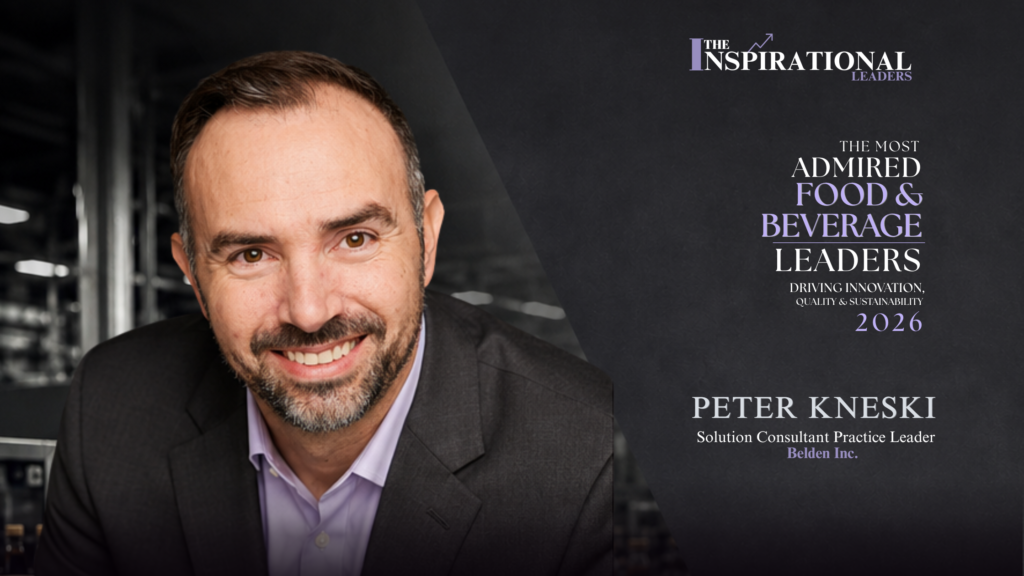
The food and beverage industry stands at a pivotal moment in its evolution. Across the globe, manufacturers are being challenged to produce more efficiently, operate more sustainably, maintain uncompromising quality standards, strengthen cybersecurity, and adapt to increasingly dynamic consumer demands. At the same time, technologies such as artificial intelligence, edge computing, digital twins, and smart manufacturing are transforming what is possible on the factory floor. Yet amid the excitement surrounding these innovations, one critical reality is often overlooked: technology alone does not drive transformation.
For Peter Kneski, Solution Consultant Practice Leader at Belden Inc., the true differentiator is not the latest technology trend but the foundation that supports it. Throughout his career, Peter has worked closely with organizations seeking to modernize operations and unlock the full potential of digital transformation. In that journey, he has witnessed a recurring pattern. Companies frequently invest in promising technologies only to discover that their existing infrastructure is not prepared to support them at scale. The result is often stalled initiatives, failed pilots, and unrealized expectations.
This perspective has shaped Peter’s approach to leadership and innovation. Rather than focusing solely on the technologies that capture headlines, he encourages organizations to think more deeply about how information flows through their operations, how systems communicate, and how infrastructure supports long-term growth. His philosophy is both practical and forward-looking: when the foundation is strong, innovation becomes sustainable, scalable, and capable of delivering measurable business value.
At Belden, Peter operates at the intersection of operational technology, industrial networking, cybersecurity, and digital transformation. This unique vantage point allows him to help manufacturers navigate some of the industry’s most pressing challenges while preparing for a future that is becoming increasingly connected, intelligent, and data-driven. His work is not simply about implementing technology; it is about helping organizations create the conditions that allow technology to thrive.
In an industry where quality, efficiency, resilience, and sustainability have become inseparable priorities, Peter’s insights offer a compelling blueprint for what comes next.
Leading Beyond Technology
One of the reasons Peter’s perspective resonates so strongly within the manufacturing sector is that it is rooted in practicality rather than hype. While many conversations about digital transformation focus on ambitious visions of the future, Peter believes successful leadership begins with understanding the details.
For him, innovation is not about adopting technology because it is trending. It is about understanding how technology functions, how it aligns with operational objectives, and how it creates measurable value. This disciplined approach has become one of the defining characteristics of his leadership philosophy.
In highly regulated industries such as food and beverage manufacturing, where quality, safety, compliance, and consistency are paramount, leaders cannot afford to make decisions based on assumptions. Every investment must be evaluated carefully. Every solution must be examined critically. Every initiative must have a clear purpose.
Peter often emphasizes the importance of continually asking the right questions. How will this technology improve operations? Why is it necessary? What outcomes should be expected? What happens if conditions change? These questions help organizations move beyond marketing promises and focus on practical results.
Equally important is the role of partnerships. Digital transformation rarely happens in isolation. Manufacturers frequently rely on external organizations to provide expertise, technology, and support. However, Peter believes selecting a partner involves much more than evaluating products or technical capabilities.
Culture matters. Values matter. Commitment matters. The strongest partnerships are built when organizations share a common purpose and a genuine desire to create value together. Peter has consistently found that technology providers who demonstrate passion, accountability, and a deep understanding of their customers’ challenges are often the ones who deliver the most meaningful results.
This people-first approach has become increasingly important as organizations navigate complex transformation journeys. Technology may enable progress, but trust, collaboration, and shared vision are often what make that progress possible.
Reimagining Manufacturing Through Digital Transformation
Few developments have influenced modern manufacturing as profoundly as digital transformation. What was once viewed as a collection of disconnected technologies has evolved into a strategic framework for improving performance across every aspect of the business.
Peter has observed this evolution firsthand. In his view, one of the most significant impacts of digital transformation has been the way manufacturers interpret and utilize operational data.
Historically, many organizations relied on delayed reporting, fragmented information, and limited visibility into production environments. Decision-making often depended on historical trends rather than real-time insights. While these approaches served their purpose, they left significant opportunities for optimization untapped.
Today, digital transformation is changing that reality. Modern manufacturing environments generate enormous volumes of operational data. When properly collected, contextualized, and analyzed, this information becomes a powerful tool for improving efficiency, consistency, and performance.
Within the food and beverage sector, throughput remains one of the most important drivers of operational success. Manufacturers constantly seek ways to increase production while maintaining quality standards and controlling costs. Digital transformation provides unprecedented visibility into these objectives.
Organizations can now compare throughput across facilities, monitor utility consumption, evaluate production efficiency, and maintain quality consistency across diverse manufacturing environments. Instead of viewing these metrics independently, they can analyze them collectively, revealing relationships and opportunities that were previously difficult to identify.
This holistic perspective enables better decision-making at every level of the organization. Leaders gain greater confidence in strategic planning, managers receive faster access to operational insights, and frontline teams benefit from clearer visibility into performance.
For Peter, the true power of digital transformation lies in its ability to turn data into actionable intelligence. It is not simply about collecting information; it is about creating the clarity needed to drive meaningful improvement.
Why Edge Computing Is Becoming a Game-Changer
As manufacturers continue to expand their digital capabilities, the volume of data generated throughout production environments continues to grow. Managing this information efficiently has become one of the industry’s most important challenges.
Among the technologies reshaping this landscape, Peter identifies edge computing as one of the most impactful developments in recent years.
Traditionally, manufacturing systems transmitted large volumes of operational data directly to centralized cloud platforms for storage and analysis. While this model offers advantages, it can also create challenges related to bandwidth consumption, cloud-computing costs, and response times.
Edge computing introduces a different approach.
By bringing data collection, processing, and analysis closer to the source, organizations can extract value from information before it ever reaches higher-level systems. Rather than continuously transmitting every data point, edge technologies analyze information locally and communicate only meaningful changes, events, or insights when necessary.
The operational benefits are significant. Organizations reduce network traffic, lower cloud-computing expenses, and improve system responsiveness. More importantly, they gain the ability to make decisions faster.
In manufacturing environments where timing can directly influence productivity, this speed creates a meaningful competitive advantage. Production teams receive actionable insights more quickly, operational disruptions can be addressed sooner, and resources can be utilized more efficiently.
Peter believes that organizations that fully understand the capabilities of edge computing are already beginning to realize substantial benefits. As digital transformation continues to mature, edge technologies will likely play an increasingly important role in enabling smarter, more agile manufacturing operations.
The Challenge of Scaling Innovation
One of the most overlooked aspects of digital transformation is scalability. Peter has seen numerous organizations achieve success during pilot programs only to struggle when attempting broader deployment. In many cases, the technology itself performs well, but the surrounding infrastructure, processes, or organizational readiness prevent sustainable expansion. This is why scalability has become one of Peter’s primary considerations when evaluating any new technology initiative.
According to him, every pilot should be designed with enterprise-wide implementation in mind. Success should not be measured solely by short-term outcomes. Instead, organizations must ask whether a solution can be standardized, replicated, and supported across multiple facilities and operational environments.
This shift in thinking changes how innovation is evaluated. Rather than focusing exclusively on technical performance, leaders begin considering long-term sustainability, governance, workforce adoption, and infrastructure requirements from the outset. These factors often determine whether a promising concept becomes a transformational capability.
Once scalability is understood, standardization becomes the next priority. Consistent frameworks, deployment methodologies, and operational standards create the foundation for repeatable success. They enable organizations to expand innovation without sacrificing quality, reliability, or efficiency.
However, Peter is quick to point out that technology adoption is never solely a technical challenge. People remain at the center of every transformation effort. Employees must understand why changes are being implemented, how new systems support their work, and what benefits they provide. Without organizational acceptance, even the most sophisticated technologies can struggle to achieve their intended impact.
For Peter, successful innovation occurs when scalability, standardization, and human engagement come together. When these elements align, transformation becomes more than a project-it becomes a lasting competitive advantage.
Turning Sustainability Into a Measurable Strategy
Sustainability has evolved from a corporate aspiration into a business imperative. For food and beverage manufacturers, environmental responsibility is no longer simply about meeting regulatory requirements or satisfying stakeholder expectations. It has become a strategic driver of efficiency, resilience, and long-term growth.
Peter believes that one of the most powerful enablers of sustainability is visibility. Most manufacturing processes consume significant amounts of energy, water, gases, and other resources. Historically, organizations measured these utilities at a facility-wide level, providing only a broad understanding of consumption patterns.
Today, that level of visibility is no longer sufficient. Modern digital technologies allow manufacturers to monitor resource utilization at increasingly granular levels-from the plant and production line to individual machines and even specific products.
This transformation is changing how sustainability initiatives are approached. Instead of relying on assumptions, organizations can identify precisely where resources are consumed, where inefficiencies exist, and where improvements can have the greatest impact.
For Peter, this represents a fundamental shift in how manufacturers think about environmental performance. Sustainability becomes measurable, actionable, and directly connected to operational excellence.
Yet none of these capabilities can exist without the infrastructure required to support them. The operational technology network serves as the backbone of modern manufacturing intelligence, enabling data collection, communication, and analysis across the enterprise. Without a scalable and reliable digital foundation, sustainability initiatives often struggle to achieve their full potential.
This belief-that infrastructure is the enabler of innovation-continues to shape Peter’s vision for the future of food and beverage manufacturing.
From Reactive Operations to Intelligent Decision-Making
If there is one challenge Peter Kneski consistently sees across food and beverage manufacturing environments, it is the gap between identifying operational issues and acting on them. In many facilities, production inefficiencies are often discovered only after valuable time has been lost. A process may be underperforming for hours before the problem becomes visible through reports, shift reviews, or management analysis. By then, opportunities for optimization have already slipped away.
Peter believes the next wave of manufacturing innovation will fundamentally change this dynamic. Through the integration of real-time data, machine learning models, artificial intelligence, and digital twin technologies, manufacturers are beginning to move away from reactive decision-making and toward predictive, intelligent operations. Rather than waiting for individuals to interpret historical information, advanced systems can identify patterns as they emerge and provide immediate guidance for corrective action.
Imagine a production line experiencing a gradual reduction in throughput. Traditionally, operators might not recognize the trend until production targets have already been impacted. In a digitally connected environment, however, machine learning models can continuously evaluate performance data, compare it against expected outcomes, and alert teams when anomalies appear. More importantly, these systems can recommend specific adjustments that may restore efficiency before significant losses occur.
For Peter, this capability represents one of the most exciting developments in modern manufacturing. Artificial intelligence is not replacing human expertise; it is amplifying it. By delivering near real-time insights, AI enables operators, supervisors, and plant leaders to make faster and more informed decisions. The result is greater agility, improved productivity, reduced waste, and a more resilient manufacturing environment.
Digital twins further enhance this potential by allowing organizations to model operational scenarios virtually before implementing changes in the real world. This ability to simulate outcomes reduces risk while accelerating innovation, helping manufacturers optimize processes with greater confidence.
As these technologies continue to mature, Peter sees enormous opportunities for organizations willing to embrace a more intelligent approach to operations.
Making Industry 4.0 Investments Matter
Few topics generate as much excitement in manufacturing today as Industry 4.0. Yet Peter believes enthusiasm alone is not enough to guarantee success.
Across the industry, organizations are evaluating a growing number of technologies, platforms, and solutions designed to improve efficiency and competitiveness. While many of these innovations offer tremendous promise, Peter has observed that the most successful organizations share one common characteristic: they approach investment decisions strategically rather than impulsively.
Too often, companies pursue technology initiatives because they appear innovative or because competitors are adopting similar solutions. While staying current with industry trends is important, meaningful transformation requires a deeper understanding of organizational readiness and business value.
According to Peter, one of the most effective starting points is a comprehensive assessment of existing operations. Before investing in new technologies, leaders should understand the strengths, weaknesses, and limitations of their current processes, standards, and infrastructure.
This is where third-party expertise can provide significant value. An experienced external perspective often uncovers opportunities and challenges that internal teams may overlook. Organizations gain access to industry insights, best practices, and objective recommendations that help prioritize investments more effectively.
These assessments frequently reveal which initiatives can generate the highest return in the shortest period of time and which foundational improvements should be addressed first. In many cases, organizations discover that infrastructure modernization is the key that unlocks multiple future opportunities.
For Peter, successful Industry 4.0 adoption is not about implementing the most advanced technology available. It is about creating an environment where technology can consistently deliver measurable outcomes. The organizations that achieve the greatest success are those that align innovation with strategy, infrastructure, and long-term business objectives.
Strengthening Cybersecurity in an Increasingly Connected World
As manufacturing environments become more interconnected, cybersecurity has emerged as one of the most important challenges facing industry leaders. The convergence of operational technology and information technology has created unprecedented opportunities for efficiency and visibility. At the same time, it has introduced new risks that cannot be ignored.
For food and beverage manufacturers, cybersecurity is no longer solely an IT concern. It is a business continuity concern. Production interruptions, data breaches, ransomware attacks, and infrastructure vulnerabilities can impact operations, customer relationships, regulatory compliance, and financial performance. Protecting manufacturing environments therefore requires a proactive and strategic approach.
Peter advocates beginning with established industry frameworks such as IEC 62443 and NIST, both of which provide practical guidance for securing industrial environments. These standards offer organizations a roadmap for evaluating vulnerabilities, implementing controls, and improving resilience.
However, Peter emphasizes that compliance alone should never be the ultimate goal. Cybersecurity must be embedded within the broader operational strategy of the organization. Leaders should assess current infrastructure, identify gaps, and develop phased implementation plans that improve security without creating unnecessary production disruptions.
One of the realities of manufacturing is that downtime is costly. Security improvements must therefore be executed thoughtfully, balancing risk reduction with operational continuity. This is another area where infrastructure plays a vital role. Secure, resilient networks form the backbone of modern manufacturing environments, enabling organizations to adopt new technologies while maintaining confidence in their operational stability.
As digital transformation accelerates, Peter believes cybersecurity will increasingly become a defining characteristic of high-performing manufacturing organizations.
Envisioning the AI-Powered Future of Food and Beverage
When Peter discusses the future of food and beverage manufacturing, one theme consistently rises to the surface: artificial intelligence.
While many organizations are still exploring the practical applications of AI, Peter believes its long-term impact will extend far beyond isolated use cases or individual automation projects. Instead, AI has the potential to transform entire value chains.
The future he envisions is one where data flows seamlessly across interconnected systems, creating highly intelligent and responsive manufacturing ecosystems.
Consumer demand patterns could be predicted through advanced analytics before purchasing trends become visible. Enterprise Resource Planning systems could automatically place orders for raw materials based on anticipated demand. Manufacturing Execution Systems could dynamically create production schedules optimized for efficiency and responsiveness.
At the same time, robotics could manage packaging and handling processes, while autonomous logistics systems coordinate transportation activities. Intelligent algorithms could continuously evaluate sourcing options, determine the most efficient production locations, and identify optimal delivery routes.
Rather than functioning as isolated systems, every component of the operation would work together as part of a unified digital ecosystem.
What makes this vision particularly compelling is that many of its building blocks already exist today. Artificial intelligence, machine learning, advanced analytics, robotics, and industrial automation technologies are rapidly maturing. The organizations that invest in foundational capabilities today will be better positioned to capitalize on these advancements tomorrow.
Peter believes the future belongs to manufacturers that view technology not as a collection of individual tools but as an integrated strategy for creating agility, intelligence, and competitive advantage.
A Message to Leaders Building the Future
Having spent years helping manufacturers navigate digital transformation journeys, Peter has developed a perspective shaped by both successes and challenges. Among the many lessons he has learned, one stands above the rest: infrastructure cannot be an afterthought.
Throughout his career at Belden, he has seen countless technology investments struggle because organizations underestimated the importance of the underlying foundation required to support them. In many cases, the technology itself performed exactly as intended. The challenge was not the application-it was the environment in which the application was expected to operate. This lesson is particularly important for organizations early in their digital transformation journey.
Many manufacturers are eager to explore emerging technologies, launch pilot projects, and pursue innovative use cases that promise operational improvements. While this ambition is understandable, Peter encourages leaders to take a step back and examine the broader picture.
How does data move through the production environment? Can the existing infrastructure support future growth? Will the solution scale across multiple facilities? Is the organization prepared for long-term adoption?
These questions may not be as exciting as discussions about artificial intelligence or smart factories, but they often determine whether innovation succeeds or fails.
Peter believes that if industry leaders carefully examine virtually every major technology trend shaping manufacturing today-from sustainability and predictive maintenance to cybersecurity and advanced analytics-they will find one common denominator: operational technology infrastructure. It is the invisible enabler behind every successful transformation initiative.
Building the Foundation for What Comes Next
The future of food and beverage manufacturing will undoubtedly be shaped by extraordinary technological advancements. Artificial intelligence will continue to evolve. Smart manufacturing systems will become more sophisticated. Sustainability initiatives will become increasingly data-driven. Cybersecurity will become more critical. Consumer expectations will continue to rise.
Yet amid all this change, Peter Kneski remains focused on a principle that is both simple and profound. Innovation is only as powerful as the foundation supporting it.
That belief has guided his work throughout his career and continues to influence how he helps organizations prepare for the future. It is a philosophy grounded not in theory, but in experience-a perspective shaped by years of helping manufacturers transform ambitious ideas into practical outcomes.
At a time when the industry is racing toward greater connectivity, automation, and intelligence, Peter offers an important reminder: technology alone does not create transformation. Transformation occurs when organizations build the infrastructure, processes, and culture necessary to support innovation at scale.
The manufacturers that thrive in the years ahead will not simply be the ones that adopt the newest technologies first. They will be the ones that create resilient foundations capable of supporting continuous evolution.
For Peter Kneski, that is where the future begins. Not with a device. Not with an application. Not even with artificial intelligence. It begins with the infrastructure that makes everything else possible. And in a world increasingly defined by digital transformation, that foundation may prove to be the most important innovation of all.