
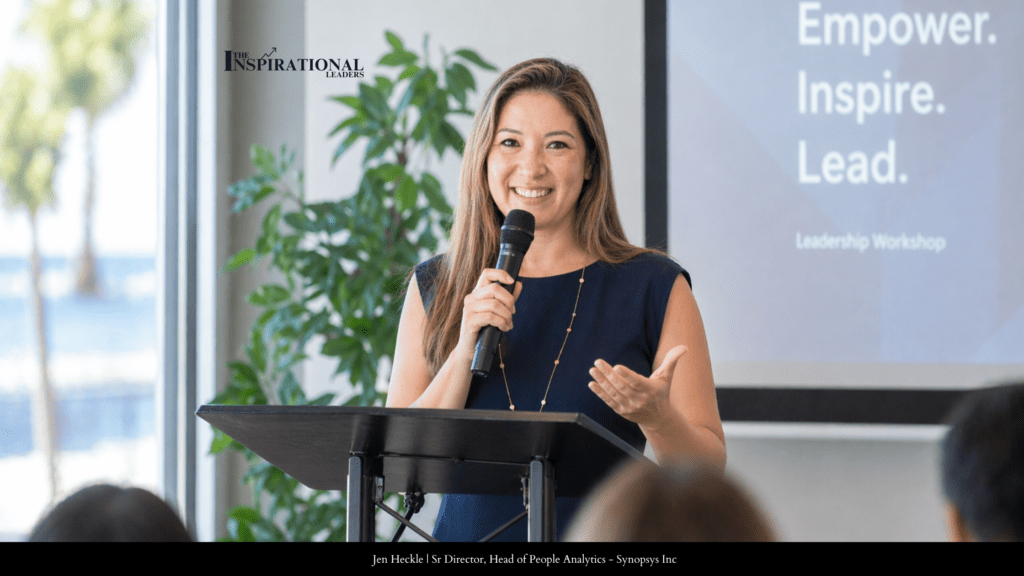
In today’s enterprise landscape, where organizations are increasingly driven by metrics, dashboards, and predictive models, one fundamental challenge remains – understanding people in a way that is both measurable and meaningful. While data can quantify behavior, it rarely explains it in isolation. Bridging that gap requires a unique blend of analytical precision and human insight – an intersection where Jen Heckle, Senior Director and Head of People Analytics at Synopsys Inc, has built her career.
Her work is not just about interpreting workforce data, but about transforming it into a strategic language that organizations can act on. In doing so, she represents a new generation of HR leadership – one that does not separate data from empathy, but integrates both to drive decisions that are not only informed, but impactful.
Where Curiosity Became Direction
Long before people analytics became a defined discipline, Jen Heckle was already navigating its foundations. Her academic interests were split between psychology and business – two fields that, at the time, seemed parallel rather than intersecting. Without the formal awareness of Industrial/Organizational Psychology as a discipline, she instinctively gravitated toward understanding how human behavior influences workplace outcomes.
That curiosity quickly found real-world expression. While still in college, Heckle managed a retail store, balancing academic theory with daily operational responsibility. What made this experience transformative was not just the exposure to leadership, but the ability to test ideas in real time.
“I would drive to my shift, after my classes, employ one of the strategies I had read about in class that day, and was able to rapidly put my learnings into action,” she reflects. The immediacy of that application created a powerful feedback loop – one where concepts were not abstract, but tangible, observable, and measurable.
It was in these moments that she recognized the practical power of psychology within a business environment. But equally important was the realization that insight alone was not enough. To influence decisions at scale, those insights needed to be translated into something leaders could trust and act upon. “Seeing the power of psychology in a workplace setting is one thing, but selling that idea to a leadership team is another thing,” she explains. “That’s where the numbers come in.”
This early understanding would go on to define her career. “Data is the secret weapon of any argument,” she adds – a statement that captures the essence of her approach: using evidence to elevate human-centered strategies from intuition to influence.
From Insight to Influence: The Strategic Role of People Analytics
As organizations grow more complex, the need to understand workforce dynamics with clarity has become critical. People analytics has emerged as a key function in addressing this need, enabling leaders to move beyond assumptions and toward evidence-based decision-making.
For Heckle, however, the value of people analytics lies not just in its ability to provide answers, but in its ability to shape better questions. It is not simply about tracking metrics such as engagement, retention, or performance, but about uncovering the underlying drivers behind them.
Her approach reflects a shift from descriptive to diagnostic thinking – moving from “what is happening” to “why it is happening” and ultimately to “what should be done about it.” This progression is what transforms data into strategy.
Equally important is the role of people analytics in aligning workforce strategies with broader organizational goals. By translating employee data into actionable insights, Heckle enables leadership teams to make decisions that are not only operationally sound, but strategically aligned with long-term success.
The Science of Employee Experience: Listening Beyond the Numbers
At the core of Heckle’s philosophy is a deep commitment to understanding the employee experience – not as a static measure, but as a dynamic and evolving journey. While quantitative data provides valuable signals, it is only one part of the equation. “The heart of People Analytics is always employee listening,” she emphasizes.
This principle reflects an important distinction: data can highlight patterns, but it is listening that provides meaning. For example, while organizations may have access to metrics indicating attrition rates, those numbers alone cannot explain the reasons behind employee departures.
“Yes, we have stats on who’s leaving, from what parts of the organization, and in what numbers,” she explains. “But, to be able to tie it to the ‘why’ required listening to employees.”
What emerges from this listening is often more nuanced than expected. Employee disengagement is rarely the result of a single event. Instead, it is typically a gradual process – a slow accumulation of unmet expectations, misaligned priorities, or overlooked frustrations. “Often times, it isn’t a single event, but a slow disengagement that builds over time, and then is sparked by a casual recruiter call,” she notes.
This insight shifts the focus from reactive to proactive intervention. Instead of responding only when employees leave, organizations have the opportunity to identify and address issues earlier in the engagement curve. “What if we could intervene farther up on that curve?” she asks – a question that encapsulates the strategic potential of people analytics.
To do so effectively, organizations must go beyond surface-level data and invest in understanding the full employee experience – what drives satisfaction, what creates friction, and what influences long-term commitment.
Trust, Transparency, and the Ethics of Data
Collecting meaningful employee insights, however, depends on one critical factor – trust. Without it, the quality and authenticity of data are compromised, limiting its value.
Heckle is clear about the responsibility that comes with handling workforce data. “In order to get employees to tell us these things, they need to absolutely trust that we handle their sentiment data with care – and are transparent about how we use their data and for what purpose.”
This emphasis on transparency is not merely a best practice – it is foundational. Employees must feel confident that their voices will not only be heard, but respected. This requires clear communication about how data is collected, how it is used, and how it contributes to decision-making.
Trust, in this context, becomes both an ethical obligation and a strategic enabler. It allows organizations to access deeper, more honest insights, which in turn lead to more effective actions.
Data as Influence: Turning Insight into Action
One of the defining challenges in people analytics is ensuring that insights lead to action. Data, no matter how robust, has limited impact if it remains confined to reports or dashboards.
This is where Heckle’s ability to influence becomes particularly significant. Her work extends beyond analysis to communication – translating complex findings into narratives that resonate with leadership teams.
Her background in psychology plays a critical role in this process. Understanding how people think, process information, and make decisions allows her to frame data in a way that is both compelling and actionable.
“Analytical thinking is required for the field I’m in, but it only matters as far as you can tell the story that accompanies the data,” she explains.
Effective storytelling, in her approach, is about relevance. It is about answering the fundamental questions that drive engagement: Why does this matter? How does it impact you? What should be done next?
“The stories that have teeth are the ones that help the audience connect with the findings,” she adds. By combining analytical rigor with narrative clarity, Heckle ensures that her insights do not remain theoretical, but translate into meaningful organizational change.
Leadership Through Service: Building Teams That Thrive
Beyond her analytical expertise, Heckle’s leadership philosophy is grounded in service. “Servant leadership has always been my main leadership mantra,” she states – a principle that shapes how she builds and leads her team.
Her approach begins with trust – hiring talented individuals and empowering them to take ownership of complex challenges. “Hire talented people, give them challenging problems, and support them in whatever ways they need to work at their best,” she explains.
This creates an environment where individuals are not only accountable, but also supported – a balance that drives both performance and engagement.
At the same time, Heckle recognizes that organizational priorities are constantly evolving. As goals shift, so too must the focus of her team. Maintaining alignment in such a dynamic environment requires clarity, communication, and shared purpose.
“As long as they’re bought in to the rationale and the journey, they’ll figure out solutions through the complexity,” she notes. Her leadership extends beyond her immediate team to her interactions with stakeholders. By aligning on challenges and demonstrating how data can contribute to solutions, she positions herself as a partner in achieving organizational success.
Mentorship and Growth: Creating a Culture of Possibility
One of the most defining aspects of Heckle’s leadership is her commitment to developing others. Having built her team from scratch, she approached the process with intentionality – focusing not just on capability, but on culture. “I hope I have created one that is collaborative, trusting, and honestly, fun to be a part of,” she shares.
This emphasis on culture reflects her understanding that performance is not just about individual capability, but about the environment in which people operate. A supportive and engaging workplace fosters creativity, collaboration, and sustained growth.
Her approach to mentorship is equally distinctive. Rather than holding on to talent, she actively supports their development – even when it leads them beyond her team.
“I am not one of those leaders who tries to keep my arms around employees,” she says. “I love watching them spread their wings – and love to keep in touch to continue cheering them on from the sidelines.”
This perspective reflects a long-term view of leadership – one that prioritizes growth, independence, and lasting impact over short-term retention.
The Future of Work: Navigating Complexity with Clarity
As the workplace continues to evolve, the role of people analytics is becoming increasingly central to organizational success. From shifting employee expectations to the growing importance of flexibility and engagement, the dynamics of work are more complex than ever.
Heckle’s perspective points to a future where organizations must become more proactive, more adaptive, and more attuned to the human experience. Data will play a critical role in this transformation – not as a replacement for intuition, but as a complement to it.
The ability to anticipate trends, identify risks, and respond to changing conditions will define the effectiveness of future leadership. At the same time, maintaining a strong focus on empathy and trust will be essential in ensuring that these changes are both sustainable and inclusive.
A Legacy Beyond Metrics: Redefining Impact in People Analytics
Looking ahead, Jen Heckle’s vision extends beyond improving metrics or optimizing processes. Her work is ultimately about impact – creating environments where individuals can perform at their best, feel valued, and contribute meaningfully to organizational success.
By integrating data with empathy, and analysis with storytelling, she is helping redefine the role of people analytics in modern organizations. It is no longer just a support function, but a strategic driver of decision-making and transformation.
In a world where data continues to grow in importance, her approach serves as a reminder that numbers alone are not enough. It is the human context behind those numbers – the stories, experiences, and perspectives – that truly drive meaningful change.
And it is in that space, where insight meets understanding, that Jen Heckle continues to lead – quietly, strategically, and with a lasting impact that goes far beyond the data itself.