
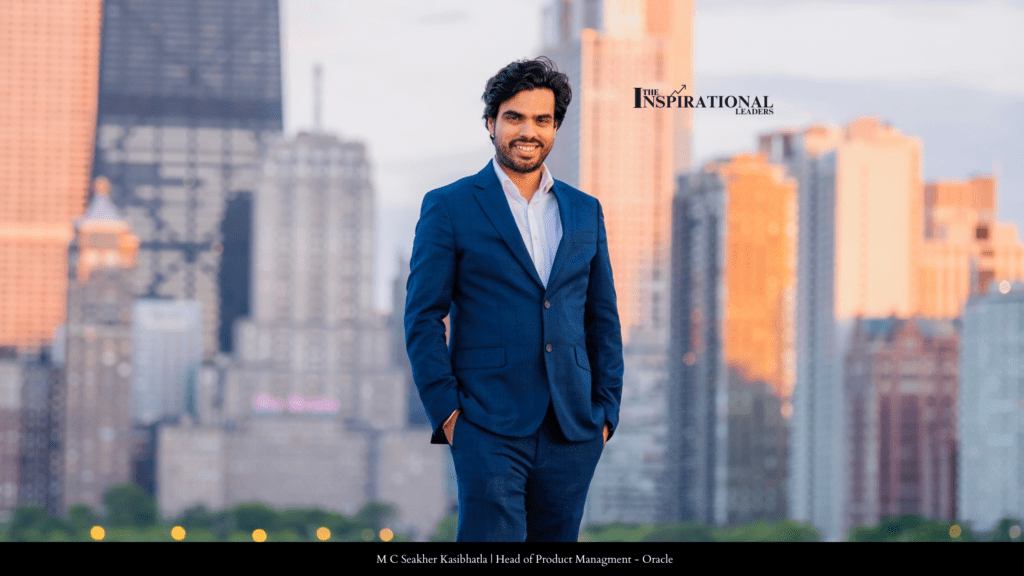
- (A leadership journey shaped across 30+ countries, five industries, and the unforgiving moments where technology meets human reality.)
There is a version of product management that exists in controlled environments – where variables are defined, systems behave predictably, and outcomes can be modeled with confidence. It is a version that rewards precision, structure, and clarity. But it is not where the most meaningful products are built.
For M C Seakher Kasibhatla, Director of Product Management at Oracle, that realization did not come from theory – it came from experience. Over the course of a career that has spanned 30+ countries, five industries, and some of the most demanding operational environments, his journey has been shaped not by ideal conditions, but by moments where systems were tested against reality – and often found wanting.
What follows is not just a progression of roles or achievements, but a deeper evolution in how products are understood, built, and scaled. From early days in simulation engineering to leading large-scale payment infrastructure at global scale, Seakher’s work reflects a consistent principle: technology only matters when it works for the people who rely on it in real conditions.
There is a version of product management that exists in controlled environments – where variables are defined, systems behave predictably, and outcomes can be modeled with confidence. It is a version that rewards precision, structure, and clarity. But it is not where the most meaningful products are built. Those are shaped elsewhere – where systems meet unpredictability, where human behavior overrides assumptions, and where reality has a way of exposing every hidden flaw.
For a leader whose career began as a simulation engineer at Ansys, this distinction became clear early, though not immediately. Simulation offered a world of control: define the inputs, run the model, and trust the output. It was elegant in its logic and satisfying in its predictability. But it also operated within boundaries – conditions that rarely mirrored the complexity of real-world environments. What simulation couldn’t teach was how to operate when those variables refused to cooperate.
The shift began with exposure to a different way of thinking. Working alongside Steve Pilz, a product manager at Ansys, revealed a fundamentally different approach to problem-solving. Where simulation emphasized certainty, Pilz operated comfortably in ambiguity. He made decisions without complete information, navigated trade-offs in real time, and focused less on being correct and more on being useful to the end user.
That distinction changed everything. It reframed product management from a discipline of control to one of adaptation – less about predicting outcomes and more about responding to reality as it unfolds. That curiosity – to understand how systems behave outside controlled environments – became the thread that carried forward into the next phase of the journey.
From Theory to Tarmac: Where Real Systems Get Tested
That transition took shape at gategroup, under the leadership of Rodney Duty, who led the Innovation and New Product Development group with a philosophy that extended beyond incremental improvement. It was an environment that encouraged exploration at the edges – where technology could be applied in ways that were not yet obvious, including early experimentation with Alexa-powered voice interfaces for warehouse operations. But the most defining lessons didn’t come from innovation labs. They came from exposure – direct, unfiltered, and often uncomfortable – to the environments where these systems actually lived.
Spending a full day traveling nearly 18,000 miles without leaving airside, moving through airports across time zones, revealed a fundamental truth: the same system behaves differently depending on context. Infrastructure, operational culture, and human behavior reshape technology in ways that cannot be replicated in controlled testing environments. That insight was reinforced in moments that were far less observational and far more direct.
In Germany, during a meeting with union representatives, the feedback was immediate and unfiltered: the product did not work for them. Not in theory, not in intention – but in practice. And later, during live deployments with easyJet crew, where the margin for error didn’t exist – 45 minutes to serve 180 passengers, in a high-pressure environment where even minor friction could cascade into operational failure.
These weren’t isolated incidents. They were reality asserting itself. And from those experiences emerged not a framework, but a reflex: get close to the user before anything else. Because the gap between what a product is designed to do and what it actually does – under pressure, in imperfect conditions – is where most systems fail.
The Breaking Point: When “Correct” Stops Being Enough
The most defining shift came during the first live deployment with easyJet. On paper, the system was flawless. It met every requirement, passed every test, and performed exactly as designed within controlled conditions. It was, by all technical standards, correct. But an aircraft cabin is not a controlled environment. It is a confined, high-pressure space at 35,000 feet, filled with variables no system design fully anticipates – passenger devices creating wireless interference, constant movement, time constraints, and the cognitive load placed on crew members managing service in real time.
The system required crew devices to maintain Bluetooth connections to payment terminals while synchronizing inventory continuously. In theory, it worked seamlessly. In reality, connections dropped. Inventory mismatches led to overselling. Crew members, under pressure to complete service, began bypassing the system entirely – relying on memory, improvisation, and speed. They weren’t failing the system. The system was failing them. That moment crystallized a principle that would shape every decision moving forward: “Correctness is a threshold. Usefulness is the actual goal.”
A product that works in isolation but breaks under real conditions is not successful. True success lies in enabling the user to perform better – faster, more efficiently, and with less friction – regardless of environment.
Designing for Reality: When Assumptions Break Down
At gategroup, the challenge wasn’t just technological – it was contextual. The primary users were not customers, but airline crew, operating within tightly constrained service windows, where every additional interaction with a system carried a cost. Every extra tap, delay, or interruption translated directly into lost time in an environment that had none to spare.
Behind them, thousands of warehouse workers and drivers operated within equally demanding conditions – loading carts, scanning items, and managing logistics on schedules dictated by flight departures. They worked quickly, often wearing gloves, rarely looking at screens, and functioning in environments where attention was fragmented.
One seemingly simple design decision exposed a deeper flaw in assumptions. A dispatch application was built for warehouse drivers. When an error occurred, the system displayed a visual alert. Logical. Standard. Ineffective. No one noticed it. Because the assumption – that users would look at the screen – was incorrect.
The solution required stepping back from the interface and understanding the context. Visual alerts were replaced with haptic and audio feedback, providing immediate, physical signals without requiring users to shift attention. The impact was immediate. Error detection improved significantly. The innovation wasn’t adding functionality. It was removing a flawed assumption about user behavior.
Scaling Complexity: Building Infrastructure That Disappears
That philosophy expanded significantly at Oracle, under the leadership of Chris Adams and Keshav Kiran, where the challenge shifted from designing within a single environment to building infrastructure that could operate across many. The goal was ambitious: a unified payments platform capable of supporting restaurants, retail, hospitality, healthcare, and utilities – each with its own operational nuances, regulatory requirements, and failure implications.
Today, that platform processes hundreds of millions of transactions annually, supporting billions in gross payment volume. But scale, in itself, is not the defining metric. The real measure is invisibility. When a system is functioning at its best, it disappears into the background. It enables rather than interrupts. It supports rather than demands attention.
This philosophy is most evident in the development of the Auto-Rescue engine – a machine learning system designed to address a critical yet often overlooked problem: failed payment authorizations. Instead of treating failures as endpoints, the system identifies them and applies intelligent, scheme-aware retry strategies, recovering approximately 35% of failed transactions. For businesses operating on thin margins, particularly in hospitality, this translates into hundreds of thousands of dollars in recovered revenue annually.
These are not features that users notice. But they are outcomes that materially change how businesses operate. Because the most impactful innovations are often the ones users never see.
Innovation at the Edges, Reliability at the Core
Balancing innovation with reliability requires clarity about where each belongs. At gategroup, experimentation was encouraged – whether through voice interfaces or alternative interaction models. At Oracle, features such as biometric checkout, alternative payment flows, and advanced retry logic continue to evolve.
But the core transaction processing layer remains non-negotiable. It must work. Every time. “Experiment at the edges. Never at the foundation.” This principle reflects a deeper understanding of risk. Innovation drives progress, but reliability sustains trust. Without a stable foundation, even the most advanced features lose their value.
Leadership in Complexity: Listening Over Defending
Leadership in high-pressure environments often defaults to certainty. But one of the most defining lessons came from choosing a different path. During the meeting in Germany with union representatives, the initial instinct was to defend the product. Preparation had been thorough. The system worked – technically.
But the feedback revealed a different reality. The interface didn’t align with real workflows. Prompts required cognitive effort at moments when attention was already stretched. The system functioned – but not for the people using it. Working alongside Simon DeMontfort Walker, the decision was made to stop presenting and start listening.
What followed was a shift – from resistance to collaboration. The same individuals who were most critical became the most valuable contributors, offering insights that directly shaped the redesign. And the redesign worked. The experience reinforced a principle that continues to guide leadership: “People who tell you directly what’s wrong with something you’ve built are doing you a favor.”
Building Teams That Think, Not Just Execute
In complex environments, clarity does not come from projecting certainty – it comes from acknowledging uncertainty. Being explicit about what is not yet known creates space for better decision-making. It invites participation. It encourages ownership.
When leaders articulate uncertainty:
- Engineers identify constraints earlier
- Compliance surfaces risks before they escalate
- Teams engage with the problem, not just the solution
The result is not just better outcomes, but stronger teams – teams that understand not just what they are building, but why.
Rethinking Infrastructure: Beyond Industry Silos
Building across five industries simultaneously introduced a discipline that single-domain systems rarely require. At a fundamental level, the mechanics of payments – authorization, settlement, retry logic – remain consistent. What changes is the context: regulatory frameworks, integration complexity, and the consequences of failure.
Designing for multiple industries forced a shift toward horizontal architecture – systems that abstract what is universal while allowing what is context-specific to remain configurable. This approach challenges traditional thinking, particularly in organizations optimized for vertical specialization. But it also produces more resilient systems – systems capable of adapting to environments that were not fully anticipated during design. Increasingly, this model is shaping the future of payment infrastructure.
The Next Frontier: From Processing to Self-Healing
The industry has invested heavily in making transactions faster and smoother. But a more pressing challenge lies in what happens when they fail. Failures are often invisible:
- A declined transaction
- An abandoned cart
- A missed authorization
For operators working with 3–5% margins, these silent failures accumulate into significant losses. The next evolution is not speed. It is resilience. The vision is infrastructure that does more than process transactions – systems that monitor their own performance, learn from failure patterns, and recover automatically.
The Auto-Rescue engine represents an early step in this direction. The broader goal is self-healing systems – infrastructure that closes the loop without requiring intervention, allowing businesses to operate with confidence and focus on what matters most.
Closing: Where Reality Wins
Across 30+ countries, multiple industries, and countless real-world scenarios, one principle remains constant: Reality is the ultimate test. The easyJet crew adapting mid-service, the union representatives in Germany, the warehouse driver scanning carts without looking at a screen – these are not edge cases. They are the product.
And building for them requires a different mindset – one that prioritizes observation over assumption, usefulness over correctness, and reality over control. Because in the end, the success of a system is not defined by how it performs under ideal conditions. It is defined by how it holds up when everything else doesn’t.