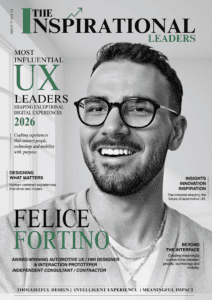

Felice Fortino: The Human Perspective Behind the Future of Automotive UX
Digital Version As vehicles become increasingly intelligent, much of the automotive industry’s attention is focused on what technology can do next. Artificial intelligence is advancing at an extraordinary pace. Autonomous systems continue to evolve. Digital ecosystems are becoming more sophisticated with every product generation. Yet for Felice Fortino, Award-Winning Automotive UX/HMI Designer and Interaction Prototyper, the more important question is not what technology can do. It is what people will need from it. That perspective has shaped his approach throughout a career spanning concept vehicles, production HMI systems, interaction prototyping, and connected mobility experiences. While the industry often celebrates technological breakthroughs, Felice has consistently focused on understanding how those advancements fit into real human behavior. His work is grounded in the belief that innovation becomes meaningful only when it improves people’s experiences in ways that feel natural, intuitive, and valuable. It is a philosophy that feels particularly relevant today. The automotive industry is navigating one of the most significant transitions in its history. Vehicles are evolving from machines primarily defined by engineering and mechanical performance into intelligent environments shaped by software, connectivity, and digital interaction. Consumers increasingly evaluate vehicles not only by how they drive but by how they communicate, how they adapt, and how seamlessly they integrate into daily life. As this transformation continues, user experience has become one of the most influential factors shaping the future of mobility. For Felice, however, the objective extends far beyond creating attractive interfaces or introducing new digital capabilities. The real challenge lies in designing experiences that people can trust, understand, and genuinely benefit from. Why Automotive UX Captured His Attention What has always fascinated Felice about automotive UX is the unique relationship between the digital and physical worlds. Unlike many other areas of user experience design, automotive experiences exist within environments where interactions carry immediate real-world consequences. Every decision affects how people move, how they perceive information, and ultimately how safely they navigate the world around them. This creates a level of responsibility that makes automotive UX fundamentally different from designing traditional digital products. At the same time, it is precisely this complexity that makes the discipline so compelling. Throughout his career, Felice has been drawn to the challenge of balancing physical and digital experiences in ways that feel complementary rather than competitive. While many discussions within the industry frame physical controls and digital interfaces as opposing philosophies, he sees them as equally valuable tools that serve different purposes. Physical controls provide reassurance, tactile feedback, and familiarity. They allow users to interact with systems confidently and efficiently. Digital interfaces, meanwhile, offer flexibility, adaptability, and opportunities for personalization that would be impossible through purely physical interactions. The future, in Felice’s view, does not belong to one approach or the other. It belongs to thoughtful integration. This perspective reflects a broader principle that has shaped his work. Technology should never exist simply because it can. It should exist because it improves an experience. Every design decision must ultimately answer a simple question: does this make life better for the person using it? When the Vehicle Becomes an Experience The role of UX within the automotive industry has changed dramatically over the past decade. What was once considered a supporting function has become a defining component of vehicle development. Major launches increasingly highlight digital experiences alongside performance specifications, reflecting a growing recognition that user experience is now central to how people evaluate products. Felice sees this evolution as both necessary and inevitable. As connected technologies continue to mature and autonomous systems become more capable, designers are being asked to rethink what mobility actually means. Historically, automotive experiences were built around a straightforward assumption: one person sits behind the wheel and actively controls the vehicle. That assumption is beginning to change. One of the most significant implications of autonomous driving is not simply the technology itself but the shift in human roles it creates. The driver gradually becomes a passenger. While discussions often focus on technical capability, Felice believes the more interesting questions concern how experiences change once driving is no longer the primary activity. Trust is the first challenge. Before users can comfortably rely on autonomous systems, they must understand them and feel confident in their decisions. Yet trust is only the beginning. As autonomy advances, vehicles become environments where people may work, communicate, relax, consume content, or engage with services during travel. Multiple occupants may have entirely different expectations and priorities while sharing the same space. One person may want productivity. Another may want entertainment. Another may simply want quiet. Designing for this future requires a fundamentally different mindset. The vehicle becomes less of a machine and more of an experience platform. The challenge is no longer helping users operate a vehicle. It is helping multiple individuals coexist comfortably within an intelligent environment that understands and adapts to their needs. For Felice, this transformation represents one of the most exciting opportunities facing automotive UX today. Keeping Technology in Service of People As technological capabilities expand, there is often pressure to introduce innovation simply because it exists. Felice views this tendency as one of the industry’s greatest risks. Technology undoubtedly creates opportunities to improve experiences, but innovation loses its value when it becomes disconnected from human needs. Features introduced solely to appear advanced often create complexity rather than clarity. They increase cognitive load, complicate interactions, and ultimately diminish the quality of the experience. This is why Felice believes great UX leaders must possess both technological curiosity and critical judgment. Understanding emerging technologies is essential. Equally important is the ability to question whether those technologies genuinely improve people’s lives. Not every capability deserves implementation. Not every innovation creates value. Sometimes the most effective solution is also the simplest. No matter how sophisticated vehicles become, one principle remains constant. Designers are creating experiences for human beings. Whether people are actively driving or interacting with increasingly autonomous systems, their expectations, emotions, limitations, and behaviors remain at the center of the design process. Technology should support those realities