
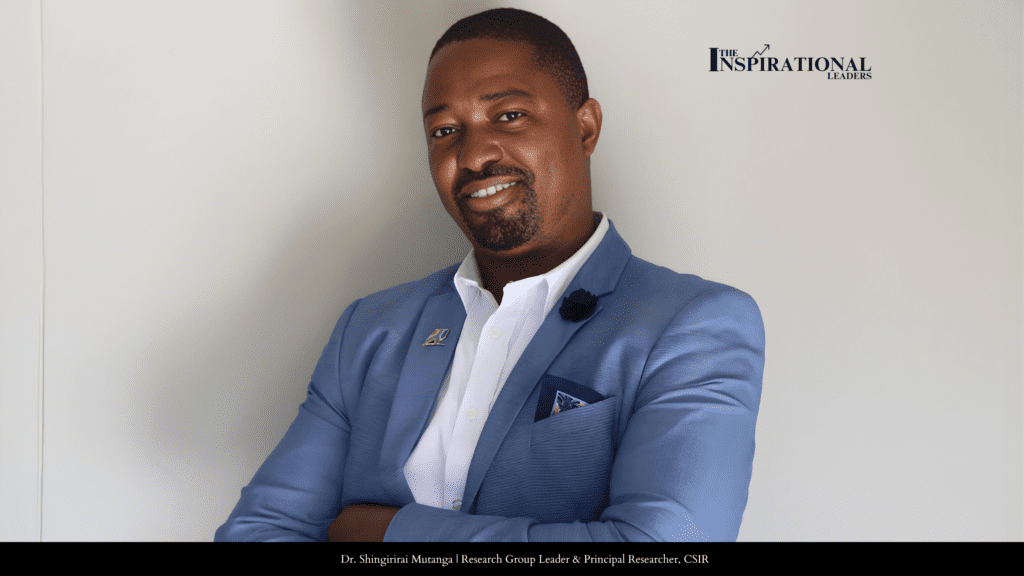
When Dr. Shingirirai Mutanga reflects on his journey from the dusty roads of rural Zimbabwe to the forefront of African climate science, one word echoes through his story — curiosity.
“I always wondered why the rains came late, why some years the harvest was good and others disastrous,” he recalls. “I didn’t have the words for it then, but I was already asking climate questions.”
That curiosity has since transformed into a career defined by purpose, persistence, and profound impact. Today, as a Research Group Leader and Principal Researcher at the Council for Scientific and Industrial Research (CSIR) in South Africa, Dr. Mutanga stands as one of the continent’s most respected scientific voices driving climate innovation, sustainability, and systems thinking.
Early Inspiration and the Spark of a Vision
Born into modest circumstances, Dr. Mutanga’s journey toward global scientific leadership was anything but straightforward. Yet, he grew up surrounded by stories that shaped his ambition — tales of Zimbabwean scholars who had earned degrees abroad at world-renowned institutions such as the International Institute for Geo-Information Science and Earth Observation (ITC) in the Netherlands, and who returned home to build the foundations of Africa’s scientific and technological progress.
“They showed me that science could change nations,” he says. “Their stories lit a fire in me — to learn, to lead, and to serve. They showed me what was possible, that excellence and service can coexist — that science can be both global and deeply local.”
Guided by this conviction, he pursued a Bachelor of Science in Environmental Studies in Zimbabwe, grounding himself in the delicate relationship between ecosystems, livelihoods, and sustainable development. His academic excellence earned him the prestigious Erasmus Mundus Scholarship, which opened doors to an international education journey that would profoundly shape his worldview.
Over the course of his studies across Southampton (UK), Lund (Sweden), Warsaw (Poland), and ITC (Netherlands), Dr. Mutanga deepened his expertise in Geoinformation Science and Earth Observation for Environmental Modelling and Management. It was during this time that he began to understand how technology could illuminate the hidden stories of the planet.
“It was the first time I truly saw how technology could tell the stories of our planet,” he recalls. “From satellite images to climate models, every dataset revealed something vital about our changing world.”
Becoming a Systems Thinker
Dr. Mutanga’s pursuit of excellence did not stop there. A decade ago, he achieved another major milestone by earning a Ph.D. in Industrial Systems Engineering — an achievement that broadened his scientific lens and solidified his role as a systems thinker.
“The PhD taught me to see the interconnections,” he explains. “It’s not enough to study one system in isolation — real sustainability lies in understanding how they all interact.”
That perspective — connecting climate, energy, water, and food systems — has since defined his leadership approach and his contributions to climate science in Africa and beyond.
Driving Science-Based Solutions at CSIR
At CSIR, Dr. Mutanga leads a team at the cutting edge of scientific innovation. His work centers on developing science-based solutions that inform both adaptation and mitigation strategies to tackle climate change.
“In climate adaptation,” he explains, “I lead efforts to develop geo-information and modelling tools (earth observation and systems modelling) that help governments and communities anticipate and respond to climate risks such as droughts, floods, and shifts in agricultural productivity. These tools strengthen national adaptation plans and resilience strategies.”
On the mitigation side, his research group advances the measurement and compilation of greenhouse gas (GHG) emission inventories and GHG scenario modelling across multiple sectors — from energy to land use — supporting low-carbon development pathways and contributing to international reporting and transparency mechanisms.
Through this dual focus on adaptation and mitigation, Dr. Mutanga and his team help bridge the gap between complex data its policy interface and propel climate action. Their work ensures that science does not stay confined to laboratories but instead reaches decision-makers who can turn insights into sustainable outcomes.
Building Interdisciplinary Collaboration
Climate change is not a problem that can be solved in silos. Recognizing this, CSIR — under Dr. Mutanga’s guidance — fosters interdisciplinary research and partnerships that cut across sectors and disciplines.
“Beyond research outputs, our impact lies in leadership across the climate, energy, water, and food nexus,” he notes. “We help decision-makers understand how policies in one sector ripple across others. Tackling climate change requires systems thinking, inclusive collaboration, and grounded African innovation.”
This interdisciplinary spirit is central to CSIR’s mission — ensuring that Africa’s response to climate change is informed, connected, and context-specific.
Innovating for Climate Resilience: The ReLISA Project
Among the many initiatives led by Dr. Mutanga, one stands out as a beacon of hope — ReLISA, a flagship project that embodies both scientific rigor and visionary collaboration.
“ReLISA is more than just a project,” he explains. “It represents a shared vision for a greener, more resilient future.”
Under this IKI initiative, CSIR provides scientific evidence to support investment in land restoration, leveraging cutting-edge technologies such as remote sensing, LiDAR, drones, flux tower data, soil sampling, machine learning, and AI modelling. These tools are used to quantify how much carbon land can store — a critical step in understanding carbon sequestration and building sustainable climate strategies.
Projects like ReLISA highlight how scientific innovation can create tangible environmental and economic benefits, positioning Africa as a key player in the global push toward net-zero emissions.
From Data to Decision: Translating Science into Action
One of the defining aspects of Dr. Mutanga’s leadership is his ability to translate complex research into actionable strategies for governments, industries, and communities.
“We engage early, communicate clearly, collaborate broadly, and follow through on impact,” he says — a principle that captures his pragmatic yet visionary approach to science communication.
This emphasis on early engagement and clarity ensures that CSIR’s research doesn’t just inform policy but actively shapes it — helping nations craft more effective climate strategies grounded in data and systems thinking.
Harnessing Technology to Protect the Planet
Advanced technologies — including AI, remote sensing, and big data analytics — play a pivotal role in CSIR’s climate efforts. As Dr. Mutanga points out, the integration of these tools enables real-time environmental monitoring and more precise decision-making.
Through AI-driven analysis, satellite data interpretation, and machine learning models, CSIR can assess everything from deforestation patterns and agricultural productivity to water stress and carbon fluxes. These insights empower policymakers to act quickly and strategically, reinforcing the importance of technology as an enabler of sustainable development.
Africa’s Climate Imperative: Priorities for a Sustainable Future
Africa’s position in the global climate dialogue is unique. It is one of the regions most vulnerable to climate impacts — yet it also holds immense potential for innovation and resilience.
According to Dr. Mutanga, the continent’s most urgent priorities lie in five interconnected areas:
- Energy Security: Advancing inclusive renewable energy transitions that empower communities.
- Climate-Smart Agriculture: Building resilient food systems capable of withstanding climatic variability.
- Water Security and Management: Ensuring equitable access to clean water through sustainable governance.
- Nature-Based Solutions: Harnessing the power of ecosystems to protect biodiversity and absorb carbon.
- Climate Finance and Innovation: Mobilizing resources and fostering innovation to scale solutions.
These priorities, he notes, require coordinated investment, policy coherence, and a commitment to capacity building — all of which are central to his work at CSIR.
Mentorship, Leadership, and Inspiring the Next Generation
Beyond his technical expertise, Dr. Mutanga is deeply passionate about mentorship and leadership development.
“I lead by example,” he shares. “I demonstrate commitment to sustainability in research, operations, and partnerships. I mentor, build capacity, and promote collaboration and networks that create opportunities for young, emerging scientists.”
His approach reflects a belief that Africa’s scientific future depends not only on breakthroughs but also on people — the next generation of thinkers, innovators, and problem solvers who will continue advancing the continent’s sustainability agenda.
Collaboration Without Borders
In addressing climate change, no nation or organization can work alone. Dr. Mutanga champions global collaboration as a cornerstone of effective climate action.
CSIR actively participates in international partnerships, including IKI-funded initiatives with global consortium partners such as UNEP, UNDP, UNESCO, EWT, UNIQUE, and EC4S. These collaborations facilitate cross-border knowledge exchange and capacity building — ensuring that African expertise informs and is informed by global best practices.
“Our partnerships demonstrate how collective intelligence and shared purpose can drive solutions that transcend geography,” he emphasizes.
A Vision for the Future: From Prediction to Transformation
As the world approaches 2030 and beyond, Dr. Mutanga believes that the time has come to move beyond understanding the problem of climate change — toward transformative and equitable solutions.
“Global risks ranked by severity point to climate extremes and failure to mitigate and adapt,” he notes, referencing the World Economic Forum’s 2025 risk outlook. “The focus should now move from predictions to transformation — coupling climate risk models with pathways for low-carbon, climate-resilient societies.”
His vision is clear: bridging global and local knowledge, accelerating decarbonization, restoring and protecting ecosystems, and transforming food and water systems to achieve sustainability for all.
A Legacy of Purpose
Dr. Shingirirai Mutanga’s journey — from a curious child in rural Zimbabwe to a scientific leader shaping Africa’s climate future — stands as a powerful reminder of what passion, education, and perseverance can achieve.
“I see myself not just as a scientist,” he says, “but as part of a movement — building the knowledge systems Africa needs to secure its climate, energy, water, and food future.” This reinforces my commitment to environmental stewardship deeply inspired by the encyclical, Laudato Si’, ushered by Pope Francis.
His story embodies the essence of leadership with purpose — proving that excellence and service can go hand in hand, and that science, when guided by vision and empathy, can truly change the world.