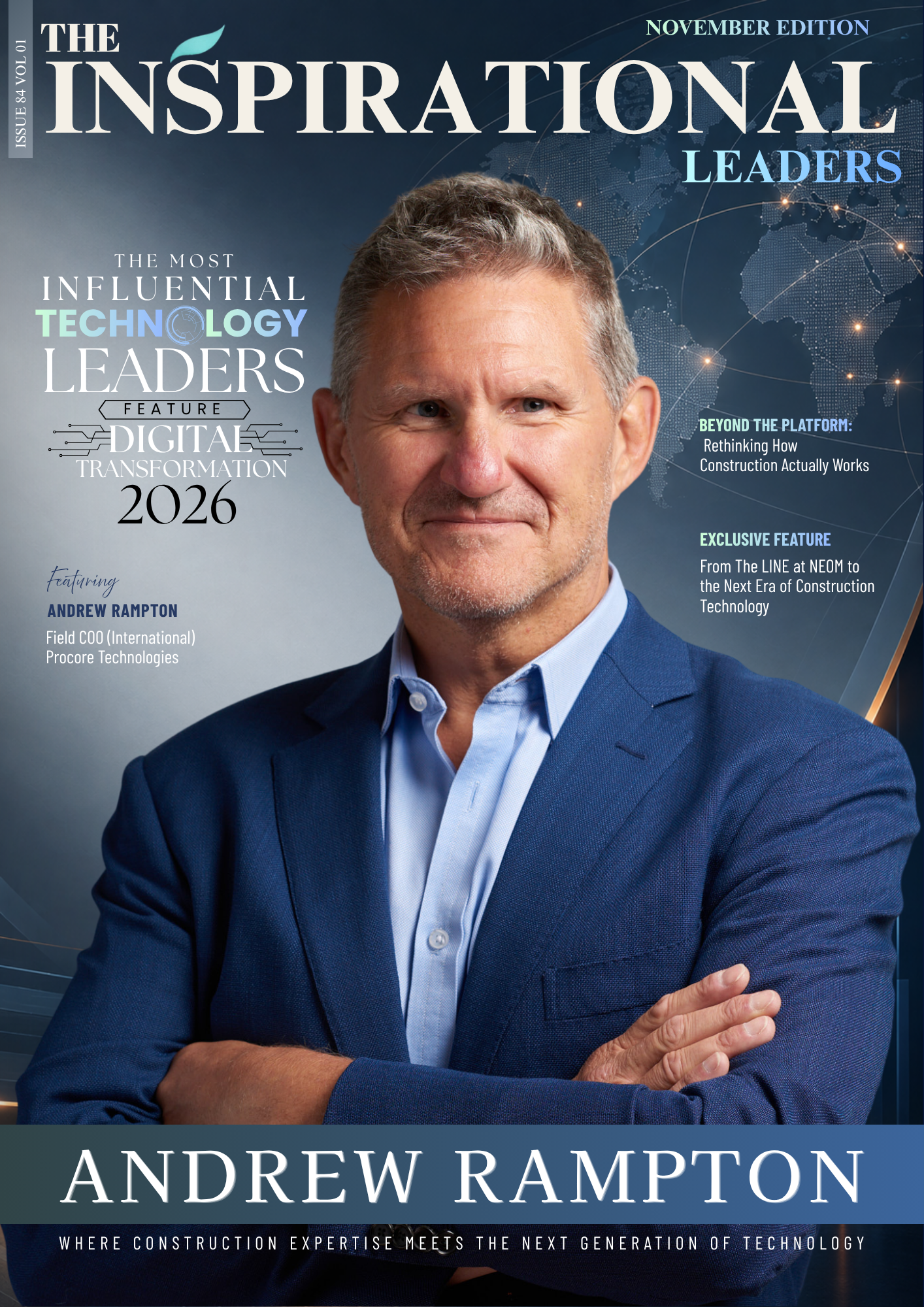

Building Change From the Ground Up: How Andy Rampton Is Shaping the Future of Construction Technology
Digital Version Andrew Rampton | Field COO, International | Procore Technologies Construction is an industry where change is constant. Designs evolve, site conditions shift, supply chains create unexpected pressures, and teams adjust every day to keep projects moving. Yet the industry has often found it harder to bring that same adaptability into the way organisations operate. For Andrew Rampton, this is where the real conversation around technology begins. The challenge is not finding another tool. It is understanding how technology can make work better for the people responsible for delivering it. That perspective has been shaped by more than three decades across engineering, construction, defence, infrastructure, property development, and business transformation. Rampton began as a mechanical engineer and spent ten years managing the development and procurement of research and manufacturing facilities for a major UK defence contractor. His career then moved through healthcare and education programmes with Skanska and Amey, business transformation at Lendlease in Sydney, governance for the Athletes Village supporting the London 2012 Olympics, and operations on The LINE at NEOM in Saudi Arabia. Today, as Field COO (International) at Procore Technologies, Andrew Rampton works across APAC and the Middle East, helping construction organisations connect business priorities with technology while bringing practical industry insight into the technology conversation. His experience has placed him on both sides of the relationship between construction and technology, giving him a perspective grounded as much in project realities as in digital possibilities. Across those different chapters, one lesson has remained constant: the hardest problems on major projects are rarely technical. They are human. A Career Shaped by Curiosity Rampton does not describe his career as the result of a carefully designed plan. Instead, he points to curiosity, opportunity, and good fortune as the forces that opened one door after another. His first major role placed him in a highly specialised part of the built environment, managing research and manufacturing facilities for one of the UK’s largest defence contractors. The environment was technically demanding, but it also gave him an early understanding of what makes complex projects work. Engineering expertise can solve individual problems, but successful delivery depends on communication, trust, judgement, and the ability of different teams to work toward the same outcome. That understanding travelled with him into the emerging PFI and PPP market, where he spent six years with Skanska and Amey developing healthcare and education programmes. The teams were operating in an environment where established approaches were still evolving. They were effectively creating the playbook while delivering the work, making adaptability essential. A move to Lendlease in Sydney in 2007 introduced him to large scale business transformation. Working within a small team creating methodologies and tools to modernise a global construction business, Rampton saw another side of organisational change. New processes could be technically sound, but they would only become effective when the people doing the work could see their experience reflected in them. That principle became one of the strongest threads in his career. Change becomes more durable when the people affected by it are involved in creating it. Learning Through Projects That Could Not Afford to Fail His role as Head of Governance for the Athletes Village supporting the London 2012 Olympics added another dimension to that thinking. Rampton came to see major projects not simply as construction exercises, but as transformation programmes in their own right. Delivering a complex development requires teams to establish processes, accountability, governance, and shared expectations while operating under considerable pressure. The Olympic project provided a particularly clear lesson because its deadline could not move. Everyone knew the objective and the date by which it had to be achieved. For Rampton, that experience demonstrated how pressure can sometimes create clarity. When the destination is fixed, teams can concentrate on what matters most instead of continually debating priorities. It also reinforced the value of shared information. When several organisations are responsible for different parts of the same outcome, effective decisions depend on people working from the same facts. That lesson has remained relevant as Rampton has moved deeper into technology and data. The experience strengthened a leadership philosophy based on listening to the people closest to the work, respecting their expertise, and making sure that new approaches improve rather than complicate their daily responsibilities. Crossing to the Other Side of the Table After more than thirty years across engineering, construction, and property development, Rampton eventually moved from the industry side of the technology relationship to the technology side when he joined Procore. The move brought together experiences that had previously existed in separate chapters of his career. He had been a technology user, a procurer, and a strategist. He had seen organisations make significant investments in new systems and had also seen the difficulty of turning those investments into lasting improvements. Today, he works as a translator between those two worlds. Across Australia, New Zealand, Asia, and the Middle East, Rampton engages with executives to help them establish data backed business strategies before developing technology strategies. His starting point is therefore not a particular platform or feature. It is the business outcome the organisation is trying to achieve. That distinction is important in a market where construction companies have more technology choices than ever. Instead of asking where a new technology might fit, Rampton believes leaders should first understand the problem they need to solve and then determine what capabilities could help address it. His conversations with the industry continue through forums, panels, roundtables, and direct engagement with leaders. These discussions also flow back into Procore, giving him an opportunity to represent the practical realities of construction and influence product direction. For Rampton, the relationship between technology providers and construction organisations ultimately depends on trust. The industry has seen many promised solutions, so credibility has to come from understanding the work rather than simply presenting another product. Why More Technology Is Not the Answer Rampton’s perspective can be summed up through three requirements for meaningful organisational change: clarity, culture, and commitment. Clarity means