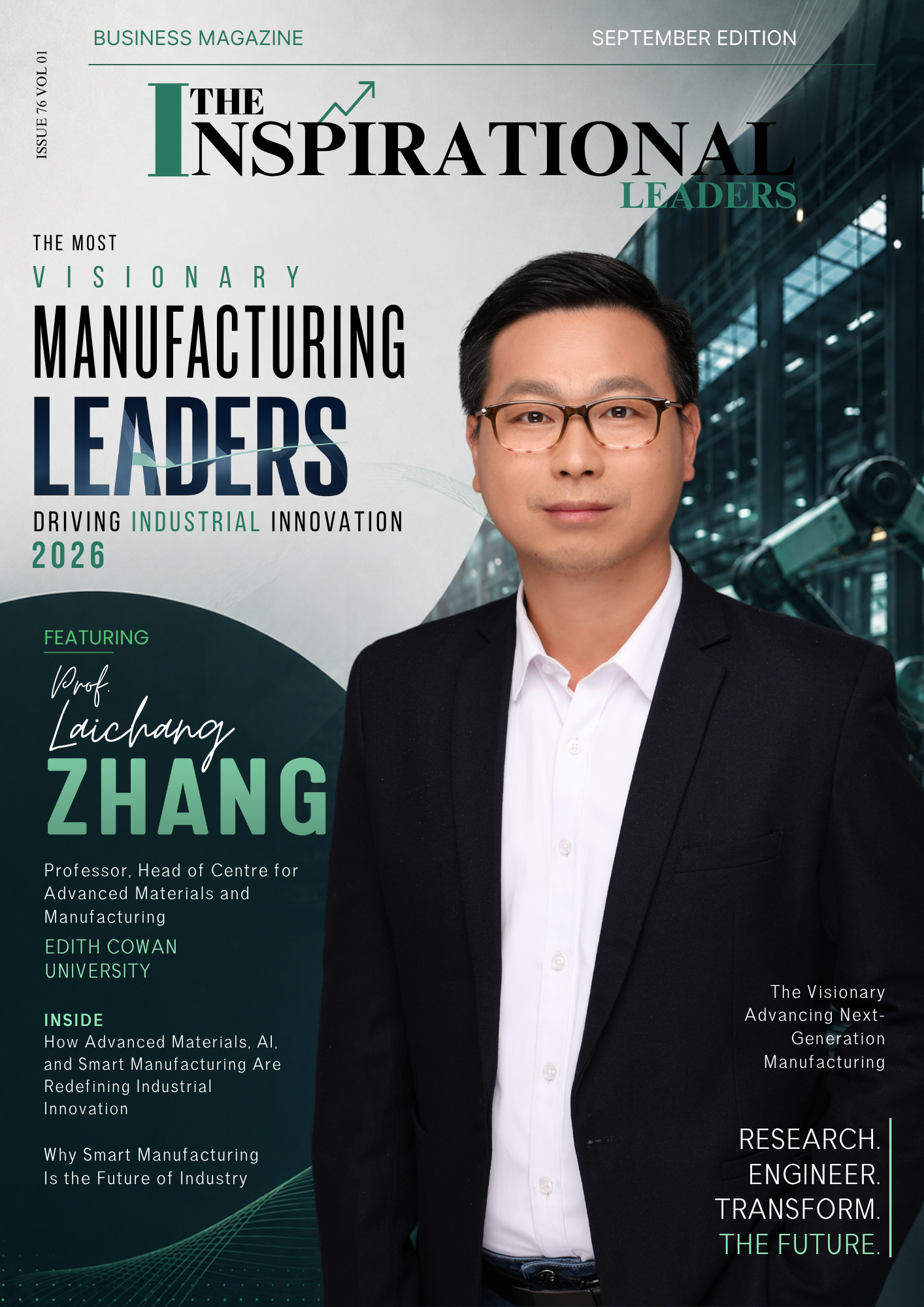
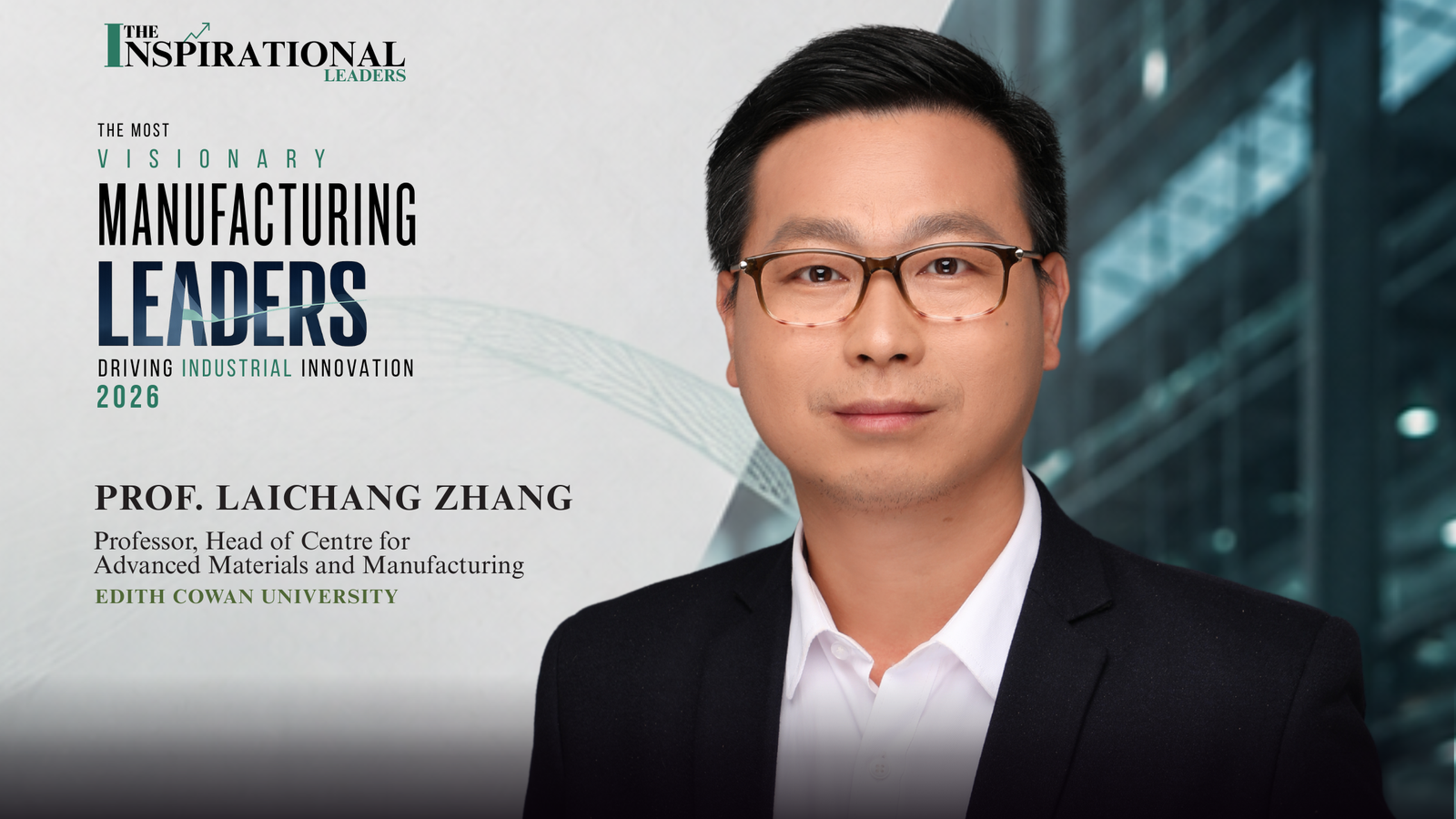
Laichang Zhang: Engineering the Materials That Will Shape Tomorrow’s Industries
Digital View Professor | Head of Centre for Advanced Materials and Manufacturing | Edith Cowan University Every major advancement in modern engineering begins long before a product reaches the factory floor. Whether it is an aircraft designed to withstand extreme environments, a medical implant engineered to improve quality of life, or an energy system built for greater efficiency and sustainability, its success depends on one fundamental element: the material from which it is made. Manufacturing transforms ideas into reality, but materials science determines what those ideas can ultimate achieve. As industries move toward lighter structures, stronger components, smarter manufacturing systems, and more sustainable manufacturing methods, the future of industrial innovation is increasingly being shaped at the intersection of advanced materials, intelligent manufacturing, and scientific discovery. Few individuals have dedicated their careers to advancing this intersection as comprehensively as Professor Laichang Zhang. Over the course of his career, he has established himself as a leading researcher in advanced materials and manufacturing, helping bridge the gap between scientific exploration and practical industrial application. His work spans high performance metallic materials, additive manufacturing, process optimisation, and advanced manufacturing technologies that enable industries to produce components with greater precision, reliability, and sustainability. Rather than treating research as an endpoint, Professor Zhang has consistently focused on translating scientific breakthroughs into practical solutions for real world manufacturing challenges. Today, as Head of the Centre for Advanced Materials and Manufacturing at Edith Cowan University, Professor Zhang leads research that brings together materials science, engineering capability, and industry collaboration. His work address challenges across sectors, such as aerospace, transportation, healthcare, energy and advanced manufacturing, with different needs but a shared demand for materials and manufacturing processes that are high-performing, reliable, scalable, and commercially viable. At the heart of his research philosophy is a clear belief: innovation creates meaningful impact only when it can move confidently from laboratory discovery to industrial implementation. Where Industrial Innovation Truly Begins Professor Zhang’s interest in materials science was shaped by a simple yet profound observation. Behind every engineering achievement lies a material whose properties determine how safely, efficiently, and reliably a product performs throughout its lifetime. Improvements in strength, durability, corrosion resistance, thermal stability, or biological compatibility often become the foundation upon which entirely new technologies are built. This understanding inspired him to pursue research into advanced metallic materials and manufacturing processes capable of unlocking new possibilities across multiple industries. Yet his work has always extended beyond discovering new materials. Early in his research career, he recognised that even the most promising material has limited value unless it can be manufactured consistently, qualified under real operating conditions, and produced at the scale required by industry. This realisation shaped a philosophy that continues to guide his research today. Scientific excellence and industrial practicality should not exist as separate objectives; they must evolve together. That mindset has also strengthened his commitment to collaboration. By working closely with students, researchers, engineers, and industry partners, Professor Zhang has helped to build an environment where scientific knowledge can be translated into practical manufacturing capability. For him, the future of manufacturing will not be defined by isolated breakthroughs, but by the ability to integrate research, engineering, and industrial application into solutions that deliver measurable value. It is this combination of scientific curiosity, engineering discipline, and real world relevance that continues to shape his contribution to the global manufacturing landscape. Transforming Scientific Discovery into Industrial Reality For Professor Laichang Zhang, scientific discovery achieves its greatest significance when it creates measurable value beyond the laboratory. While research remains the foundation of technological progress, he believes innovation is truly successful only when it can be translated into reliable, scalable, and economically viable manufacturing solutions. Throughout his career, this conviction has shaped not only the direction of his research but also the way he approaches collaboration with industry. Every promising material, no matter how advanced its properties in the laboratory, it must ultimately prove its performance under real operating conditions, integrate into existing manufacturing systems, satisfy regulatory and certification requirements, and demonstrate long-term reliability before it can create meaningful industrial impact. Bridging the gap between scientific discovery and industrial implementation is often the most demanding stage of the innovation journey. It is where promising ideas are tested against the realities of large scale production, commercial viability, and long term performance. Materials that perform exceptionally well in controlled experiments may behave differently when production scales increase or manufacturing environments become more complex. Manufacturers must evaluate process stability, raw material availability, quality assurance, certification requirements, supply chain resilience, and long-term service performance alongside technical capability. Rather than treating these considerations as obstacles, Professor Zhang views them as essential elements of responsible engineering. From the earliest stages of research, his team considers manufacturability, defect control, scalability, and qualification alongside material performance, ensuring that scientific advances remain closely aligned with practical industrial needs. A significant part of this work has focused on additive manufacturing, which Professor Zhang regards as one of the most transformative developments in modern manufacturing. Although additive manufacturing is widely recognised for its capability of producing complex geometries, he believes its true potential extends much further. It endows engineers with unprecedented control over material composition, microstructure, and component performance, creating opportunities to develop functionally graded materials, multimaterial components, and highly specialised products that would be extremely difficult to manufacture using conventional techniques. More importantly, it enables materials design and manufacturing to evolve together rather than as separate stages of development, fundamentally changing how engineers approach product innovation. At the same time, Professor Zhang emphasises that advanced manufacturing cannot evolve through materials science alone. The future lies in the convergence of digital technologies, automation, artificial intelligence, and engineering expertise. Intelligent data analytics, digital twins, and real-time process monitoring are facilitating manufacturers to move beyond traditional quality inspection toward continuous process optimisation. These tools allow defects to be detected earlier while improving productivity, consistency, and resource efficiency. Yet, Professor Zhang remains cautious about relying solely on digital capability. Artificial intelligence can accelerate discovery and optimise