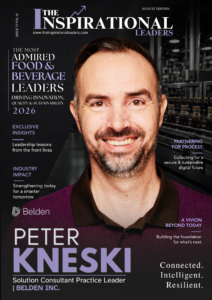
The Infrastructure Behind Innovation: How Peter Kneski Is Shaping the Future of Food & Beverage Manufacturing
Digital Version The food and beverage industry stands at a pivotal moment in its evolution. Across the globe, manufacturers are being challenged to produce more efficiently, operate more sustainably, maintain uncompromising quality standards, strengthen cybersecurity, and adapt to increasingly dynamic consumer demands. At the same time, technologies such as artificial intelligence, edge computing, digital twins, and smart manufacturing are transforming what is possible on the factory floor. Yet amid the excitement surrounding these innovations, one critical reality is often overlooked: technology alone does not drive transformation. For Peter Kneski, Solution Consultant Practice Leader at Belden Inc., the true differentiator is not the latest technology trend but the foundation that supports it. Throughout his career, Peter has worked closely with organizations seeking to modernize operations and unlock the full potential of digital transformation. In that journey, he has witnessed a recurring pattern. Companies frequently invest in promising technologies only to discover that their existing infrastructure is not prepared to support them at scale. The result is often stalled initiatives, failed pilots, and unrealized expectations. This perspective has shaped Peter’s approach to leadership and innovation. Rather than focusing solely on the technologies that capture headlines, he encourages organizations to think more deeply about how information flows through their operations, how systems communicate, and how infrastructure supports long-term growth. His philosophy is both practical and forward-looking: when the foundation is strong, innovation becomes sustainable, scalable, and capable of delivering measurable business value. At Belden, Peter operates at the intersection of operational technology, industrial networking, cybersecurity, and digital transformation. This unique vantage point allows him to help manufacturers navigate some of the industry’s most pressing challenges while preparing for a future that is becoming increasingly connected, intelligent, and data-driven. His work is not simply about implementing technology; it is about helping organizations create the conditions that allow technology to thrive. In an industry where quality, efficiency, resilience, and sustainability have become inseparable priorities, Peter’s insights offer a compelling blueprint for what comes next. Leading Beyond Technology One of the reasons Peter’s perspective resonates so strongly within the manufacturing sector is that it is rooted in practicality rather than hype. While many conversations about digital transformation focus on ambitious visions of the future, Peter believes successful leadership begins with understanding the details. For him, innovation is not about adopting technology because it is trending. It is about understanding how technology functions, how it aligns with operational objectives, and how it creates measurable value. This disciplined approach has become one of the defining characteristics of his leadership philosophy. In highly regulated industries such as food and beverage manufacturing, where quality, safety, compliance, and consistency are paramount, leaders cannot afford to make decisions based on assumptions. Every investment must be evaluated carefully. Every solution must be examined critically. Every initiative must have a clear purpose. Peter often emphasizes the importance of continually asking the right questions. How will this technology improve operations? Why is it necessary? What outcomes should be expected? What happens if conditions change? These questions help organizations move beyond marketing promises and focus on practical results. Equally important is the role of partnerships. Digital transformation rarely happens in isolation. Manufacturers frequently rely on external organizations to provide expertise, technology, and support. However, Peter believes selecting a partner involves much more than evaluating products or technical capabilities. Culture matters. Values matter. Commitment matters. The strongest partnerships are built when organizations share a common purpose and a genuine desire to create value together. Peter has consistently found that technology providers who demonstrate passion, accountability, and a deep understanding of their customers’ challenges are often the ones who deliver the most meaningful results. This people-first approach has become increasingly important as organizations navigate complex transformation journeys. Technology may enable progress, but trust, collaboration, and shared vision are often what make that progress possible. Reimagining Manufacturing Through Digital Transformation Few developments have influenced modern manufacturing as profoundly as digital transformation. What was once viewed as a collection of disconnected technologies has evolved into a strategic framework for improving performance across every aspect of the business. Peter has observed this evolution firsthand. In his view, one of the most significant impacts of digital transformation has been the way manufacturers interpret and utilize operational data. Historically, many organizations relied on delayed reporting, fragmented information, and limited visibility into production environments. Decision-making often depended on historical trends rather than real-time insights. While these approaches served their purpose, they left significant opportunities for optimization untapped. Today, digital transformation is changing that reality. Modern manufacturing environments generate enormous volumes of operational data. When properly collected, contextualized, and analyzed, this information becomes a powerful tool for improving efficiency, consistency, and performance. Within the food and beverage sector, throughput remains one of the most important drivers of operational success. Manufacturers constantly seek ways to increase production while maintaining quality standards and controlling costs. Digital transformation provides unprecedented visibility into these objectives. Organizations can now compare throughput across facilities, monitor utility consumption, evaluate production efficiency, and maintain quality consistency across diverse manufacturing environments. Instead of viewing these metrics independently, they can analyze them collectively, revealing relationships and opportunities that were previously difficult to identify. This holistic perspective enables better decision-making at every level of the organization. Leaders gain greater confidence in strategic planning, managers receive faster access to operational insights, and frontline teams benefit from clearer visibility into performance. For Peter, the true power of digital transformation lies in its ability to turn data into actionable intelligence. It is not simply about collecting information; it is about creating the clarity needed to drive meaningful improvement. Why Edge Computing Is Becoming a Game-Changer As manufacturers continue to expand their digital capabilities, the volume of data generated throughout production environments continues to grow. Managing this information efficiently has become one of the industry’s most important challenges. Among the technologies reshaping this landscape, Peter identifies edge computing as one of the most impactful developments in recent years. Traditionally, manufacturing systems transmitted large volumes of operational data directly to